Timeline · In the government of the realm
Indulgence for Giske chapel
1345
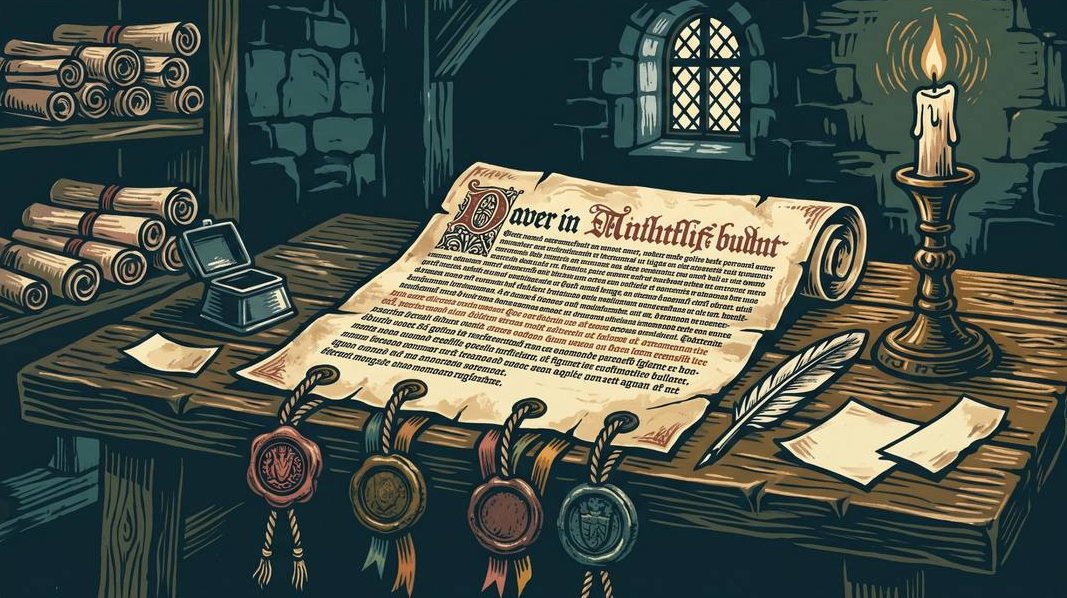
In June 1345 Pope Clement VI, pope from 1342 to 1352, issues a letter at Villeneuve, on the other side of the river Rhône from Avignon. Anyone who repents, confesses and visits the chapel on Giske on the feast days of the Virgin Mary, John the Evangelist and Nicholas shall have a hundred days of their penance remitted. Such a letter was called a letter of indulgence.
Avignon lay on the Rhône in southern France. The popes had resided there since 1309, and under Clement VI the papal palace was extended into one of the largest buildings in Europe. To the Curia, the papal court, came envoys from all of Christendom with petitions for dispensations, offices and indulgences, and the grants were entered in the papal registers. From here also came a small letter about a marble church on a sandy island by the Norwegian Sea.
The pope writes that «the forefathers of our beloved son, the noble man Erling Vidkunsson, knight of the diocese of Nidaros, founded, built and endowed the chapel», in honour of the Virgin Mary and the saints John the Evangelist and Nicholas the Confessor. Erling owned Giske and had been drottsete (steward of the realm), the highest officer of the realm under the king. The letter is the oldest written evidence of which saints the church on Giske was dedicated to. That the forefathers founded the chapel is what the pope had been told, and the letter does not say when it happened. Øystein Ekroll, who has written about the church in Store norske leksikon, dates the marble church to around 1130, as a private chapel at the manor. Nicholas was the saint of seafarers.
The church stands on the south coast of Giske, on thick beach deposits of sand and gravel, with the sea just below. It is built of marble blocks that were probably carried by sea from the quarry at Magerholm by Storfjorden east of Ålesund, an estimated 25 kilometres away. Around the church lay the chieftain's seat with the stone house by the boathouses, the farmyard and the painted loft where Erling the year before had made an agreement with Ogmund Eiriksson about the island of Humla. The chapel was the family's own church. From the 1070s the Church had taken fixed form with bishops in Nidaros, Bergen and Oslo, and many of the first churches were private churches on the manors. Whoever built the church also owned it. Under the Gulating Law, the old law of western Norway, the sail of the leidang ship (naval levy ship), the ship the farmers of the district built and manned for the king, was to be kept in the church while the hull stood in the boathouse. On Giske the church and the boathouses lay close together on the south side of the island, and a leidang sail in the church and a ship in the boathouse below fit with what archaeology has found. No source says directly that a Sunnmøre leidang ship stood on Giske. Giske church had received 12 månedsmatsbol (a land-rent unit) in Skodje, the district east of Ålesund, in the will of Erling's paternal uncle, the councillor of the realm Bjarne Erlingsson, who died in 1313, and Lady Margrete had given 6 for her soul.
A letter of indulgence had to be applied for and paid for, and it is reasonable to think that Erling himself was behind the petition. An indulgence meant that part of the penance the Church imposed for sins was remitted. The letter was meant to bring people to the chapel on the feast days and make them give gifts there, and it lent prestige to the family that owned it. The Church was at the same time the largest landowner in the country. Older calculations give it about 40 per cent of the land around 1350 measured in land rent, the rent from the tenant farmers, newer research 20 to 40 per cent. Erling was around 53, a former ruler of the realm with estates from Lofoten to Romsdal and Sogn.
It was a long way from Giske to Avignon. Letters and messengers went by ship across the North Sea to Flanders, in present-day Belgium, or England and on overland through France. Many of the cargo ships across the North Sea were now Hanseatic cogs, with flat bottoms and a rudder on the sternpost, while western Norway held on to clinker-built ships with keels. The crossing could take a few days with a fair wind, and the road from Flanders to Avignon was an estimated thousand kilometres or so, a journey of many weeks. All in all it took months each way. Lady Gyrid, Erling's mother, entered a journey to Flanders and Rome among the expenses in the guardianship accounts for her nephew's estate in 1309. Sailing took place in the summer half of the year. Bishop Håkon in Bergen wrote in 1340 that he had not travelled to a meeting in Tønsberg on the Oslofjord because he feared the winter. Envoys to the papal court often travelled with business for several people at once. In July 1351 Clement VI sent identical letters granting a free choice of confessor to four bishops, two knights and a canon from the Nordic countries on the same day, probably after a joint petition.
Erling and his family had used the Curia before. In September 1342 the same pope had granted a dispensation for the marriage between his daughter Ingebjørg and Sigurd Havtoresson of Sudreim in Romerike, grandson through his mother of King Håkon V, who were related in the fourth degree. The petition from Archbishop Pål of Nidaros and Bishop Halvard states plainly that the marriage was to «preserve peace and concord» between the parties and avert strife in the realm. Sigurd himself had had to petition Avignon in 1334 to be released from excommunication after he had stopped the bishop of Hamar on the road and held him for a day and a night in a kinsman's house. Anyone who laid hands on a bishop was excommunicated under canon law, and only the pope, or someone he gave authority, could absolve him.
The letter's own dating, the third day before the Ides of June in the pope's fourth year, corresponds to 11 June 1345. The editor of Diplomatarium Norvegicum gives 14 June. The sources disagree about the day.
King Magnus Eriksson ruled both Norway and Sweden and had bought Scania. In France and England the Hundred Years' War was under way, and the following year the English won at Crécy. The Black Death, the plague that came to Norway in 1349, was four years off. Some 170 years later the trade in letters of indulgence became the starting signal for the Reformation, which in the end took from the Church both its land and its power.
People: Erling Vidkunsson
Sources
DN 1/294; DN 6/166; DN 6/145; DN 2/93; DN 8/124; DN 7/229; DN 15/1; Store norske leksikon (Ekroll, «Giske kirke»; hansakogg); Gulatingsloven, utgjerdsbolken kap. 11; prosjektnotatet «Båtbygging, seil og leidang»; prosjektnotatene «Giskebrevene 2», «Slik ble Giske kirke bygd», «Steinfrakten til Giske» og «Giskefolket i arkiver og kilder»; nettsidens sider «Makten i riket» og «Slektsbånd».