Timeline · In the government of the realm
Baron Bjarne Erlingsson
c. 1280 to 1300
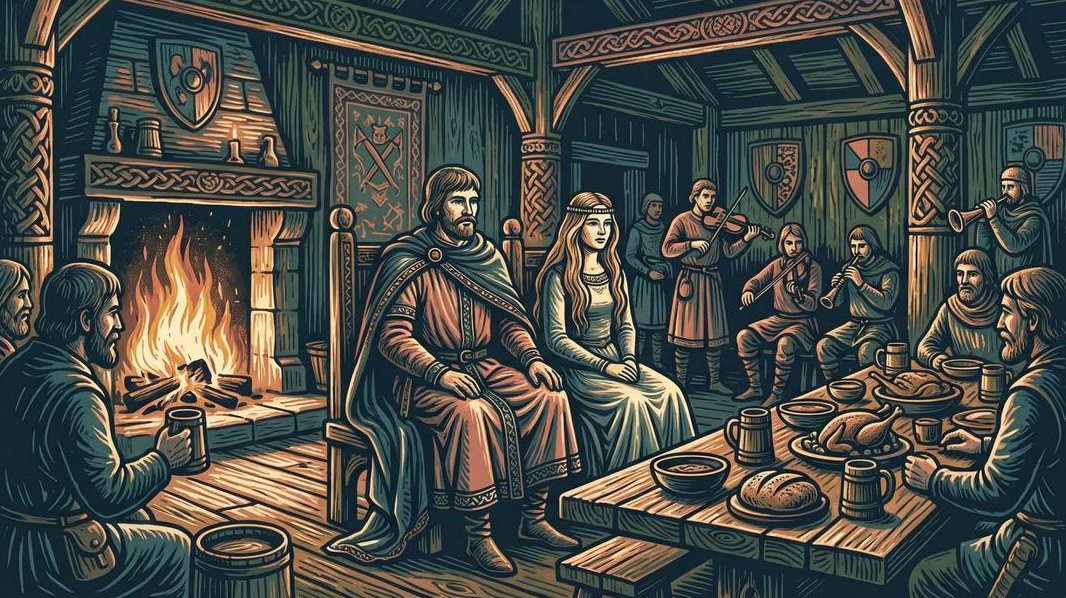
Around 1270 Bjarne Erlingsson of Bjarkøy, an island north of Harstad in Troms, marries Margrete Nikolasdatter. She is the sole heir of the lendmann Nikolas Petersson, one of the king's foremost men on Sunnmøre, and with her comes Giske, on the sea route midway between Bergen and Nidaros, present-day Trondheim. For the next forty years Bjarne is one of the most powerful men in the realm.
Giske is a small, low island, 2.67 square kilometres. The highest point, Ørnebakken, lies around 25 metres above sea level. In the middle of the island there is bog, and out towards the sea lie fields and pasture on light sandy soil, with sandy beaches almost all the way round. No source mentions woodland, and the island was probably treeless, like the rest of the outer coast with its open heather moorland. To the west Godøya rises with Storhornet, almost 500 metres high, and between the two islands runs Giskesundet, the main route for ships between Bergen and Trøndelag. Outer Sunnmøre lies between the two most dangerous stretches of open sea on the coast, Stad to the south and Hustadvika to the north, and anyone who wanted to pass had to go through the waters by Giske. The kaupang (trading town) of Borgund, the trading place east of present-day central Ålesund, lay about ten kilometres to the south-east, in sheltered Katavågen. Giske itself had no sheltered harbour, and ships were probably drawn up or moored by the south beach below the church.
By the church archaeologists have found a stone house of two rooms by the boathouses, with lime-mortared and rendered walls of a type belonging to the end of the 1100s and the 1200s, and a stone-paved yard with a flagstone path. Cultivation layers by the church are dated to, among others, 1200 to 1270 and 1280 to 1320. So grain was grown at the chieftain's seat in the years Bjarne and Margrete owned it. The sand is easy to work, but it is poor in nutrients and exposed to sand drift. The Code of the Realm (Landsloven) of the 1270s, King Magnus the Lawmender's common law for the whole realm, mentions both ard and plough. On the small patches of field in Western Norway the ard was probably the usual implement, a tool that scratches up the soil without turning it, and the grain was cut with a sickle. No source says so directly. Water mills came into use in Norway in the 1200s, alongside the hand quern. The accounts of 1563 show that the main farm then ate more grain than it grew, and that the tenant farmers on the estate paid their land rent, the annual rent, in stockfish. Corresponding figures do not exist for Bjarne's time.
Margrete was the last link in the old Giske family. The family overview traces the line from Torberg Arnesson, the chieftain on Giske in the 1000s, through Skofte, Pål Skoftesson and Nikolas Kuvung down to her father, Nikolas Petersson, who died in 1265. Some accounts give 1264. Bjarne came from the other end of the realm. His father, the lendmann Erling Ivarsson, sat at Bjarkøy in Hålogaland, the northern part of the country. The family overview traces the Bjarkøy family back to Arne Arnesson, brother of Torberg on Giske, while Knut Helle writes in Norsk biografisk leksikon that Bjarne reckoned his descent from the Arnmødlings, another name for the Arnlings, through the maternal line. The generations of the Bjarkøy family between c. 1140 and 1250 are disputed. Both ways lead to the same family, and with the marriage two branches of the Arnlings, the old chieftain family on Giske, were united again after around 200 years. Bjarne was born around 1248, and was about twenty when he married.
According to Helle, Bjarne had over twenty farms on Bjarkøy from his father, and later he also got Dønnes in Helgeland. Through Margrete came the Giske estate with about forty farms and scattered land on Sunnmøre and in Romsdal. Helle calls it probably the largest coherent estate complex in the country. The estate was to grow further. In 1563 it had 104 rent-paying properties on Sunnmøre and 50 in Romsdal. It stretched from Lofoten to Sunnmøre, and it lived on the fish. Every winter the skrei (spawning cod) came in towards Lofoten to spawn, and the fishery was so important that King Håkon V, king 1299 to 1319, decided in 1313 that the courts in Hålogaland were to stand still from 2 February to 25 March. The fish was gutted and hung on drying racks, where it dried for about three months, and was then shipped south along the route to Bergen. Knut Helle cites an estimate, probably after Arnved Nedkvitne, of 3000 to 4000 tonnes of stockfish a year from Bergen in the years 1303 to 1311, and stockfish accounted for around 82 per cent of the value of goods from Norway to England. The figures are scholarly estimates. Converted, they correspond to 18,000 to 24,000 tonnes of cod caught. It went to England, which had bought Norwegian stockfish since the 1100s, and to the German towns. Back came grain, flour, cloth and rope.
The farms on the estate were worked by tenant farmers. Between the 1000s and the 1200s the majority of farmers in Norway had gone from owning their land themselves to renting it, and the tenant farmers were legally free. Slavery was gone. In the Code of the Realm of 1274 thralls are no longer mentioned as a separate group, except for the cooks on the leidang ships. The tenant farmer paid an annual land rent to the owner, and before the middle of the 1300s it may have amounted to about one sixth of the harvest. That is an estimate. Around 1300 Norway probably had between 300,000 and 500,000 inhabitants and around 60,000 farm holdings, and scholars disagree about the population. Bergen had an estimated 7000 inhabitants, Nidaros and Oslo around 3000 each, and most people lived their whole lives without seeing a town. On Sunnmøre the farmers fished for skrei in winter, from Candlemas on 2 February to Lady Day at the end of March, with hand lines from open boats, and worked the farm the rest of the year. In Sørheim's assessment the fishery in Borgundfjorden, between Ålesund and the island of Sula, was as important as the Lofoten fishery became in the 1500s and 1600s, because the fish was dried closer to Bergen.
Whoever owned the fish had to have a foothold in Bergen. The family had an old town property, Fatten, on Bryggen, and Bjarne built a new property that some called Bjarnegarden and others Nygarden, with a bathhouse and a cabbage garden. The letter of 1307 places it in Sutarstretet, the tanners' street, while Helle places it in Vågsbotn, at the inner end of Vågen in Bergen. The sources disagree about the location. Margrete died at the latest in the autumn of 1307. In her last days she had given a quarter share of Fatten to the altar of St Mary in Christ Church, the cathedral in Bergen, for her soul. Bjarne kept Fatten and instead gave the altar Bjarnegarden, and Bishop Arne in Bergen approved the exchange on 5 November 1307. Whoever held the altar was to keep an årtid (anniversary) for Margrete with requiem masses for ever. Why Bjarne wanted to keep Fatten, the letter does not say. The ships that carried the fish to and from Bergen could be large. At Bryggen the remains have been found of a ship of pine, felled in the winter of 1187/88 and probably cut in Sogn, which by estimate carried at least 60 lasts, around 120 tonnes. It ended up as building timber after the town fire of 1248. In the customs rolls of the early 1300s the largest Norwegian ship and the largest cog each carried 80 to 100 lasts. Arne Emil Christensen therefore believes that the dominance of the Hansa, the league of German trading towns, rested on things other than the ships. The German merchants had received privileges for grain imports in 1277, and much of the trade in Bergen consisted of exchanging stockfish for grain. In 1294 a law forbade foreigners to trade north of Bergen, in the waters where the Bjarkøy estate lay.
Bjarne is first mentioned in 1273, as a lendmann at the assembly of the realm in Bergen. The following year came the Code of the Realm, and from 1277 the foremost lendmenn used the title baron, with Herr before their names. They were now the king's men in the government of the realm more than chieftains in the countryside. The lendmenn had their role in the leidang (naval levy). Together with the king's årmenn (royal stewards) they sent out the summoning tokens, announced the weapons thing in autumn and held it in spring. The Code of the Realm also required lendmenn and sysselmenn (royal district officers) to keep groups of five or more armed men for three months, together a force of 1200 to 1300 men. The ships were the farmers' responsibility, and the sources do not say whether the Giske lendmenn were helmsmen of Sunnmøre leidang ships. When King Magnus the Lawmender died in 1280, his son Eirik Magnusson became king, twelve years old, and Bjarne, who was around thirty, sat on the regency council around him. In the summer of 1281 he led the delegation that swore to the marriage agreement at Roxburgh in southern Scotland between Eirik and the Scottish king's daughter Margaret. In 1284 he was in England with his brother Vidkunn to renew the alliance with King Edward I of England, and according to Helle that may have been when he received the gold belt he later bequeathed. No English source for the belt has been found. The same year the Wendish Hanseatic towns, led by Lübeck, closed off trade with Norway, and the grain did not get through. During the blockade of 1284 to 1285 Bjarne travelled with Bishop Narve of Bergen to the Swedish and the Danish kings and negotiated with the German towns. Peace was concluded at Kalmar in Sweden in 1285.
After the Scottish king Alexander III died in 1286, Bjarne was in Scotland in 1286 and 1287 to secure the right of inheritance of Eirik's little daughter Margaret. He brought home an English version of the story of Olif and Landres, which was translated into Old Norse and is preserved in Karlamagnús saga. In 1289 he led the negotiations in Copenhagen during the leidang against Denmark, together with the Icelandic bishop Árni Þorláksson. The leidang was the farmers' duty to provide ships, men and food. The coast was divided into skipreider (ship districts), and every skipreide was to build, equip and man one ship. Under the Gulating Law, chapter 22, «Mørene», which probably corresponds to Sunnmøre, was to provide 16 ships of the large type with 25 sesser (rowing benches). With two oars per bench and two men per oar, that gives 80 to 100 men per ship, and at a full levy an estimated 1300 to 1600 men from Sunnmøre. The calculation is an estimate. The farmers built the boathouse and sewed the sail, with a fine for every ell of sailcloth that was missing, and the sail was to be kept in the church. Experiments with reconstructions suggest that a large woollen sail required wool from somewhere between 200 and 700 sheep and one to several man-years at the loom, most often women's work. The estimates diverge, and the museums regard the sail as just as valuable as the ship. The Gulating Law required the farmers to send «to månadsmatar av kvart» (two months' food of each kind) for every oar place, and the Code of the Realm of 1274 set the leidang service at three months against two before. In peacetime the leidang had become an annual tax. From around 1200 the king received part of the provisions every year whether or not the fleet went out, and from the end of the 1200s the tax was reckoned according to the farm's land rent. When the young Margaret, the Maid of Norway, was sent west from Bergen in 1290 and died in Orkney, the islands north of Scotland, it was Chancellor Tore Håkonsson, the father-in-law of Bjarne's son Andres, who led the embassies. The sources disagree about whether she sailed at the end of August or around the turn of September and October. Bjarne is not mentioned among the envoys. He sat at King Eirik's deathbed in Bergen on 12 July 1299, the day before the king died.
Under King Håkon V, Eirik's brother and successor, Bjarne was one of the leading men in the standing council in Bergen. In the council chamber in the royal residence he judged cases in the king's name, and in May 1307 he and Erling Amundsson had to order an agent to settle up after a judgement that had not been followed. In January 1308 or 1309 he sat in Bergen and made his will. His wife and his son Andres were dead. He chose a grave in Christ Church in Nidaros, by the outermost altar in the south-west corner of the new building, and gave land and silver to churches, monasteries and hospitals from Tønsberg to Bjarkøy. Giske church received 12 månedsmatsbol in Skodje, east of Ålesund, land that gave an annual rent equal to twelve months' food. St Catherine's Hospital in Bergen received two marks of burnt silver and his bed. The poor in Romsdal and on Sunnmøre each received a last of grain. The last was a large measure that varied with commodity and period, and conversions from later sources give an estimated 1.4 to 2 tonnes. On outer Sunnmøre grain was the scarcest commodity. Queen Eufemia received his gilded sceptre, and his sister-in-law Gyrid, Vidkunn's widow, received the gold belt that «the great Edward, the king of England» had given him, together with a drinking cup. His granddaughter Kristin received the whole of Giske, with Rund and Gauksøyene. Among the witnesses stood his nephew Erling Vidkunsson, who was to inherit most of the rest.
The will survives only in Danish copies from the 1600s and 1700s, and the editor of Diplomatarium Norvegicum warns against arbitrary changes, so several place names are uncertain. The year is given as 1308, but the king's regnal year points to 1309. It is also unclear who Kristin was. The will calls her his son's daughter, and Helle assumes that she died at about the same time as Bjarne. Andres had been married to Kristin Toresdatter, and it is also possible that it was the daughter-in-law who received Giske and sat there as a widow. The sources disagree, and the most thorough discussion is by Audun Dybdahl in Historisk tidsskrift from 1998. The copyist also describes the seal: Bjarne on horseback in full armour, with a griffin with outspread wings on his shield and peacock feathers on his helmet. He calls him drottsete, the highest officer of the realm, a title the contemporary letters do not give him.
Bjarne died in Trondheim on 7 July 1313, around 63 years old, and was buried in Christ Church as he had asked. A fragment that is probably his gravestone has been found in the cathedral. At the same time the annals of northern Europe record a great famine in the 1310s. According to the historian Nils Hybel's survey, it is the last until around 1500. In Bjarne's lifetime Edward I had conquered Wales and waged war in Scotland, and German merchants had become a fixed part of life in Bergen.
People: Bjarne Erlingsson, Margrete Nikolasdatter
Sources
DN 1/110; DN 2/88; DN 15/1; Gulatingsloven, utgjerdsbolken; Norsk biografisk leksikon (Helle, «Bjarne Erlingsson av Giske og Bjarkøy»); prosjektnotatene «Giskebrevene 1», «Fiskeværene og Giskegodset», «Giskefolket i arkiver og kilder», «Slektsoversikt» og «Giske: landskap, beliggenhet og jordbruk»; NIKU 168/2013; prosjektnotatene «Båtbygging, seil og leidang», «Jordbruk i Norge 800 til 1650» og «Fiske og fiskeredskap»; Gulatingsloven kap. 22; Christensen 2002 (Deutsches Schiffahrtsarchiv 25); Helle 2019 (AmS-Skrifter 27); Hybel (Historisk Tidsskrift, DK); Vikingeskibsmuseet; bygdeboka Borgund og Giske, bind I; Store norske leksikon; Sandberg 1986; prosjektrapporten «Giskegodset og produksjonen»; prosjektsidene «Makten i riket» og «Slektsbånd».