Timeline · The estate is broken up
The tenants buy their farms
1872
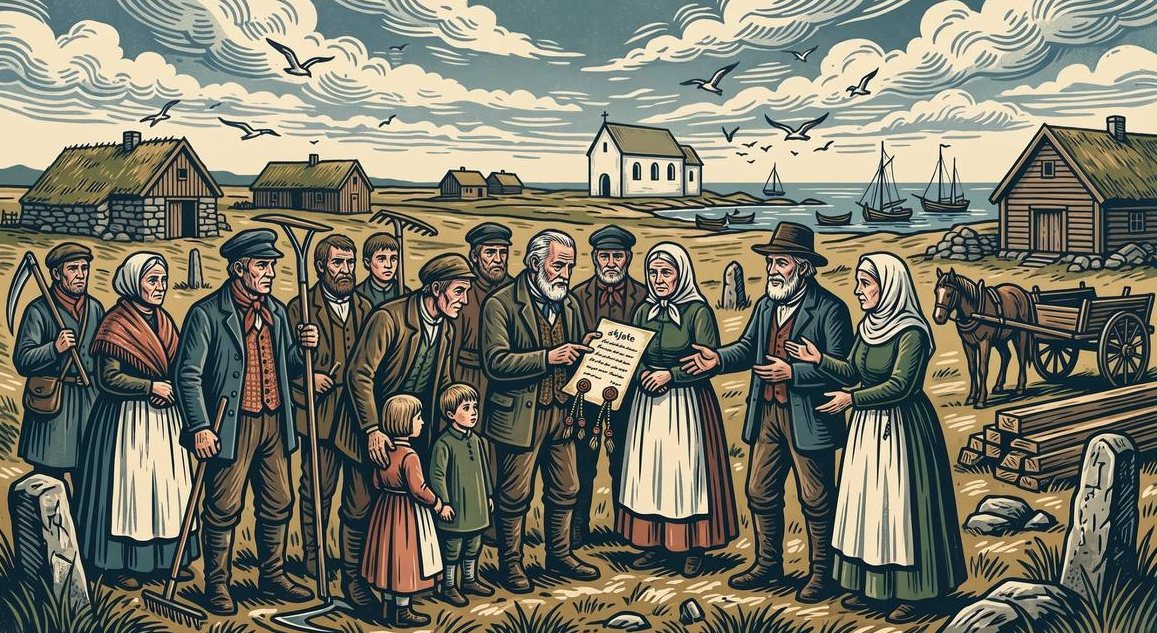
From 1872 the farms on Giske, which the farmers have rented until then, are sold to those who work them. The farmers on the island now own the land they farm themselves.
After the death of P. E. Rønneberg, who owned the main farm in 1831, the main farm was sold at public auction to the merchant Ole Strøm in Ålesund. He leased it out (bygsel) to two farmers, and after his death his heirs owned it. Rønneberg's farmhouse was taken down and moved to Brunholmen near Ålesund, according to the historian Peder Fylling.
The change happened gradually. The census of 1865 shows both tenant farmers, who rented the land, and freeholders, who owned it, on Giske. Peter Marthinussen was «Gaardbruger og Leilænding» (farmer and tenant) at Giskeødegården, while Kristofer Hagerup, aged 49, was «Gaardbruger og Selveier» (farmer and freeholder). In 1875 he was listed as farmer and fisherman. In 1910 his son Johan Hagerup, born on Giske in 1853, ran the farm at farm number 130, holding number 1, he too as farmer and fisherman.
The marble church still stood. It was modernised «på en hardhendt måte» (in a heavy-handed way) in the 1860s, writes Store norske leksikon, and today it is managed by Giske kyrkjelege fellesråd (the joint parish council). When it passed from private ownership to the Church is uncertain.
In 1563 a single estate bailiff (gardsfut), the manager of the estate, sold 493 våger of stockfish in Bergen for the estate. In 1910 Johan Hagerup farmed his own land and did his own fishing. From 1872 to today it is roughly five generations.
Sources
Lokalhistoriewiki, Giskegodset; Peder Fylling (1859, s. 82; 1883, s. 47 og 70); Digitalarkivet, folketellingene 1865, 1875 og 1910 for Giske; SNL, Giske kirke; Gjørvels regnskap 1563 (Sandberg 1986); rapporten «Giskegodset etter 1582».