Timeline · In the government of the realm
Erling Vidkunsson rules the realm
1323 to 1332
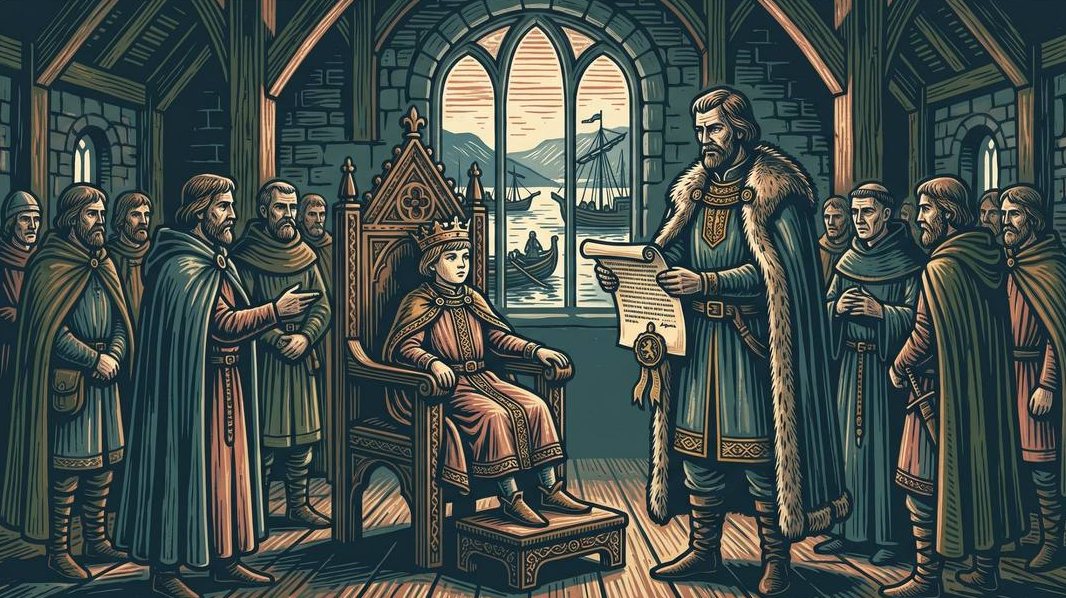
In 1323 the Council of the Realm, the foremost magnates of the realm, meets and sets the king's mother, Duchess Ingebjørg, aside. Erling Vidkunsson of Bjarkøy and Giske, around 31 years old, becomes drottsete, the highest governor of the realm, and is to govern Norway for the seven-year-old King Magnus Eriksson.
Bergen was the place where many of the matters were decided. The town lay around Vågen, the harbour bay in the middle of the town, with the royal residence and the cathedral on Holmen at the outer end of the north side of the harbour, the town properties and wharves along the bay and the monasteries on the outskirts. Many of the letters from the drottsete period were written here: deeds of purchase, receipts and judgements, with witnesses from the royal residence and the canons of Christ Church. When Erling bought land in the royal residence in August 1329, a man called Jon of Lübeck stood among the witnesses, a sign that German merchants were already part of the town several decades before the Hanseatic merchants' German Kontor was organised around 1360.
Erling was the son of Bjarne Erlingsson's brother Vidkunn, who died on 1 May 1302 according to the Icelandic annals, and Fru Gyrid Andresdatter of the Ståreim family in Nordfjord, the fjord districts just south of Stad. His parents had received a papal dispensation in 1291, and Erling was probably born around 1292. He was a knight by 1316 at the latest and married to Elin Toresdatter, daughter of Chancellor Tore Håkonsson. His cousin Andres, Bjarne's son, had been married to her sister, Kristin. From his mother he got the Ståreim estate, and from his uncle Bjarne, who had married into Giske and died in 1313, he inherited most of the family's estate on Bjarkøy, an island north of Harstad in Troms, and on Giske. When he got Giske itself is disputed. If it was Bjarne's granddaughter Kristin who inherited in 1313 and died young, the farm came to him shortly afterwards. If it was the daughter-in-law Kristin Toresdatter, he took over only after her death, according to Helle probably around 1340.
Magnus Eriksson had become king of Norway after his maternal grandfather Håkon V in 1319, three years old, and in the same year was elected king of Sweden. Erling was among the leading lendmenn and knights who in the same year signed the agreement in Oslo on the union with Sweden. In the first years his mother, Duchess Ingebjørg, had great influence, and the Norwegian council was dissatisfied. In 1323 the council put Erling at the head as drottsete with royal authority. He governed until 1331 or 1332, the sources disagree, and was probably also chancellor from 1324 to 1327. How much power he had in practice alongside the Council of the Realm is debated. The Council of the Realm was the foremost clerical and secular magnates, who governed together with the king or in his place. The lendmenn had received the title baron and Herr and were now the king's men in the government of the realm more than chieftains in the countryside. His uncle Bjarne had been one of the guardians of the twelve-year-old King Eirik Magnusson from 1280, and the family had thus stood in the government of the realm for two generations.
The same year he felt how exposed the estate in the north was. A Russian raid burned his farm on Bjarkøy in 1323. The borders with Novgorod, the Russian trading town by Lake Ilmen, were unclear, and both Norwegians and Karelians claimed tribute in the northern regions. In 1326 the government concluded an agreement with Novgorod on peace and tribute in the north. Erling knew the region well. Two years before he became drottsete, on 8 May 1321, he sat in Oddshus at Vågan in Lofoten and received a compensation in land at Sandtorg by Tjeldsundet south of Harstad, with the priest at Trondenes by Harstad and the lawman of Hålogaland, the old name for Northern Norway, as witnesses. In May the skrei fishery was over, and the settlements were probably made before people went home from the fishing village.
The letters show the drottsete at work. From Båhus, the castle by Göta älv north of present-day Gothenburg, the king wrote in July 1326 to the sysselmann, the king's official, and the lawman in Jämtland, the province east of Trøndelag, about the archbishop of Uppsala, who had complained to Erling and the Norwegian councillors that people were wronging his fishery at Ragunda in eastern Jämtland, probably the salmon fishery in the Indalsälven. Erling set his seal beneath, together with the king's. From the papal court in Avignon in southern France the king's procurator, the knight Bertrand de Succiolis, wrote, probably in August 1324, to Bishop Audfinn in Bergen. His squire, Aymeric Beronis, had travelled to Norway with money and jewels for the king and the king's mother and had died there, and the belongings were held by the Friars Preacher, the Dominicans, in Oslo and by the drottsete Erling. A letter from Bergen of 6 March 1329 shows the leidang, the farmers' old duty to provide ships and food for the king's fleet, in use as a tax in the drottsete period. From Voss, the inland district east of Bergen, came live and slaughtered cattle, hides, butter, malt and grain to the royal residence, what had once been the provisions for the fleet. In 1327 came a retterbot, a royal amendment to the law, which strengthened the older church law against the church's new tithe rules, and the following year Erling was in dispute with Bishop Audfinn over tithes. In 1330 and 1331 came measures for trade and the privileges in Bergen, and an ordinance in August 1331 is his last known act as drottsete.
At the same time he built up the estate. In October 1324 he bought 21 månedsmatsbol (a land-rent unit) at Stovreim in Fjordane, the district between Sogn and Sunnmøre. Payment went in several instalments to the church in Bergen in accordance with Fru Torbjørg's will, and only in March 1330 could Bishop Audfinn establish that everything had been paid. In 1327 he bought Bleike in Asker west of Oslo, six markebol, for 30 marks of burnt silver, with a clause on how the land rent was to be reckoned if it was paid in English money. In 1329 he bought ten månedsmatsbol at Systrond in Leikanger in Sogn, the districts around the Sognefjord, for forty marks forngild, reckoned in the old, full value of the coin. On New Year's Day 1330 Svein Sigurdsson gave him a third of Hval in Sogndal, forty månedsmatsbol, with sixty kyrlag (cow units) of the livestock, four horses and his share in the mill by the waterfall, probably a water mill of the type that came into use in Norway in the 1200s, and six bol at Valaberg that paid three barrels of tar a year. Tar and timber were goods the fjord districts had and Giske lacked. The ships of Western Norway were mainly built of pine, and two dendro-datings, of a cargo ship from around 1030 and of the great ship from Bryggen from 1187/88, point to Sogn as the source of the timber. Norwegian figures for tar consumption are lacking. For the Danish reconstruction Havhingsten in Roskilde in Denmark, a longship of about 30 metres, 600 litres of tar were used. Erling's purchases in Sogn may also have given him access to forest and tar. Svein gave as the reason for the gift the goodwill he had met as a child from Erling's mother.
Prices were reckoned in burnt silver, refined silver by weight, and in English coin, and land in månedsmatsbol, land that gave an annual rent equal to one month's food. A month's food was reckoned in butter and flour, but the quantity is not known. In his mother Fru Gyrid's guardianship accounts from Bergen in 1309, five lasts of grain are converted into 127 months' food «in butter». Land gave rent year after year, in butter, grain, fish and tar. Before the middle of the 1300s the land rent may have been about one sixth of the harvest, and that is an estimate. The land was hard pressed. The annals of northern Europe tell of a great famine in the 1310s, and in the decades before 1350 there are signs that farms were abandoned, especially in Western Norway and Northern Norway. According to Store norske leksikon the fishing districts are an exception. Who owned the land is also disputed. Older calculations reckon that around 1350 the church owned about 40 per cent measured in land rent, the king about 7 per cent and the secular aristocracy about 20, while more recent research gives the church 20 to 40 per cent. Perhaps only a third of the farms were owned by farmers.
The estate also reached across the sea. Through Elin, Erling had a right of inheritance in Orkney, the islands north of Scotland, where Tore Håkonsson had acquired odal land. In March and April 1329 his agent, Sigurd Jodgeirsson, sold the lands on Ragnvaldsøy, probably North or South Ronaldsay in Orkney, and the Pentland Skerries, the skerries in the strait between Orkney and Scotland, to Countess Katarina of Orkney and Caithness, the northernmost province of Scotland. Payment was to be made in burnt silver and English coin, partly in Bergen the same summer. The letter also mentions «Herr Håkon and Fru Kristin», and it is probable that these were Elin's siblings Håkon and Kristin Toresbarn.
The drottsete period lies about 700 years back, an estimated 25 generations from today. In Europe the popes sat in Avignon. In France the last of the direct Capetians, Charles IV, died in 1328, and the dispute over his inheritance became the prelude to the Hundred Years' War. After the drottsete period Erling continued in the Council of the Realm. In 1333 he joined the Havtoressønnene, the daughter's sons of Håkon V, in a rebellion against King Magnus at Tønsberghus, the royal castle in Tønsberg, received an amnesty and kept his estate. Erling's seal bore a lion, and it is the model for the Giske lion in the coat of arms of Giske municipality today.
People: Erling Vidkunsson
Sources
DN 1/163; DN 1/175; DN 1/177; DN 4/163; DN 4/168; DN 1/190; DN 1/204; DN 2/168; DN 2/170; DN 1/207; DN 1/208; DN 2/93; Norsk biografisk leksikon (Helle, «Erling Vidkunsson av Bjarkøy og Giske»; Bjørgo, «Tore Håkonsson»); UiB Landslovjubileet (leidang); Christensen 2002; Vikingeskibsmuseet; prosjektnotatene «Båtbygging, seil og leidang», «Jordbruk i Norge 800 til 1650», «Giskegodset og produksjonen», «Giskebrevene 2», «Giskefolket i arkiver og kilder» og «Giske-løva: våpenet og slekta bak»; Store norske leksikon; nettsidens sider «Makten i riket» og «Slektsbånd».