Timeline · The Arnlings
Before the Arnlings
c. 2000 BC to 900
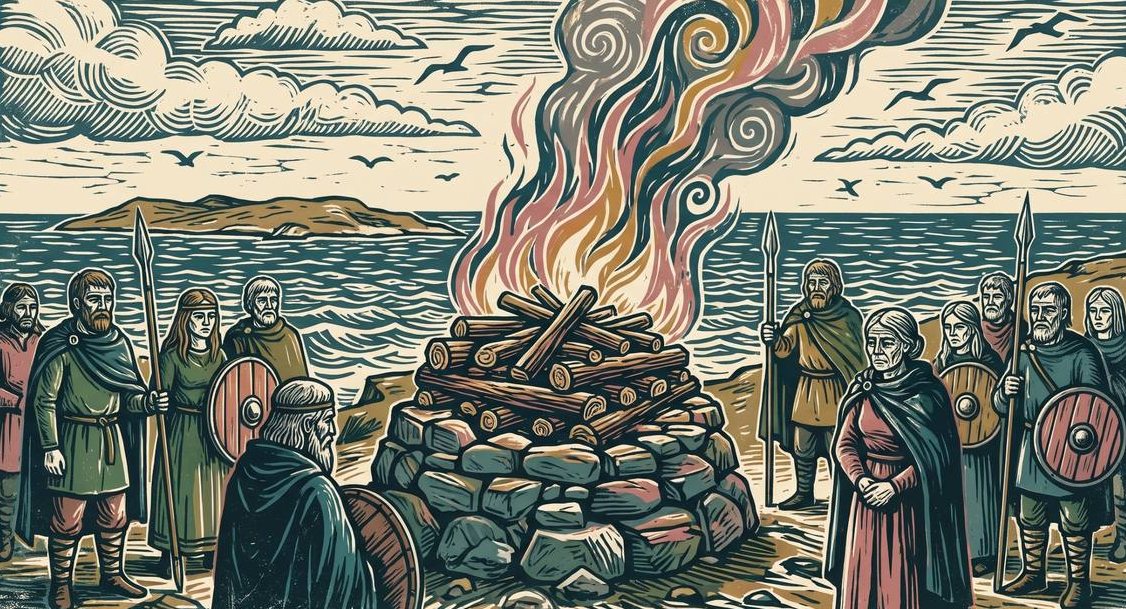
Around 1300 BC a powerful person is buried in a large burial mound on Giske, with a view over the sailing route and inland towards the Sunnmøre Alps. The cist inside the mound is built of eight large stone slabs. The stone is not found on the island and was carried along the coast from Trøndelag or further south. The slabs are carved with ships and patterns resembling woven textiles. Some 1700 years later, across the sound on Godøya, another powerful person is burnt on a pyre and laid in a cairn with a gold ring of 311 grams and a gold medallion made on the model of a Roman imperial medallion. Long before anyone wrote about them, powerful chieftains ruled the islands and the ships that passed by.
Giske, Godøya, Vigra and Valderøya lie close together on the outer edge of Sunnmøre, facing the open sea. Between them runs Giskesundet, where the sailing route comes in from the sea between Stad in the south and Hustadvika in the north, two of the most dangerous stretches on the coast. Every ship between north and south had to pass the islands, and before Stad and Hustadvika they were often weatherbound for days or weeks. The crews needed harbour, water and food. Around the islands lay rich fishing banks, and in spring the cod came into the sounds. Whoever ruled the islands could receive the travellers, trade with them and keep an eye on who came and went.
The stone cist on Giske lies in Mjeltehaugen, a burial mound around 30 metres across and 6 to 9 metres high. When it was excavated in 1847, 1867 and 1878, the slabs came to light with ships and bands of zigzag lines, wave bands and herringbone patterns. The University Museum of Bergen calls it the largest find of rock carvings from a grave in Norway. The closest parallel is the Kivik grave in Scania, the decoration recurs in graves in eastern Germany, and the researchers Melheim and Sand-Eriksen compare a dagger on the slabs with daggers from the Alps. Store norske leksikon dates the grave to around 1300 to 1100 BC, while some researchers believe the slabs are older, from the end of the Stone Age. Around AD 200 a woman was buried in the top of the mound with two silver-plated bronze brooches. The mound was known and used for over a thousand years.
Godøya rises almost 500 metres above Giske. The genealogy Sunnmørsættlegg tells that Eiliv jarl «liggjer i Eilifshoug i Gudøy» (lies in Eilifshaug on Godøy), and the local history «Borgund og Giske» believes that the Møre jarls, the jarl family the sagas tell of around the year 900, had one of their seats on the island. This is tradition. Eilifsrøysa on Godøya is dated «trolig» (probably) to the Bronze Age by Store norske leksikon and to the Late Roman Iron Age by others, and the mound is in any case far older than the jarl tradition links to it. The gold ring and the medallion from around the year 400 show that people with wealth and connections lived on Godøya in the Iron Age.
The world outside was close. The best flint in the Stone Age came from southern Scandinavia, and bronze was made from copper and tin from places including the Alps and Cornwall. The gold in the graves followed Roman weight, the ounce of 27.3 grams, which became the Nordic øre. On Haramsøya, around 20 kilometres north of Giske, lay a grave with 622 grams of gold and a Roman bronze dish, and on Valderøya lay Kongshaugen with a solid gold ring and two bronze cauldrons. Whether the gold came with men who served in Roman armies or as gifts between chieftains is disputed. Later, Arabic silver came across Russia and the Baltic, and in graves in Ørsta lay mounts from the British Isles, made into jewellery around 770 to 840.
Wealth gave power, and power had to be defended. Whoever controlled swords and metal also controlled people, and the archaeologist Anders Hagen believed that the rich graves on Godøya, Vigra, Valderøya and Giske belonged to an upper class. At Kvalsund in Herøy a rowing ship of around 18 metres was sunk in a bog as an offering, and at Ose in Ørsta a cult house has been excavated. In Hjørungavåg in Hareid, archaeologists found in 2024 traces of what is probably a longhouse from the Viking Age, and the project leader believes the site may have been a centre of power in the Iron Age.
By the church on Giske archaeologists have found cooking pits from 540 to 680 and an oven where seal oil was boiled from around 900 to 1020. Around 500 metres east of the church lay a double grave from the Viking Age with two oval brooches, a silver ring, a spearhead and a balance for weighing silver. Just north of the church lies Ørnebakken, a burial cairn with a bauta stone (standing stone). A few kilometres away the trading town (kaupang) of Borgund grew up in the same generation as the Arnlings.
The family's own genealogy says of the progenitor Finnvid that «ingen kjenner ætta hans» (no one knows his kin), and legend tells that he was found in an eagle's nest. The graves tell something else about the place. Power by the sailing route was over two thousand years old when the Arnlings appear in the sources at the end of the 900s. Whether they grew out of the families that already ruled the islands, or took over an old chieftain's seat, no one knows, and no source links the graves to the family. Either way, the Arnlings entered a world where the struggle over the sea, trade and people was already old.
Sources
SNL, «Godøyfunnet», «Mjeltehaugen», «Skjonghelleren» og «Ragnvald Mørejarl»; Universitetsmuseet i Bergen, rapporter om Giskegjerdet (2019) og Valderhaug (11/2022); Hatling 2012; Bergsvik om Anders Hagen; Nordeide, Bonde og Thun 2020 om Kvalsund; Universitetsmuseet i Bergen og sciencenorway.no om Ose i Ørsta; bygdeboka Borgund og Giske, bind I; prosjektnotatet «Makt på Sunnmøre før Arnungene». NTB/forskning.no 4.11.2024 om funnene i Hjørungavåg. Universitetsmuseet i Bergen, rapport 846, Valderhaug 2022; Fjord Norway, «Gravrøyser i Giske»; Spor 2014, «Gullskatten på Tornes»; NIKU 2020, «Nytt båtfunn på Edøy». Heen-Pettersen, European Journal of Archaeology 2019; Nyland, UBAS Nordisk 3; Universitetsmuseet i Bergen, «Bronzes», Møre og Romsdal; Melheim og Sand-Eriksen 2020; SNL, «Jernalderen i Norge»; Bakka om gullets vekt; Universitetsmuseet i Bergen, rapport Giske 2011; Walker m.fl. 2025 om Borgund; Primitive tider 2019 om Sunndal; prosjektrapporten «Funn i Møre og verden»; DigitaltMuseum: Mjeltehaugen på Giske