Timeline · In the government of the realm
Peace with Scotland
1312
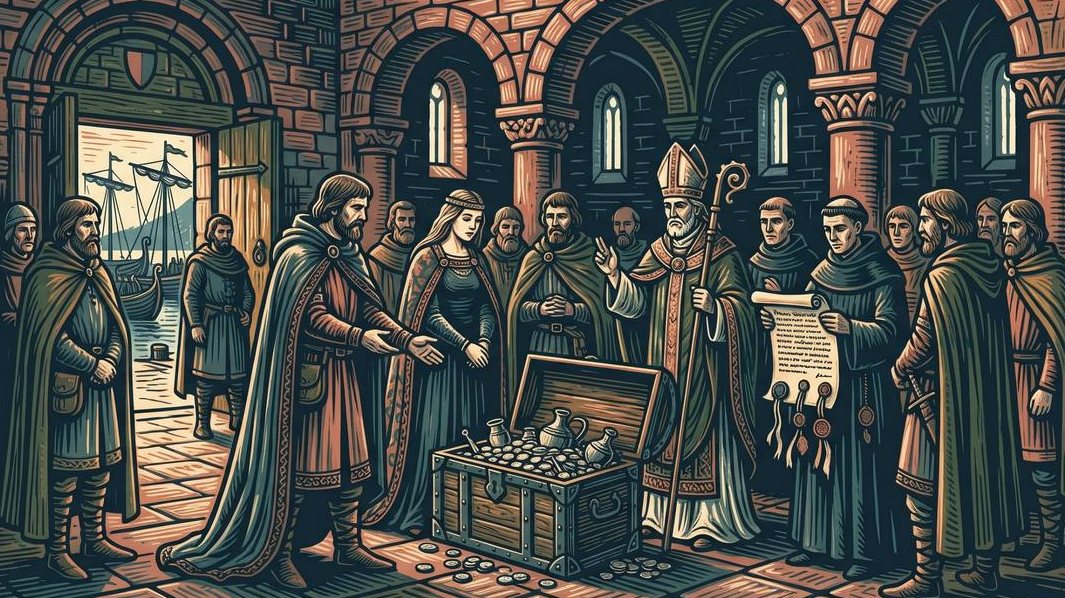
On Thursday 23 March 1312 Bjarne Erlingsson, the lord of Giske and Bjarkøy and one of the foremost magnates of the realm, stands in St Magnus Cathedral in Kirkwall in Orkney, the islands north of Scotland, and receives 600 marks sterling from the envoys of the Scottish king Robert Bruce, king 1306 to 1329. He is around 62 years old and gives a receipt on behalf of King Håkon V, king of Norway 1299 to 1319.
Orkney still belonged to the Norwegian king. The islands were an earldom between the North Sea and the Atlantic, and above Kirkwall rose St Magnus Cathedral, built of red and yellow sandstone from 1137 over the saint earl Magnus Erlendsson. Magnus was a great-grandson of Finn Arnesson from Giske, through Finn's daughter Ingebjørg, who was married to Torfinn, Earl of Orkney, and was called «Jarlemor» (the Earls' Mother). Magnus was killed by his cousin around 1117 and regarded as a saint, and the builder of the church was his sister's son, Ragnvald Kale. Orkney lay midway between the two kingdoms and was a natural place for Norwegian and Scottish envoys to meet. With Bjarne was the canon Ivar Olavsson, who held office at the churches both in Bergen and in Orkney.
The letters do not say when Bjarne sailed over, nor which ship he used. Bergen could build large ships. A ship of pine from Bryggen, felled in the winter of 1187/88, carried an estimated 120 tonnes, and in the customs rolls of the early 1300s the largest Norwegian ship carried 80 to 100 lasts. The Danish replica Ottar of Skuldelev 1, a cargo ship from around 1030 built in the Sognefjord, makes up to 10 knots under sail and only 1.5 knots under oars, so a cargo ship lay waiting in calm weather. From Bergen to Kirkwall is an estimated 270 nautical miles, about 500 kilometres, and with a fair wind a ship could manage it in around two days and nights. Orkney Museums reckons the crossing for the first Norse settlers, who mostly came from Western Norway, at one to two days. For comparison, the saga of Håkon Håkonsson tells that the king was «two nights on the sea» from Western Norway to Shetland in July 1263. The King's Mirror advises the merchant to make his ship ready «at the beginning of summer» and preferably not to go to sea in autumn, and in Norse reckoning summer began at sommermål in mid-April. The King's Mirror also advises tarring the ship in autumn and leaving it to stand over the winter with the tar. A crossing in March would fall before that time. This is uncertain, and Bjarne may just as well have spent the winter in the west. According to the sagas and the finds from the Viking Age, the food on long voyages consisted of porridge, flour, stockfish, butter and bread, with water as the usual drink and ale on the grandest ships.
The money had a long prehistory. King Håkon Håkonsson's expedition west in 1263, against Scotland, is regarded by the University of Bergen as the largest leidang in Norwegian history, the largest levy of ships and men the farmers were obliged to provide, with 120 ships in all. The saga gives the king's own ship, built in Bergen, 37 rooms, oak and a gilded dragon head. The expedition showed that a large levy of farmers could be beaten by smaller, trained forces with horsemen. After the expedition, at the peace of Perth in 1266, Norway had given up the Hebrides and the Isle of Man to Scotland in return for a lump sum and an annual payment of 100 marks sterling for all time. During the Scottish wars of independence after 1296 the payment had not been made. Robert Bruce had been king since 1306 and was at war with England. The receipt shows that his envoys, Bishop Ferchard of Caithness, Earl Magnus of Caithness and Master Roger of Inverness, paid 100 marks for 1312 and the same for each of the five years before. The receipt was handed to the Scots, for it was their proof.
In the autumn Bjarne and Ivar travelled on to Inverness in northern Scotland, at the inner end of the Moray Firth. Between Orkney and Caithness, the northernmost part of the Scottish mainland, lies the Pentland Firth, where the tidal stream can reach 12 knots and the sea becomes high and steep when it meets the swell from the Atlantic. Which way the envoys went, the sources do not say. The sea route from Kirkwall round Caithness and into the Moray Firth to Inverness is an estimated 110 nautical miles, around 200 kilometres. On Sunday 29 October 1312, just before All Saints' Day and at the time when the King's Mirror wanted ships on land, they met King Robert in person.
Two documents were written that day. One renewed the whole Treaty of Perth of 1266, and among the witnesses stood the bishops of Aberdeen, Moray, Ross, Caithness and Orkney and the earls of Ross, Atholl and Moray. The other settled specific disputes. Scottish wrongdoers had made raids on Orkney and taken the king's sysselmann, the king's official on the islands, a knight whom the Scottish documents call «Bernier Peff'», prisoner. He had to buy his life with the dues he had collected for the king. Robert declared that he was wholly ignorant of the matter. For the sake of peace and friendship between the kingdoms he nevertheless agreed to pay 600 marks sterling in St Magnus Cathedral in Orkney. The damage in Shetland was to be investigated later.
The Scots had their own claims. Merchants from St Andrews on the east coast of Scotland had been put in prison in Norway, and the king's bailiffs had taken their goods, worth 600 pounds sterling. After long captivity they had travelled home «with empty hands». The squire Patrick de Monte Alto had been beaten and put in chains in Orkney and had to buy himself free for 40 marks. Bjarne and Ivar promised that the merchants' goods would be returned. So Scottish trading ships sailed to Norway, settlements were made in English sterling, and merchants' goods could be seized when the kings disagreed.
The agreement was written as a chirograph, a double document cut in two along a jagged line, so that each king got his part and its authenticity could be tested by putting the parts together. The Scottish part survives in the original in the National Records of Scotland. There Bjarne is called «Berner de Berkerey», baron. The Scots knew him by Bjarkøy, the island north of Harstad in Troms. The agreement was confirmed several times later and is regarded as one of the cornerstones of the relationship between Norway and Scotland in the late Middle Ages.
The order of events is disputed. The receipt from Kirkwall is dated the Thursday before the Annunciation in the year of grace 1312, and on the usual reading it was written seven months before the meeting in Inverness. The three Scots who paid in Kirkwall are the same as those who swore in Inverness. It may therefore be asked whether the receipt belongs to 1313, with the new year beginning at the Annunciation on 25 March, so that it was the settlement after the agreement. The weekday fits best with 1312, for 23 March was a Thursday that year. Nor has it been settled whether the 600 marks in Kirkwall were the payment for six years, as the receipt says, or the compensation for Orkney, which the Inverness agreement mentions, or whether the two sums coincided in one settlement.
Bjarne died in Trondheim the following summer, on 7 July 1313. In June 1314 Robert Bruce defeated the English at Bannockburn in Scotland.
People: Bjarne Erlingsson
Sources
DN 2/111; DN 2/114; Regesta Regum Scottorum V nr. 24 og 25 (NRS SP8/1, etter POMS); Håkon Håkonssons saga; Kongsspeilet; Vikingeskibsmuseet; Christensen 2002 (Deutsches Schiffahrtsarchiv 25); UiB Landslovjubileet; prosjektnotatene «Båtbygging, seil og leidang», «Giskebrevene 1», «Giskefolket i arkiver og kilder» og «Havner, seilaser og mat langs kysten, kontrollert»; Store norske leksikon; Orkney Museums; prosjektrapporten «Funn i Møre og verden»; prosjektsiden «Slektsbånd».