Timeline · In the government of the realm
The gift of Humla
1344
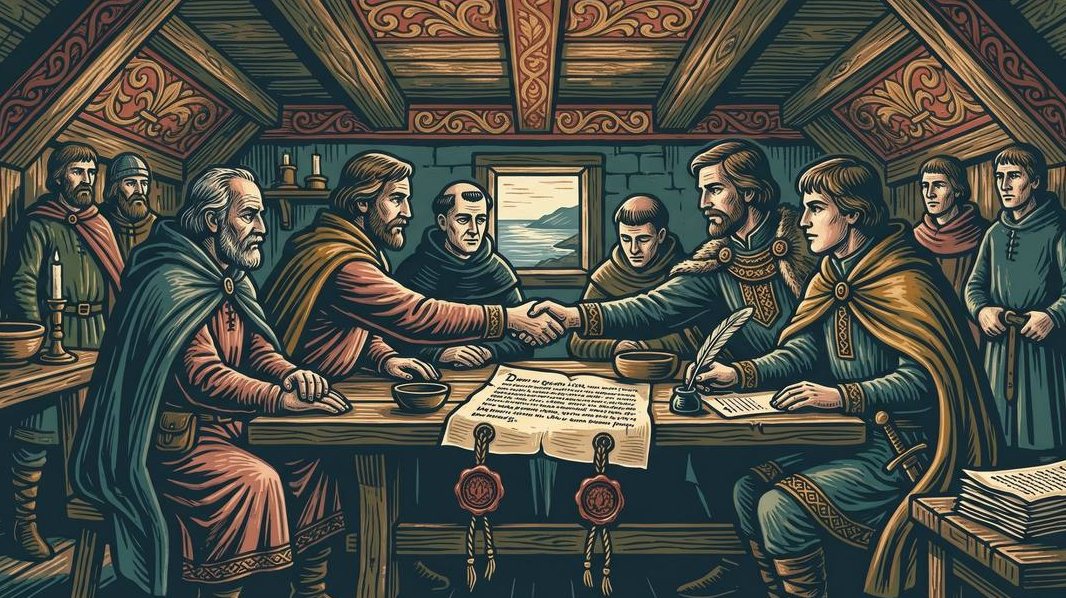
On Monday 19 April 1344, the first Monday of the summer half of the year, eight men are gathered «j steinda lofteno aa Gidzska», in the painted loft on Giske. Ogmund Eiriksson gives the small island of Humla in Borgundfjorden, the fjord between Ålesund and Sula, to Sir Erling Vidkunsson, the knight who owns Giske and has been drottsete (steward of the realm), the highest officer of the realm under the king. The same day Ogmund moves in at Giske.
It is early spring on Giske. The spring cod fishery in Borgundfjorden, from Candlemas on 2 February to Lady Day at the end of March, is over. The island has bog in the middle and sandy soil out towards the beaches, and to the west the neighbouring island of Godøya rises steeply. Sommermål, the start of the summer half of the year in the Norse reckoning of time, fell in mid April, and the letter is dated after it. It was also the time when ships could be made ready. The King's Mirror advises the merchant to sail «at the beginning of summer», and a ship that had not been tarred in the autumn was to be tarred when spring came. On the outer coast the heather moorland was the most important outlying land, and according to later sources it was burnt regularly and grazed by sheep all year round. Giske and the neighbouring islands were probably managed in the same way. No source describes this for Giske in particular.
«Steinda» means painted. The word comes from Old Norse steina, to colour or paint, and has nothing to do with stone. A loft was a building with a room on the upper floor, often the finest room on the farm. The letter does not say where the loft stood. It was probably a separate loft building in the farmyard, where the great man received people and made agreements with witnesses present. By the boathouses below the church archaeologists have found a stone house with lime-mortared and plastered walls, and west of the church ground-penetrating radar in 2013 found a structure measuring 49 by 7 metres, probably a building or a wing of a building. Whether either of them held the painted room, we do not know. What is certain is that Giske had a decorated hall.
The witnesses were Jon Brynjulfsson, Gudbrand Berdorsson in Vik, Eirik, priest on Giske, Gjurd Håkonsson, Gunnar Halldorsson, Bjarne in Heid, Arne Helgesson and Torbjørn Eilivsson. They saw and heard «the words, the purchase and the handshake». Ogmund gave Erling and his descendants Humla, 15 månedsmatsbol (a land-rent unit), a measure of the value of land reckoned by the land rent, «outside the fence and inside». In return Ogmund was to receive the same board on Giske as Erling's sveiner, the armed servants, received «in food and malt drink», for as long as he lived. His sister was to have the same board as the other workers on the farm, and his son was to be provided for until he turned 16, and after that only for as long as Erling was pleased with his service. The letter was made in two copies. It shows who lived at the chieftain's seat: sveiner, workers and children. The thralls who had worked on the great farms in the Viking Age were gone, and in the national law of 1274 they are no longer mentioned as a separate group. The workers on Giske were probably free servants, although the letter says nothing about their status. It was a provent agreement, a life insurance in an age without public care, and for Erling a way of gathering land. An island of 15 månedsmatsbol was exchanged for board for three people.
What the board consisted of, the letter does not say. The malt drink was ale. Giske grew little grain, so the malt probably had to be bought in. More than two hundred years later, in 1563, the farm's own harvest gave 28 såld of grain, while the people on the farm ate 37. The bailiff bought hops and malt, and cows, oxen, sheep and pigs went to slaughter. The workforce was then six farmhands and five women. The farmhands received two or three daler a year and wages in vadmel (homespun woollen cloth), linen and a hide, the women only in cloth and shoes, and the farmhands themselves fished 30 våger (c. 18 kg each) over the year. On the farm 56 ells of vadmel were woven. The wool came from the sheep, and on the farms it was woven into clothes, rugs and sailcloth. Whether conditions were the same in Erling's time, we do not know.
Humla lay in the parish of St Peter's Church in Borgund, the old trading town (kaupang) east of present-day central Ålesund, on the marble seam along the north side of the fjord, an estimated 12 to 15 kilometres by sea from Giske. An isotope study from 2026 concludes that the Borgund churches probably got their marble from Humla, «the nearest sizeable one», about four kilometres away, while the marble for Giske church probably came from Magerholm by Storfjorden, the long fjord that runs into Sunnmøre east of Ålesund. Name, parish and location fit, and much suggests that Ogmund's island is the same Humla. From 1344 the family on Giske thus owned the deposit the Borgund churches had been built from, nearly two hundred years after the churches were raised.
Erling was around 52. He had stepped down as drottsete twelve or thirteen years earlier and still sat on the Council of the Realm, the council of great men and bishops that governed the realm together with the king. The letter is his first known letter written on Giske, and that fits with his perhaps having taken over the farm only a few years before, without proving it. In August 1343 he was in Varberg in Halland, on the west coast of present-day Sweden, together with Ivar Ogmundsson and other Norwegian knights when King Magnus Eriksson's younger son Håkon was accepted as king in Norway. The same spring he bought land at Sodgar in Romsdal, the fjord country north-east of Sunnmøre, and the purchase was witnessed in Bernargarden on Veøy, a small island in Romsdalsfjorden, the family's town house at the old trading and church site in Romsdal. He gathered land around Giske and in Romsdal, and according to the historian Knut Helle his estate is reckoned at no less than seven per cent of all noble land in Norway. For comparison, older calculations reckon that the whole secular aristocracy owned about 20 per cent of the land around 1350 measured in land rent, the annual rent the tenant farmers paid for the land, the Church about 40 and the king about 7. The figures are disputed.
The preceding years had been unsettled. King Magnus Eriksson, king in Norway from 1319, had come of age in 1332 and ruled both Norway and Sweden, and he stayed mostly in Sweden. Many Norwegian great men disliked this, and in 1338 and 1339 a group of them rebelled, led by Ivar Ogmundsson and Sigurd Havtoresson. Bishop Håkon in Bergen wrote regularly to Erling and his son Bjarne in these years, and his letters show how news and friendship travelled along the coast. The bishop had left Tønsberg without waiting for Bjarne because he «got a good wind before winter». News that Bjarne wrote to his father just after he left Bergen did not reach the bishop until St Catherine's Day, 25 November. He promised Bjarne a boat that stood ready in his boathouse, and Jon Havtoresson a boat that eight men could row. That may have been what was later called an åttring, with eight oars in four rowing spaces. The word is considered old, and in the 1400s the åttringer were handline boats in the fisheries, but the oldest dated description of the boat type is from 1591. He asked Bjarne to write «seldom and not too openly». In 1342 Erling's daughter Ingebjørg was betrothed to Sigurd Havtoresson to keep the peace between the families. Sigurd's mother Agnes was the daughter of King Håkon V, and Sigurd and his brother Jon belonged to the king's closest kin.
In Europe the Hundred Years' War between England and France had begun in 1337, and in 1346 the English won at Crécy in northern France. Five years after the agreement in the loft, the Black Death, the plague that killed a large part of the population, came to Norway.
People: Erling Vidkunsson
Sources
DN 5/171; DN 1/285; DN 6/166; DN 8/99; DN 8/117; DN 8/118; DN 9/134; SDHK 4906; Kongsspeilet; Gjørvels regnskap 1563 (Sandberg 1986); Store norske leksikon (åttring, trell); prosjektnotatene «Jordbruk i Norge 800 til 1650», «Fiske og fiskeredskap», «Giskegodset og produksjonen», «Giskebrevene 2», «Ruinene på Giske», «Slik ble Giske kirke bygd», «Giske: landskap, beliggenhet og jordbruk» og «Giskefolket i arkiver og kilder»; NIKU 168/2013; Heldal m.fl. 2026; nettsidens sider «Makten i riket» og «Slektsbånd».