Timeline · The heirs fight over the estate
Giske is pledged
1464
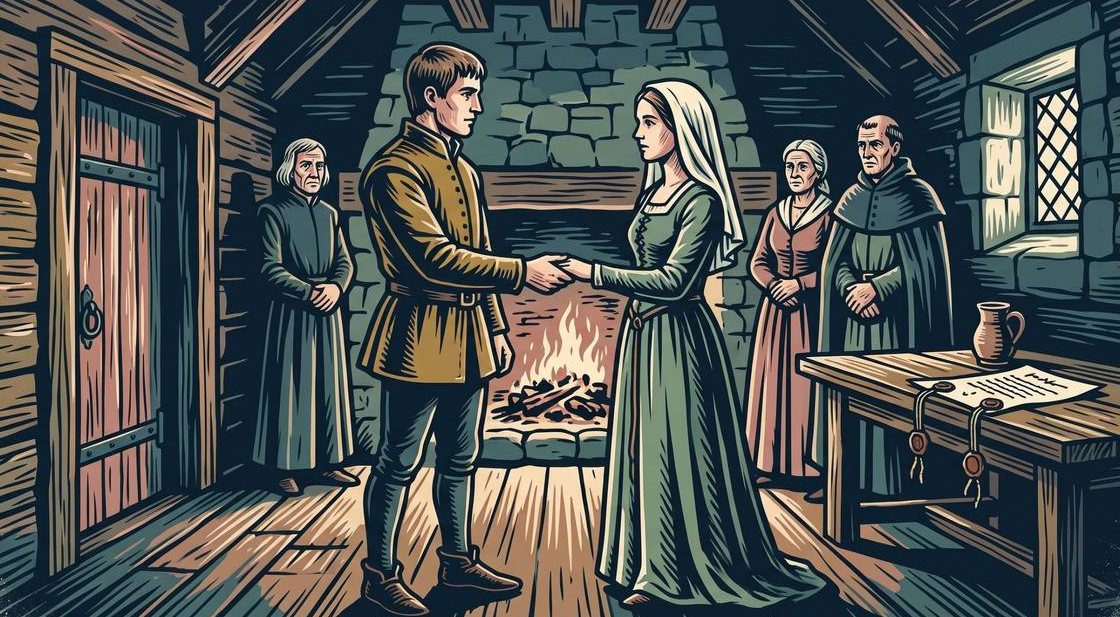
On Mid-Lent Sunday, 11 March 1464, a group of men are gathered in the burghers' hall in Ny-Varberg in Halland. The well-born squire Hans Sigurdsson, son of the drottsete Sigurd Jonsson, is betrothed to the maiden Ingeborg, daughter of Sir Åke Axelsson. As security for the morning gift, the gift the bridegroom promises the bride, he puts Giske and the whole Giske estate in pledge.
Halland is a flat and open coastal land between Scania and Viken, the land around the Oslofjord, with beech woods on the plains and rivers flowing out into the Kattegat. The land belonged to the Danish crown. On the coast lay the castle of Varberg and the town of Ny-Varberg with mayor, town bailiff and councillors. Åke Axelsson belonged to the Tott family, one of the most powerful in Denmark and Sweden, with Varberg as its seat. According to the sagas it was in this landscape that Finn Arnesson from Giske had been jarl four hundred years earlier, and at the river mouth of Niså, where Halmstad lies today, he fought in 1062. How Hans and his mother came to Varberg in March, and from where, the letter does not say.
The witnesses are named. First comes Iver Vikingsson, provost of St Mary's Church in Oslo, then the esquires Karl Bengtsson, Germund Bengtsson, Lauris Finkenow and Anders Pedersson, mayor Hans Vædde, town bailiff Niels Unge and six councillors in Ny-Varberg. Hans and his mother, Lady Philippa, hang their seals first under the letter. Philippa was present and consented «with free and good will».
Hans was the only known son of the drottsete Sigurd Jonsson and Philippa, who in Norwegian letters is also called Filippa Hansdatter. She was the daughter of Count Hans of Eberstein, of the Pomeranian Neugarten line, and her father had served King Eric of Pomerania. Sigurd and Philippa married around 1435, and Hans was therefore probably under 30 in 1464. Sigurd died around 1453, at some point between December 1452 and November 1454. He had been drottsete, regent and candidate for the throne, and SNL calls him the largest landowner of his time. He became drottsete in September 1439, when King Eric of Pomerania, deposed in Denmark and Sweden, sat at Visborg on Gotland and gave him full royal powers in Norway. The letters of the Council of the Realm from these years ended with «God and St Olaf», and when Christian I and Karl Knutsson Bonde fought over the Norwegian throne in 1449, both sides used Olaf in their election letters. Sigurd supported Christian, and in 1450 the Treaty of Bergen bound Norway to Denmark under one king. The estate stretched from Sudreim in Romerike north-east of Oslo and Giske in Sunnmøre to Dønnes in Helgeland, the fishing villages on Outer Senja and Sørøya in Finnmark, and on to the Faroe Islands, Shetland and town yards in Bergen. The estate also yielded goods from the rivers, and in 1445 Sigurd was to deliver five barrels of salmon to Akershus. Through Philippa Swedish pledged estates also came into the family. In 1447 eight knights divided the pledge sum for Gripsholm fief by Lake Mälaren in Sweden, 24 000 Swedish mark, and Sigurd received 9 489 mark on Philippa's behalf.
The betrothal was a contract between two families. «As soon as they both come into one bed», there was to be helmingsfelag between them, so that husband and wife each owned half of everything. As morning gift Ingeborg received ownership of all the estate Hans and his mother owned in Västergötland in Sweden. If Philippa outlived her son, she was to receive as much of his estate in Norway before the division of the inheritance. In addition Ingeborg received 300 lødige mark, mark of fine silver, and for that sum Hans put Giske and the whole Giske estate in pledge. The pledge could not be redeemed from Ingeborg as long as she lived, if she outlived him. Her heirs, on the other hand, could have it redeemed for 300 lødige mark in gold and silver. If Ingeborg became a widow without children, she was first to have her morning gifts, her clothes, her silver and her gold, and the quarter gift and the tenth gift, the quarter and the tenth the law allowed one to give away freely. If Hans became a widower without children, he was first to have the horses, the armour, the gold rings and the best thing on the farm. The rest was to be divided in two. What the Giske estate was worth in 1464, the letter does not say. Around 1531 the estate in Sunnmøre, Romsdal, Helgeland and Shetland was valued at 3000 Bergen guilders according to the land rent, and in 1563 it comprised 104 properties paying land rent in Sunnmøre and 50 in Romsdal. The coins cannot be reckoned directly against each other. Rents were low in these years. After the period of deserted farms, the land rent around 1500 was about a quarter of its level before 1350.
Philippa ran the estate after her husband's death. In June 1463 she met Morten Jensson in the council hall at Breidalmenningen in Bergen. They settled the debt that Morten and his father-in-law Henrik Sost owed Sigurd Jonsson and her, and as part of the settlement she received the yard and plot Brynjulfstomten, «from the street down to the edge of the shore», the yard row that lay nearest the wall by the Church of the Apostles. A later endorsement places the plot in Dreggen, the quarter north of Bryggen. Plots with their own shore were valuable, because goods could be loaded and unloaded at one's own wharf. Ten years after Sigurd's death she was thus still collecting money he had lent out. Bergen was a turbulent town. In 1455 the German merchants had killed the commander Olav Nilsson and Bishop Torleiv in Munkeliv monastery on Nordnes in Bergen. Olav Nilsson had wanted to forbid the Germans to winter in the town. According to Store norske leksikon Sigurd Jonsson himself is said to have declared that he would drive the Germans out of Norway even if he had to drink water for the rest of his life, but the Council of the Realm forced him to confirm the Hanseatic privileges in 1445 and 1447.
Åke Axelsson already had connections with the family. In November 1454 King Christian I at Varberg had given Alv Knutsson Solør, the forest districts in eastern Hedmark, as a fief for life, as Sigurd Jonsson had held it, and the letter says this was done at the request of Åke Axelsson. Alv was the grandson through his mother of Sigurd's sister Katarina. In the years that followed he bought land in Hedmarken, Toten, Voss and Namdalen, and he was in bitter conflict with Hartvig Krummedike, the Holstein commander at Akershus, who in 1445 had taken the castle from Sigurd Jonsson. Alv was one of those who stood to inherit if Hans died without children.
The king was Christian I, king of Denmark and Norway since 1450 and of Sweden from 1457. In 1464 he lost power in Sweden, and Varberg lay on the border between the realms. Constantinople had fallen in 1453, and the Gutenberg Bible had been printed in Mainz some ten years before the betrothal. The art of printing was spreading in Europe.
Hans died in 1466 without children. According to SNL he died unmarried, which suggests that the wedding was never held. On 30 December 1466 Philippa in Oslo gave the fishery Kedum and other property to the «maiden» Ingeborg Åkesdatter, according to two Swedish letters. An endorsement from the 1500s on the betrothal letter says that it «concerns Kydem», and the gift was probably the settlement of the morning gift. The estate lay undivided for 24 years, with Philippa and later Alv Knutsson as administrators. Philippa gave Dreggen in Bergen to Alv in 1472 and died in 1477 or 1478.
Ingeborg's patronymic is written differently in the literature, as Åkesdatter, Aksdatter and Ågesdatter, and the family name as Tott or Thott. An endorsement from the 1600s calls the letter Iver Vikingsson's morning-gift letter, probably because the provost comes first among the witnesses.
People: Hans Sigurdsson (junker Hans)
Sources
DN 16/219; DN 3/862; DN 2/808; DN 2/774; DN 1/900; DN 2/766; DN 16/540; SDHK 28656 og 28658; prosjektnotatene «Giskebrevene 5», «Giskebrevene 6», «Giskefolket i arkiver og kilder», «Giskegodset og produksjonen» og «Jordbruk i Norge 800 til 1650»; Gjørvel Fadersdatters regnskap 1563 (Sandberg 1986); SNL/NBL, Sigurd Jonsson; SNL, landskyld; SDHK 23266 (Visborg 1439); Njåstad, Opsahl og Sunde 2022, Historisk tidsskrift 101; Ringvej, Et kongerike foran undergangen; prosjektsiden «Makten i riket».