Timeline · The heirs fight over the estate
Debt in stockfish
1405
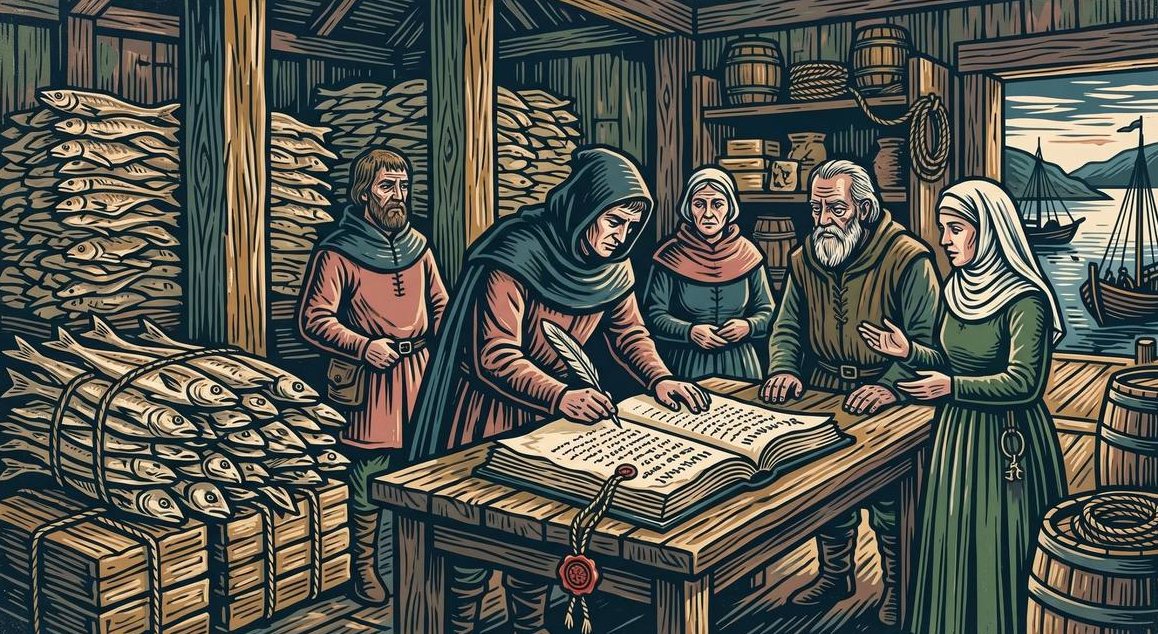
Bergen, St Bartholomew's Day, 24 August 1405. Håkon Sigurdsson, the owner of Giske, hangs his seal under a letter in which he acknowledges that he owes Archbishop Eskil of Nidaros, present-day Trondheim, fourteen lasts of stockfish, «i godom oc gildom haløyskom fisk».
The town he stands in is the country's largest trading place. The town yards lie close around Vågen, the harbour bay in the middle of the town, and on the north side the German merchants have had their office on Bryggen for about forty years, since around 1360. From the second half of the 1300s the Hanseatic merchants had their grip on the stockfish from northern Norway, writes Store norske leksikon. Vágar in Lofoten had lost its position as a trading place after the middle of the century, and the fish now went straight to Bergen. Twelve years earlier, in 1393, the Victual Brothers, pirates from the Baltic, had plundered the town. In later centuries the autumn fair in August and September was the great time for the jekts (cargo boats) from the north, and the trading year probably looked much the same in 1405.
Håkon was the son of Sigurd Havtoresson of Sudreim, who died around 1390 according to Bjørkvik in Norsk biografisk leksikon, or 1392 according to Swedish reference works, and Ingebjørg Erlingsdatter, who had been given Giske by her father, the drottsete Erling Vidkunsson, the highest officer of the realm under the king, in 1354. Through his paternal grandmother Agnes Håkonsdatter he was a great-grandson of King Håkon V. He inherited Giske, the manor of Sudreim in Romerike north-east of Oslo and the great estate in the north that had come from the Bjarkøy family, the family from Bjarkøy north of Harstad. Whether his mother was still alive is unclear. In March 1400 an Ingebjørg won a case in Tønsberg against farmers at Eiker west of Drammen who owed malt for a ship, but Bjørkvik thinks Ingebjørg Erlingsdatter probably died in 1370, and it may concern two different women. How old Håkon was, we do not know. He was married before 1388 to Sigrid Erlendsdatter from Losna in Gudbrandsdalen. A deed of gift he wrote in Bergen in 1391 or 1392 lists what he had given her: a gold circlet with large pearls on the eighth day of Christmas 1388 at Slinde by the Sognefjord, a gold brooch the year after, and when she lay in childbed with their daughter Ingebjørg, a new gold circlet and a psalter with gold that had belonged to his mother. Erlend Filippusson, who sets his seal beside Håkon's in 1405, was probably Sigrid's father.
The letter of pledge, in which land is put up as security for a debt, is precise. The archbishop has undertaken to pay the fourteen lasts to Tideke Sæm or his heirs on Håkon's behalf. As security the archbishop and the Church receive everything Håkon owns free of his own share in Senja, the large island south-west of Tromsø, and in Tromsø parish, in larger and smaller portions. The Church is to collect what the estate yields each year and keep proper accounts, and the cost of the men who do the collecting is to be reckoned in fairly. When the debt is paid, Håkon or his heirs are to have the land back without claim. Should it turn out that some of the estate is not free and is taken from him by law, the archbishop is to have the rest for that much longer. Lawman Einar Eindridesson of Gulating, the law province of western Norway, and Bergen also set his seal to it. The letter is dated «in the sixteenth year» of Lord Eirik's reign, that is King Eric of Pomerania.
Who Tideke Sæm was, the letter does not say. The name is German, and it is reasonable to think that he was a Hanseatic merchant in Bergen. A last was originally a shipload, and how much fish it corresponded to is uncertain. Conversions in the scholarly literature range from about 1.4 to 2 tonnes per last, and the last varied by commodity and period. With these figures fourteen lasts come to an estimated 20 to 28 tonnes of stockfish. For comparison, the great ship from Bryggen, built of pine felled in the winter of 1187/88, carried by one estimate at least 60 lasts, and in the customs rolls from early in the 1300s the largest Norwegian ships and the largest cogs carried 80 to 100 lasts each. The letter nevertheless shows how stockfish worked as money. The land in the north yielded land rent, the annual rent, in fish, the fish was carried to Bergen, and there it was reckoned against grain, cloth and credit. A debt could be moved from a German creditor to the archiepiscopal see in Nidaros, with land in Senja as security. Mona Ringvej writes that at the end of the 1400s the archiepiscopal see controlled large parts of the fisheries north of Stad, and it may have been the case that the archbishop already in 1405 had enough fish and credit to step in as lender. Credit also went further north. The Hanseatic merchants gave the northerners equipment and goods in advance against the next year's fish, an arrangement called the nordfarer debt. The fisherman was thus bound to the merchant through the debt and to the landowner through land rent and landvare, the fee for rowing out from the fishing village, which had to be paid whatever the catch. A bad fishing year probably hit the fisherman first.
Senja lies an estimated 1 200 kilometres north of Bergen along the sailing route. Outer Senja faces the Norwegian Sea, with mountains plunging into the sea and the fjords Torsken, Gryllefjorden, Mefjorden and Øyfjorden. Farthest out by the sea lay the fishing villages. In winter the skrei (spawning cod) from the Barents Sea came in towards the coast. In 1313 Håkon V decided that the court assemblies in Hålogaland, the old name for northern Norway, should be suspended during the skrei fishery, from 2 February to 25 March. The fishermen were farmers who rowed out in open boats in winter and worked their farms the rest of the year. The gear was the handline, one line per man held down with sinkers, and in the 1400s the åttringer, boats with four rowing spaces and four or five men, were handline boats. The longline first broke through in Finnmark at the end of the 1500s. The fish was hung on wooden drying racks, whole as round fish or split along the back as rotskjær. It dried in wind and cold for about three months, lost about 70 per cent of its water and then lay two to three months indoors to mature before it was shipped south. The racks required timber. In Iceland, where forest was lacking, the fish was dried on rock and gravel, and in 1494 the German Kontor demanded that this stop. The king had long taken his share. An amendment from the kings Øystein, Sigurd and Olaf required every man who fished in Vågan in Lofoten to give the king five fish. Whoever owned the ground at the fishing village could demand landvare, a fee per boat for each fishing season. In 1563 the editor of the Giske accounts reckoned the landvare from the fishing villages on Outer Senja at about four times the land rent from all the estate's farms in the north.
The trade had been through a crisis. According to a scholarly estimate in AmS-Skrifter (Helle 2019), Bergen may have exported 3000 to 4000 tonnes of stockfish a year early in the 1300s, and exports may have fallen to about half by the end of the century. The figures are probably based on Arnved Nedkvitne's calculations. The Black Death came to Bergen with a cog from England in 1349. SNL estimates that the population fell by 30 to 45 per cent, while Ole Jørgen Benedictow reckons with about 60 per cent. In the second half of the 1300s the price of stockfish rose noticeably, and much suggests that fewer fishermen and a higher price belong together. SNL also points out that the deserted farms that appeared in the decades before 1350 did not affect the fishing districts. Fish could be traded for grain, and the fishing communities therefore probably fared better than the farming communities after the plague as well. For a landowner like Håkon the fishing villages in the north were the safest part of the inheritance.
The family had gathered this estate piece by piece, and Håkon had to defend it. In May 1367 six men testified in the hall at Bjarkøy that Holte Gunnarsson had paid Arne Eiriksson for the sixth of Senja that Arne owned jointly with Håkon's parents, Sir Sigurd and Lady Ingebjørg. Holte probably paid on Sigurd's behalf. On Giske on 11 March 1401 Håkon gave the knight Alv Haraldsson authority to pursue his cases against Tidike Vistenaker and Lady Margareta Eilivsdatter concerning the estate of Lady Herdis Torvaldsdatter and Erling Einarsson in Hildegarden in Bergen. On 23 June 1404 lawman Olav Skulesson of Hålogaland and twelve members of the law court at Steig in Steigen, north of Bodø, awarded the lands and fishing places in Trondenes near Harstad to Håkon, until better evidence could be produced. On 25 May 1405 six men sat on Giske, among them Brother Arne Olavsson, and heard the judgment read with all its seals intact. They copied it word for word and sealed the copy. Three months later Håkon sat in Bergen and pledged the estate in Senja.
The king was Eric of Pomerania, who was reckoned king in Norway from 1389 and was crowned union king over the three Nordic realms at Kalmar in southern Sweden in 1397. In practice Queen Margaret ruled, and the union was eight years old. The following year Eric married the English princess Philippa. Out in Europe the Church was split between two popes, and the Hanseatic towns were at the height of their power in the North Sea and the Baltic. For a landowner with land in the north, it was on Bryggen that the fish was turned into grain and money.
Håkon died two years later, probably in 1407. Some accounts give a later year, and the sources disagree. His daughter Ingebjørg is not mentioned again. When the inheritance came before the lawman in Bergen in August 1409, Sigrid said that she knew of no other heirs than the children of Håkon's sister Agnes, and that suggests the daughter died before her father. The dispute over his will lasted from 1409 to 1426. The family still had farms and shares in the landvard in Senja when the inheritance was divided in 1490. When the pledge to the archiepiscopal see was redeemed does not appear from the letters.
People: Håkon Sigurdsson
Sources
DN 1/604; DN 1/537; DN 1/395; DN 2/562; DN 2/566; DN 2/580; DN 2/585; DN 1/621; prosjektnotatene «Giskebrevene 3», «Fiskeværene og Giskegodset», «Penger og verdier», «Slektsoversikt», «Fiske og fiskeredskap», «Båtbygging, seil og leidang» og «Jordbruk i Norge 800 til 1650»; rapporten «Havner, seilaser og mat» (kontrollert); Helle 2019 (AmS-Skrifter 27); Christensen 2002 (Deutsches Schiffahrtsarchiv 25); SNL, norsk fiskerihistorie, åttring, line, jekt, svartedauden og ødegård; UiT Northern Lights; Norsk biografisk leksikon (Bjørkvik, «Sigurd Havtoresson»); Ringvej, «Et kongerike foran undergangen».