Timeline · The last century
The estate passes to the king
1582
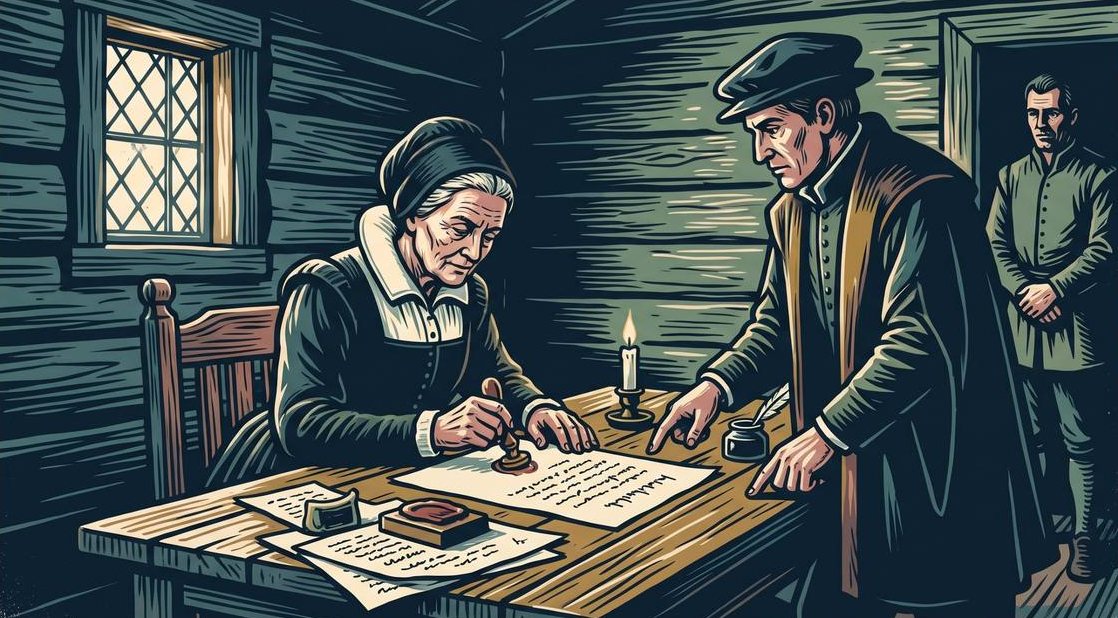
Copenhagen, 1 March 1582. Gjørvel Fadersdatter, the owner of the Giske estate, sets her seal to a skjøte, a deed transferring property, which gives King Frederick II and the crown all her inherited estate north of the mountains in Norway and all the estate in Shetland, the islands north of Scotland, «strax aldeles» (at once and entirely).
Copenhagen was the king's town, with the castle on Slotsholmen and the chancery where the letters for the whole realm were written and entered in the registers. It was there the deed was written, and today it stands in Norske Rigs-Registranter. Chancellor Niels Kaas, the treasurer Christoffer Valkendorf and Hans Speigel sealed it together with her. The name Valkendorf was known from Giske's history. Erik Valkendorf had been archbishop in Nidaros and exchanged land with Karl Knutsson of Giske in 1516. How the two were related is uncertain. Gjørvel was the widow of the Danish nobleman Lage Brahe, her third husband, who died in 1567. The sources disagree about the year of her birth, so in 1582 she was between 65 and 72 years old. She was the granddaughter of Knut Alvsson through her mother and the last of the family to own the Giske estate as a whole.
The matter had begun nine years earlier. The king was Frederick II, son of Christian III, who after the Reformation of 1536 and 1537 had placed Norway under the Danish crown and taken the bishops' estates. The Norwegian Council of the Realm, which at Bud in Romsdal in 1533 had declared who was Giske's rightful heir, no longer existed. Gjørvel held crown land in Denmark in pledge and had promised King Frederick II inherited land in Norway in return for keeping the pledge for life. On 17 August 1573 the king wrote complaining that almost a year had passed without her sending any register of the estate. He wanted a clear register.
The deed lists the estate farm by farm with land rent, under the headings Romsdal, Sunnmøre, Voss, Hardanger, Ryfylke and Senja. Giske, written «Giedtzskøe», is entered with 10 våger of fish. Skjåvanger is entered with 5 våger of fish and 5 meler of grain, and then Valderøy, Gjøsund and Giskemo. Under Senja, the large island in Troms, are Hundstad, Stene, Ørjen, Østerholmen, Holmen, Kjerlingvik and Flatnes, and finally the landvare, the fee boats paid for fishing from a fishing village, from the fishing villages on outer Senja: «af Grønefjord, Møiefjord, Øfjord, Thredigen udi Thorsken» (from Grønefjord, Møiefjord, Øfjord, the third part in Torsken), 21 våger of fish. The Senja part brought in about 35 våger a year in all. Bjarkøy is not mentioned. The king probably received only this part of the old northern Norwegian estate, which had been divided in three after the division of the inheritance in 1490.
In return Gjørvel received for life Børringe Abbey with its lands, the hundred of Froste and three farms belonging to the chapter in Lund, two in Verpinge and one in Önnerup, all in Scania. Four days later, on 5 March, the king wrote that he had received the deed. She was to search out all title deeds and documents of ownership for the estate and send them to the king, since she no longer had any use for them. The same day she was given permission to shoot ten to twelve roe deer and four to five head of large game a year for her own table.
Giske lay where it had always lain, by Giskesundet, with the marble church on the south coast and the tenant farms around it. The deed shows that Jens Skriver, the bailiff who had kept the accounts in the 1560s, occupied properties on Sandøy in Romsdal without paying any fee. The editor of the account interprets this as a sign that he served Gjørvel for a long time. In 1583 Hans Lindenov, the lensmann at Bergenhus, the fortress in Bergen, received a letter of enfeoffment, the king's letter granting him the estate to govern as a fief (len), for «Giskø Gods» (the Giske estate). The estate was governed from Bergen and Copenhagen, and the land rent in fish went from then on to the crown. After the king took over, he received both the rent as owner and the tax as king.
The Shetland estate came with it. A separate land register from 1582 shows 71 farms with land rent in butter and vadmel (homespun woollen cloth), a total of 136 lispund 12½ marks of butter and 1121½ ells of vadmel. In 1583 the king wrote that the Scot Robert Cheyne had held land in Shetland in trust for fru Gjørvel, and that the king of Scotland had interceded for him. At Kronborg near Helsingør on 17 October 1584, Cheyne received a letter of enfeoffment for the land on Vaila, an island in the west of Shetland, «Valløy» in the letter, against 66 good dalers a year, delivered at Bergenhus castle by Olsok at his own cost and risk. It was the same sum as in 1563. From Lerwick to Bergen it is roughly 195 nautical miles, 28 to 39 hours across the North Sea with a good wind, and Olsok, 29 July, lay in the middle of the summer half of the year, the time the King's Mirror (Kongsspeilet), a Norwegian textbook from the 1200s, recommends for sailing the open sea.
When the Giske estate passed to the crown is a well-known point of dispute. Store norske leksikon gives 1574, in exchange for land in Scania, and this may refer to the pledge matter that began in 1573. The deed for Giske and the estate north of the mountains is dated 1 March 1582. The Gudbrandsdal estate followed in 1586, and the exchanges for the rest of the Norwegian estate dragged on until 1599 or 1608. In 1601 Christian IV became her universal heir. According to the encyclopaedia the estate was held as a separate Giske fief with its own land register until 1652, and it calls this the only known Norwegian case of a private estate being a separate fief for so long. The priest Hans Strøm, who wrote in 1766 on the basis of the accounts of the estate steward (ombudsmann) Anders Iversen, the manager on Giske, gives the estate 196 farms in 1620, 126 in Sunnmøre, 57 in Romsdal and 13 in Nordland. Lokalhistoriewiki has the same figures but dates them to around 1600. The counts measure different things from year to year and cannot be compared directly with the 154 properties of 1563. In the bailiff's accounts for Senja for 1611 to 1612, the landvare from the fishing villages, among them «Inder Gryll», is entered as the crown's «uvisse» (uncertain) income, because it varied with the fishing.
How the estate fared under the crown is shown by a report from the steward in October 1647. The fief was «frii forlehnit» (granted free) to the treasurer, the king's finance officer, and the king received no «affgifft eller Rettighed» (dues or rights) from it. Of the 14 sawmills under Giske in Romsdal, only five had «noget Lidet skouff» (some little forest) left, and they were stream saws that could run «3 eller 4 Uger i det höyeste» (3 or 4 weeks at the most) in autumn and spring. At the others the forest was «nu mesten gandske udhugget» (now almost entirely cut down), and the farmers used the boards mostly «till deris gaards forbedring» (for the improvement of their farms). In 1563 the sawmill at Solnør in Skodje, by the Storfjord east of Ålesund, had cut boards for sale to Trondheim and Copenhagen. The salmon trap at Festøya, by the Hjørundfjord south of Ålesund, now yielded «en tönde Lax 2 eller 3» (a barrel of salmon, 2 or 3) for the household. The tithe of the whole fief was about 80 barrels of grain, 35 våger of fish and 8 våger of cheese, and the steward added that it varied «det ene Aar noget mehr, et andet minder, effter som Wor herre giffuer sin welsignelse» (one year somewhat more, another less, as Our Lord gives his blessing). He called the furnishings of the main farm «ringe» (poor). The report has been read from scanned images, and several readings are uncertain.
The land rent had hardly changed. A farm by farm count in the land register of 1642 gives roughly 460 våger of fish, against 432 in 1563, and the largest fishing farms were Haram with 22½ våger, Ulnes with 18 and Fjørtoft and Myklebust with 14½. The land register also has a separate list of leidang «af Giedske Bönder paa Sundmör» (from the Giske farmers in Sunnmøre), the old naval defence duty, which was now a fixed levy. The sources disagree whether it was paid in goatskins and calfskins or in fish and meal or butter, and the list has not been transcribed. It is likely that the same contribution which under the Gulathing Law was to keep 16 ships from Sunnmøre at sea had become an item in the estate's accounts. The land register also lists 14 strandsittere, people with houses on leased ground by the shore without farmland, among them «Encken Ladberg oc hendes Søn» (the widow Ladberg and her son), and each paid a pund or a våg of fish a year. While the estate was a fief, the longline came into the fishery in Møre and caused conflict in the Borgundfjord by Ålesund with those who used the old handline. Store norske leksikon dates this to the 1600s, Vollan to the beginning of the 1660s.
The fief accounts show seven Danish feudal lords from 1583 to 1648, among them the treasurer Sivert Beck from 1599 to 1623. On 19 December 1648 the estate was conveyed by deed to the viceroy (stattholder) Hannibal Sehested, and after his fall the Sunnmøre properties were sold to the financier Gabriel Marselis in 1657. Hans Strøm writes that 113 farms in Sunnmøre went with the main farm. The sources disagree about the order of owners after 1657.
Gjørvel lived at Børringe for the rest of her life. In 1585 the king exempted the Børringe farmers from a new tax, because she had received the abbey «for hendes fri Arvegods, som hun har tilskødet Kronen» (for her free inherited estate, which she has deeded to the Crown). In 1588 she was among the noblewomen summoned to Kronborg after the death of Frederick II, and in 1590 she and Peder Brahe were given permission to have dalers of fine silver minted under the king's name and image. She died on 20 April 1605, between 88 and 95 years old, and lies in Lund Cathedral together with Lage Brahe. Her gravestone and portrait are in the north aisle.
The same year as the deed, Pope Gregory XIII introduced the Gregorian calendar, and in October 1582 the Catholic countries skipped ten days. Denmark and Norway kept the old calendar until the year 1700. The Arnlings had sat on Giske from around 980, and the estate the family had gathered around the manor over some six hundred years was now crown land. In the local history «Borgund og Giske», volume I, there are 22 generations from Finnvid funnen (Finnvid the Foundling), the progenitor in the family's genealogy, to Gjørvel. From the deed to today it is roughly 15 generations. Much suggests that the oldest Giske letters went to the chancery in Copenhagen after the order of 5 March 1582, and that many of them are therefore known from Danish archives and copies.
People: Gjørvel Fadersdatter (Sparre)
Sources
Norske Rigs-Registranter bd. 2 (1861), s. 452 til 457 og 582 til 583; Kancelliets Brevbøger 1580 til 1592; Sandberg (utg.), Gørvel Fadersdatters regnskap 1563 (1986); Digitalarkivet 77105 (Senja 1611 til 1612); SNL og Lokalhistoriewiki (Giskegodset); prosjektnotatene «Danske kilder om Gjørvel», «Giskegodset i nord etter 1582», «Arkivsøk», «Giskefolket i arkiver og kilder» og «Slektsoversikt»; Digitalarkivet 76953 (jordebok 1642, rapport 1647); Hans Strøm, Søndmørs beskrivelse (1766); SNL (line); Vollan 1942; NIKU Oppdragsrapport 168/2013; prosjektnotatene «Giskegodset og produksjonen», «Fiske og fiskeredskap» og «Båtbygging, seil og leidang»; bygdeboka Borgund og Giske, bind I; prosjektsidene «Makten i riket» og «Slektsbånd».