Timeline · The estate is broken up
Hannibal Sehested receives the Giske estate
1648
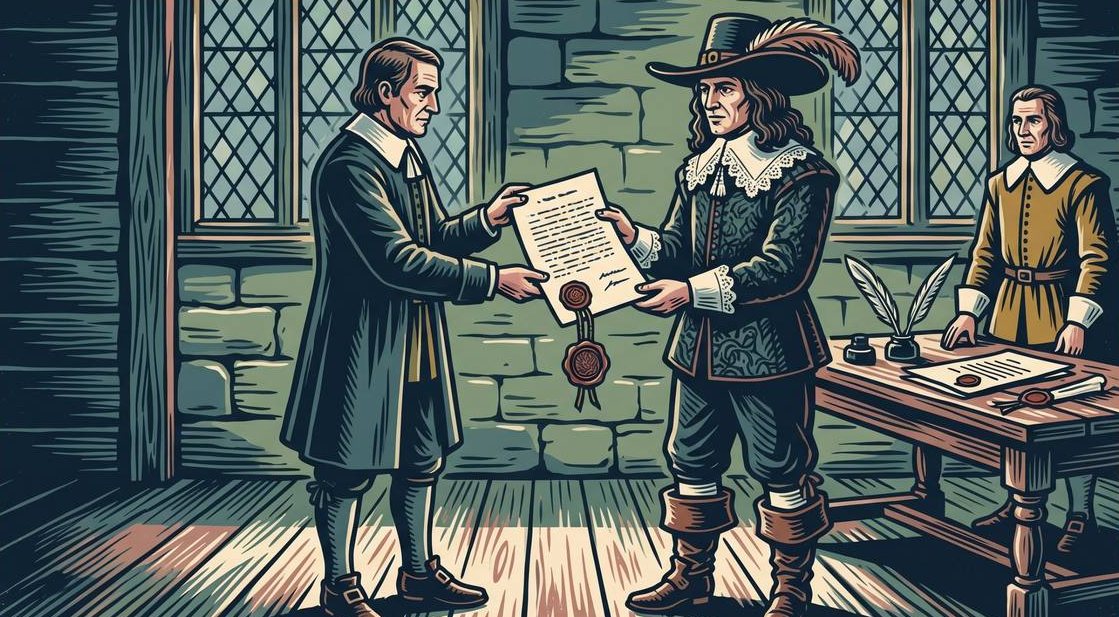
On 19 December 1648 King Frederick III conveys the Giske estate in Sunnmøre by deed to Hannibal Sehested, the viceroy (stattholder), the king's highest official in Norway. For the first time since Gjørvel Fadersdatter deeded it to the crown in 1582, the estate has an owner who is not the king.
For 66 years the king had held the estate as a separate Giske fief (len), an administrative area whose income went to a feudal lord. The feudal lords sat in Bergen and Copenhagen, among them Hans Lindenov at Bergenhus from 1583 and the treasurer Sivert Beck from 1599 to 1623, while an estate steward (ombudsmann), the manager of the estate, ran it from Giske. According to the priest Hans Strøm's description of Sunnmøre from 1766, the accounts of the steward Anders Iversen from 1620 show 196 farms: 126 in Sunnmøre, 57 in Romsdal and 13 in Nordland. In October 1647 the steward wrote that the king received no «affgifft eller Rettighed» (dues or rights) from the fief, because it was «frii forlehnit» (granted free) to the treasurer, the king's finance officer.
Hannibal Sehested was born in 1609, a Danish nobleman married to Christiane, daughter of Christian IV. From 1642 he was viceroy and governed Norway from Akershus by Christiania, today's Oslo. Store norske leksikon writes that from 1645 he secured large parts of the crown land in pledge and ownership at a low valuation and became by far the largest landowner in the country. He himself put the value of his properties in Norway at 226,000 rixdollars.
The crown needed money. Christian IV had waged war against Sweden from 1643 to 1645, and on the Norwegian side the war is called Hannibalsfeiden (Hannibal's Feud) after the viceroy. Debts were paid with land. Around 1660 barely a third of all land in Norway was crown land, and Frederick III and Christian V sold or pledged large parts of it to cover debts from war and palace building in Denmark.
Sehested did not hold Giske for long. On 24 June 1651 he was brought down and had to give up all his properties and offices. The estate went back to the crown, and according to the historian Peder Fylling (1859 and 1883) it was leased out to Henning Hanssen Smit, bailiff in Romsdal. The sources disagree about the date of the deed: Lokalhistoriewiki gives 19 December 1648, while an article in Søndmøre Folketidende in 1897 gives 19 September.
The same autumn the Peace of Westphalia was concluded, and the Thirty Years' War in Germany was over. Since Gjørvel Fadersdatter, the last of the family to own the Giske estate, deeded it to the king in Copenhagen, about two generations had passed.
Sources
Lokalhistoriewiki, Giskegodset; SNL, Hannibal Sehested; SNL, krongods; Hans Strøm, Søndmørs beskrivelse (1766), s. 108; Digitalarkivet 76953 (rapport om Giske len 1647); Peder Fylling, Historisk-antikvariske Bemærkninger (1859) og Giskeætten paa Søndmør (1883); Søndmøre Folketidende 10.5.1897; rapporten «Giskegodset etter 1582».