Timeline · The last century
The meeting of lords at Bud
1533
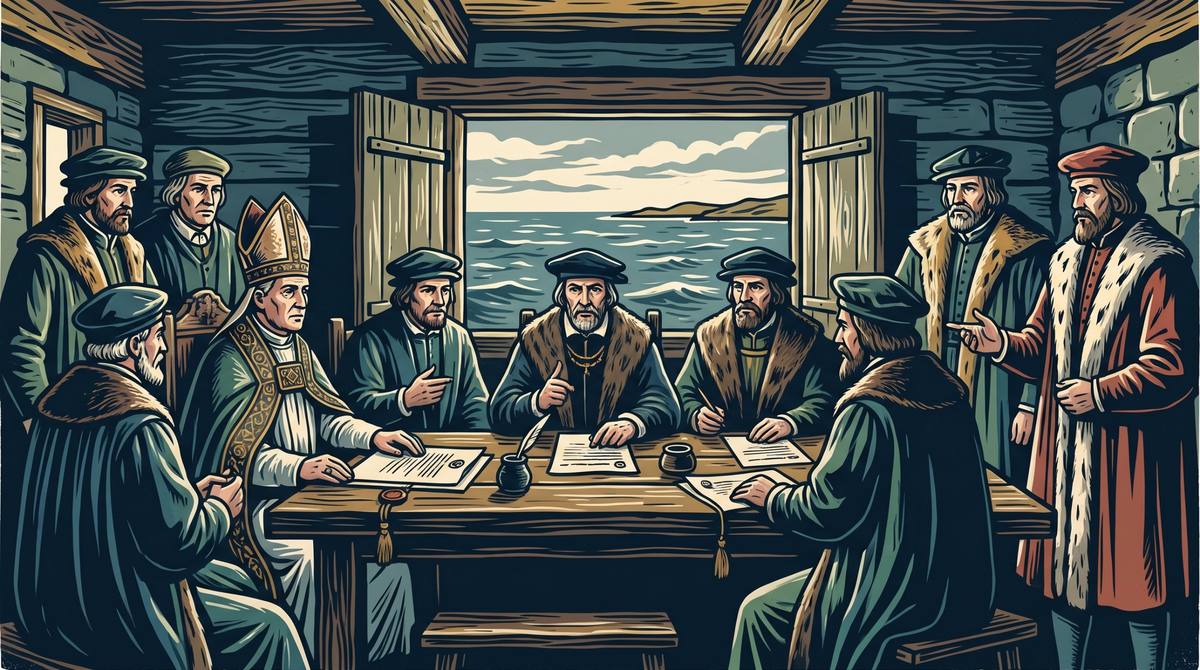
Early in September 1533 the Norwegian Council of the Realm is gathered at Bud in Romsdal, on the outer coast facing Hustadvika, the open stretch of sea between Molde and Kristiansund. King Frederick I of Denmark and Norway is dead, and the council governs the country. One of the letters they write goes to Gustav Vasa in Sweden and concerns Giske.
Bud was a small trading place with a harbour among islets and skerries, where the coast opens towards Hustadvika. Together with Stad, the weather-beaten headland south of Sunnmøre, this stretch is reckoned the most dangerous on the sailing route between Bergen and Trøndelag. The ships probably lay in the outer harbours here waiting for weather before they crossed. Archbishop Olav Engelbrektsson had called the herremøte, a meeting of the Council of the Realm, after Frederick I died at Gottorp in Schleswig in April. As a young dean he had led the work on the printed missals for his predecessor, Archbishop Erik Valkendorf, and according to Mona Ringvej the sources point to his being the son of Engelbrekt, the man who killed the bailiff Lasse Skjold in 1497. Skjold was bailiff for Knut Alvsson, the councillor of the realm who owned Giske and was killed in 1502. This is not certain. From the Battle of Stiklestad in 1030, where Olaf the Holy fell, to Bud, 503 years had passed, and the archbishop at Olaf's grave was still the foremost man in the Council of the Realm. From Bud to Giske it is roughly 35 nautical miles south-west along the sailing route, a day's sailing with a good wind.
The council had received two letters from Gustav Vasa, brought by the courtier Peder Pedersson. Swedish noblemen claimed an inheritance after Alv Knutsson, Giske's owner in the 1400s and father of Knut Alvsson, and his brother Jens Knutsson. Among them were Johan and Lasse Tursson, sons of the Swedish councillor of the realm Ture Jönsson, and Peder Nilsson, who was married to Gjørvel Fadersdatter, Knut Alvsson's granddaughter. The council replied on 3 September. The envoy had no authority and no proof, «ikke annet med seg enn» (nothing with him but) the king's letter of recommendation, and the opposing parties, fru Inger Ottesdatter, who occupied Giske, and her son-in-law Vincens Lunge, had not been lawfully summoned. Even so, the council declared that the maiden Karine Alvsdatter, Alv Knutsson's daughter and Knut Alvsson's sister, was «nærmeste og sanneste arving til Giske og Giskegodset» (the nearest and truest heir to Giske and the Giske estate). Next after her stood fru Gjørvel, Peder Nilsson's wife, «og ingen annen» (and no other).
Two days later fru Inger wrote at Bud that she had handed over Giske and the Giske estate in Romsdal and Sunnmøre to the maiden Karine. She thanked the landbor, the tenant farmers, under Giske for «all den lydighet og hørighet» (all the obedience and service) they had shown her, and asked them from now on to obey Sir Simon, who was to manage the estate for Karine. The council's letter says that this happened after mediation, and that Inger held back a small part of the estate until the next herredag, the next meeting of the Council of the Realm.
Inger Ottesdatter was one of the most powerful women in Norway. Her seat, Austrått on Ørlandet, lies at the entrance to the Trondheimsfjord, a place which, like Giske, overlooked the ships coming in. She was the widow of the councillor of the realm Nils Henriksson, and two of her daughters were married to the Danish noblemen Vincens Lunge and Nils Lykke. Henrik Ibsen later made her «Fru Inger til Østeraad» (Lady Inger of Østråt). The historian Randi Bjørshol Wærdahl shows that her ship in 1527 seized Scottish, German and Dutch merchant ships, and that in the 1530s the archbishop held her and her daughter captive. The sources are uncertain whether she took possession of Giske in 1521 or 1522, and in 1523 she was accused of occupying it unlawfully.
In the years before Bud, Giske had been a military base. In the winter of 1531 to 1532 the deposed Christian II tried to win Norway back, and the archbishop went over to him. Vincens Lunge, fru Inger's son-in-law and commander at Bergenhus, stayed loyal to Frederick I. On 21 February 1532 Lunge wrote from Østerpollen in Hardanger that the ice blocked the way, and that he had laid a boom across a strong current with a jakt full of courtiers behind it. His men from the north had tried «to eller tre ganger» (two or three times) to get round Stad, and the weather had held them back. Their scouts had learnt that 60 of the archbishop's men lay on Giske waiting for him. Lunge sent a new jakt with 16 men and ordered them to attack. The jakt, or jekt, was the working ship of the coast, open and clinker-built in the western Norwegian tradition, with a transom stern, a covered room aft for sleeping and cooking, and a square sail divided into bonnets that could be unlaced when the wind rose. How large the jekts were before 1621 is unknown. In that year jekts came to Bergen with 4 to 18 lester of cargo, roughly 7.5 to 32 tonnes. As early as 1381 an ordinance had limited «uformuende bønder» (farmers without means) to vessels of four lester, a rule that applied until 1814. February lay far outside the summer half of the year, which the King's Mirror (Kongsspeilet) counts as the time for seafaring, and the letter shows what that meant: Stad could close the route for weeks.
The war ended in 1532 with Christian II taken prisoner, and Ture Jönsson, who had been on his side, was killed. Frederick I then gave Giske to Nils Lykke, believing that the estate was Ture's and forfeit to the crown. The king soon heard that this was not right, and wrote in September that the gift only applied if the estate really had been Ture's. In February 1533 Nils Lykke wrote from Tautra, the monastery island in the Trondheimsfjord, that in his view the crown had no right there. He named three who claimed the estate: his mother-in-law fru Inger, the maiden Karine and a maiden Gjørvel in Sweden. A letter which is probably from 1531 shows that the estate was valued at 3000 Bergen guilders, excluding the main farm, and that fru Inger was planning to buy it.
The money in this dispute came from the fish, and the fish went through Bergen. In the summer of 1533 the aldermen and the eighteen master men of the German Kontor, the office of the Hanseatic merchants at Bryggen in Bergen, wrote to the archbishop about a priest in Trøndelag who owed a Hanseatic merchant money according to an account from 1530. The letter shows how the merchants gave credit against payment in stockfish and kept books of who owed what. The tenant farmers, the farmers who rented land from the estate and had to pay, fished the spawning cod (skrei) in the Borgundfjord by Ålesund from Candlemas on 2 February to Lady Day at the end of March, with handlines from open boats, and farmed the rest of the year. The archaeologist Helge Sørheim believes that the Borgundfjord fishery was as important as the Lofoten fishery became in the 1500s and 1600s, because the fish were dried closer to Bergen. That is his scholarly assessment. A good year for the owner of Giske was a year in which the tenants delivered the land rent and the fish fetched a good price in Bergen.
The handover took time. Only in August 1535 did Vincens Lunge mediate at Hamar between his mother-in-law and Karine. Karine waived all the income Inger had taken from Giske up to Bud, and Lunge promised to see that the rest of the estate was handed over without a lawsuit. A few months later both sons-in-law were dead. Nils Lykke was executed at Steinvikholm, the archbishop's castle in the Trondheimsfjord, in December 1535, and Vincens Lunge was killed in Trondheim in January 1536. Denmark was at the same time in civil war, the Count's Feud, and Gjørvel was held prisoner for 14 months. She was then married to the Danish nobleman Truid Ulfstand, after Peder Nilsson drowned in Lake Mälaren near Stockholm in 1533.
Karine Alvsdatter died in the winter of 1536 to 1537. Store norske leksikon gives 1536, while other sources give early 1537. On 30 January 1537 Truid Ulfstand wrote that she was dead and that his wife was the nearest heir. He wanted the land rent delivered in Bergen, where a reliable merchant could turn it into gold and silver. On 26 March the priest Nils Torkjellsson, estate steward (ombudsmann), the estate owner's manager, on Giske, wrote that the farm had been plundered twice that same winter. Only a few old vessels and 16 or 18 cows were left, «godt og vel 23 stykker fe» (a good 23 head of cattle) had been slaughtered, the houses had been broken into and the doors smashed, and he himself had been beaten and robbed of everything he owned. The loss probably hit the people who remained hard, for the account from 1563 shows that the main farm ate more grain than it grew and depended on deliveries from the tenants. The letter does not say who did the plundering. It may have been connected with the conflict between the archbishop and the king's men. In June Truid asked for compensation for what the king's soldiers had taken from Giske when they first came north. The same year, according to Store norske leksikon, Truid led a fleet of 14 ships and around 1500 men to Trondheim, and the archbishop fled the country. The Gulathing Law, the old regional law for western Norway, had once reckoned on 80 to 100 men in a leidang ship with 20 or 25 rowing benches, built and equipped by the farmers. The fleet of 1537 belonged to the king and the nobility. The leidang (naval levy), the farmers' duty to provide ships and crews for the king's fleet, had long since become a tax: from around 1200 the king received part of the leidang provisions every year whether or not the fleet sailed, and from the late 1200s the tax was reckoned according to the farm's land rent.
Three years after Bud, Norway was placed under the Danish crown, and the Council of the Realm was abolished. The herremøte at Bud was one of the last. Archbishop Olav Engelbrektsson had led the Council of the Realm since his election in 1523. Christian III's coronation charter of 30 October 1536 stated that Norway would from then on belong under the Danish crown. The archbishop fled from Nidaros on 1 April 1537 and died in the Netherlands the following year. The archbishopric's estates went to the crown. This was the Reformation, when the king introduced the Lutheran church order. In 1536 and 1537 the books in Nidaros were burnt and more than 30 altars in the cathedral taken down. Mona Ringvej believes religion was the weapon and power the goal: if Norway was to be placed under Denmark, Olaf, the eternal king of the realm, also had to be removed. On 1 April 1538 Nils Torkilsson stood up at the county thing in Borgund, by today's Ålesund, and asked whether anyone had heard that the Giske estate had been claimed or sued for. Twelve lagrettemenn, sworn farmers of the thing court, among them Gunnar in Fjørtoft and Knut at Gamlem, answered that Alv Knutsson, Knut Alvsson, Karl Knutsson and the maiden Karine had owned the estate «fritt og ubeklaget» (freely and without challenge). No one mentioned that Knut had been declared an outlaw in 1502. From 1538 Gjørvel was the undisputed owner. The following year, in 1539, it was decided that the land rent could only be raised by decision of a lagrette of farmers, and it therefore rose little in the decades that followed. A letter of testimony from 1539 tells that fru Inger had unlocked the chest containing Alv Knutsson's letters in the Dominican friary in Bergen and taken the letters she wanted. Inger drowned in the Rovdefjord in Sunnmøre in 1555, on her way to Bergen.
The same year as Bud, Henry VIII of England married Anne Boleyn and broke with the pope. In the years that followed the crown took over church property both in England and in Norway.
People: Ingerd Ottesdatter (fru Inger), Karine Alvsdatter, Gjørvel Fadersdatter (Sparre)
Sources
DN 23/347; DN 2/1111; DN 9/691; DN 16/554; DN 9/710; DN 22/230; DN 16/540; DN 15/495; DN 2/1114; DN 22/354; DN 22/368; DN 22/394; DN 2/1125; DN 1/1092; SNL (Ingerd Ottesdatter, Vincens Lunge, Nils Lykke, Truid Ulfstand, Tre Rosor); prosjektnotatene «Giskebrevene 7», «Giskefolket i arkiver og kilder», «Slektsoversikt» og «Havner, seilaser og mat»; SNL (jekt, leidang, landskyld); Sørheim (Equinox); prosjektnotatene «Båtbygging, seil og leidang», «Fiske og fiskeredskap», «Jordbruk i Norge 800 til 1650» og «Giskegodset og produksjonen»; Ringvej, Et kongerike foran undergangen; Wærdahl 2019, Collegium Medievale 32; prosjektsiden «Makten i riket».