Timeline · The last century
Karl and Erik die
1520
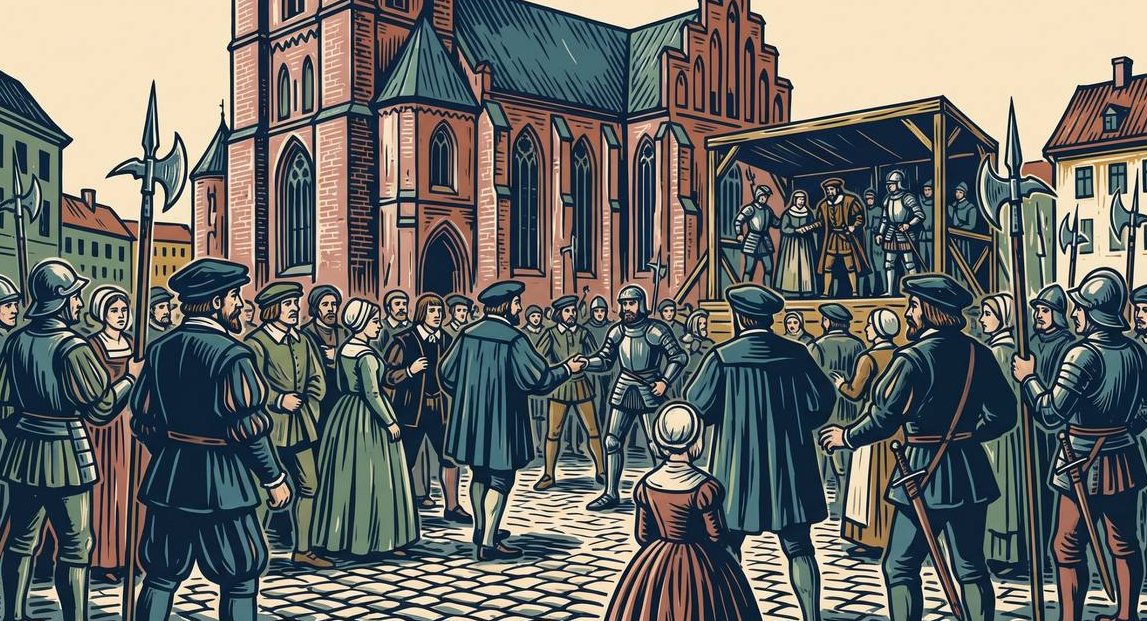
The square in Stockholm, 8 November 1520. Four days after his coronation, Christian II, king of Denmark and Norway, has his opponents led out to be beheaded. Among them is Erik Knutsson, son of the councillor of the realm Knut Alvsson and brother of Karl Knutsson, the lord of Giske.
Stockholm lay on the islets where Lake Mälaren meets the Saltsjön, with the castle of Tre Kronor on the north side of the town island and the square close to the Storkyrkan church. It was Sweden's largest town, and it controlled the sea approach to the Mälaren valley. Christian II had conquered Sweden in the war against the regent Sten Sture the Younger, who had fallen earlier the same year, and on 4 November he was crowned in the Storkyrkan by Archbishop Gustav Trolle. Sten Sture was the son of Svante Nilsson, who in 1504 had married Knut Alvsson's widow Mette Dyre. Whether Mette was the mother of Erik and Karl is uncertain. After the coronation feasts, the opponents from the Sture party were arrested and condemned as heretics. More than eighty people were executed in what was later called the Stockholm Bloodbath. The number is given differently in the sources. Erik Knutsson was one of them.
The same year his brother Karl Knutsson was killed. Karl died without children. How he died is poorly described in the sources. With the two brothers the male line of Knut Alvsson died out, eighteen years after their father was killed under safe conduct, that is with a promise of safe passage, near Oslo in 1502.
The brothers had grown up in the shadow of the verdict against their father, who had been declared an outlaw in 1502. The estate had been confiscated, and the family had to find its way back into the king's favour. On 29 July 1515 Karl made a settlement with the councillor of the realm Henrik Krummedike, and under Christian II, who had become king of Denmark and Norway in 1513, he got the family estate back. In Sweden Christian became king only in 1520, and he held the country only until 1521. It was almost ten years since Giske had come under the crown. In August 1515 Karl was in Copenhagen and set his seal as a witness to a receipt between Danish and Swedish noblemen concerning thirty marks for a horse. The letter shows that he moved in the circles around the court.
In 1516 he travelled around gathering evidence. In February old men in Aurskog in Romerike testified that Mangefisket had belonged to Sudreim, the family's manor in Sørum in Romerike, since the time of Sir Sigurd Jonsson, the regent who owned Giske and Sudreim in the 1400s, until it was taken from the farm when the war began. In May twelve sworn lagrettemenn, farmers who judged and gave witness at the thing (assembly), from farms around Ålesund such as Nørve, Vatne, Godøy, Haram and Blindheim, met at Malnes and testified that Rud, Malnes and Rosvika had belonged to Giske for as long as they had heard. No one had laid claim to them before Knut Alvsson was killed. When written letters were missing, such testimony from the oldest people in the district was the proof the law accepted.
On 29 June 1516 Karl exchanged land with Archbishop Erik Valkendorf in Nidaros, today's Trondheim. Valkendorf was a nobleman from Funen, of a family that had immigrated from Germany, and had been the king's chancellor in Copenhagen from 1494 and chancellor to Christian while he ruled Norway as viceroy from 1506. In March 1507 he had held the pen when Duke Christian got selected men in Oslo to accept him as «fullmektig herre over Norges rike» (lord with full powers over the realm of Norway), according to Mona Ringvej's book on Erik Valkendorf. In 1510 he became archbishop. King Hans, Christian's father, had him elected against the will of the cathedral chapter, and Ringvej interprets the election as an attempt to break the power of the archbishopric from within. The exchange with Karl, the son of the king's enemy, came five years after Valkendorf arrived in Nidaros. Five years after the exchange with Karl, he himself was driven out of the country after a conflict with the king over the rights of the Church, and he died in Rome in 1522. Karl received Rørvika on Vigra and half of Gjuv on Godøya, two of Giske's neighbouring islands, and the archbishop received farms in Trøndelag. The exchange shows how Karl gathered the estate around Giske. Giske covers 2.67 square kilometres, with bog in the middle and fields, pasture and sandy beaches towards the sea. Godøya with Storhornet lies close by to the west, and Vigra and Valderøya lie to the north and east. The main sailing route ran through Giskesundet between Giske and Godøya, where Den norske los (the Norwegian pilot guide) warns of sudden downdraughts from the mountain in strong westerly or southerly winds. No source describes forest on the island, but it was probably treeless. The marble church stood on the south coast, where the chieftain's seat had been for several hundred years. By the church thick cultivation layers dated from 1200 to 1410 have been found, so grain was grown in the sand by the seat throughout the Middle Ages. The outlying land on the outer coast was heather moor, burnt regularly, grazed by sheep all year round and mown for winter fodder. No source describes farming on Giske in particular, but it is likely that the island was farmed in this way.
What made the estate worth fighting for was the fish. Valkendorf had himself sailed to Vardøhus in Finnmark, probably in the summer of 1512, as the first archbishop there in several hundred years, and in a short description in Latin he called stockfish so valuable that it was carried out to almost all Christian peoples. The spawning cod (skrei) spawn off Møre in winter, and the land rent, the yearly rent the tenant farmers paid the landowner, from the farms in Sunnmøre and Romsdal was paid in stockfish. Far to the north, on the outer side of Senja in Troms, five farms and a third of the landvare in Gryllefjord, Torsken and Øyfjord belonged to Alv Knutsson's share after the skifte, the division of the inheritance, in 1490. Alv Knutsson was Knut Alvsson's father. The landvare was the fee each boat paid the landowner for rowing out to fish from a fishing village. The sources show that in 1520 it cost ten «sperrer» of fish per boat to row from Torsken and Gryllefjord. The fish were caught with handlines, juksa, from open boats. The åttring, with four rowing spaces and four or five men, was a handline boat in the 1400s, and the larger fembøring first appears in the middle of the 1500s, according to Store norske leksikon. The longline came to the Norwegian coast later. The cod were hung whole as round fish or split as rotskjær on wooden drying racks (hjeller), and there they hung for about three months until they had lost about 70 per cent of their water. The racks required timber. Iceland lacked timber for racks of the Norwegian type, and in 1494 the German Kontor, the office of the Hanseatic merchants at Bryggen in Bergen, demanded that drying on rock in Iceland and Finnmark should stop. From the fishing village the fish were carried by jekt (coastal cargo vessel) south to Bergen, where the German merchants at Bryggen exchanged them for grain, flour and cloth. The merchants gave the northern traders goods and equipment on credit against next year's fish, the nordfarergjeld (northern traders' debt). The fisherman was thus bound to the merchant through the debt and to the landlord through land rent and landvare, which had to be paid whatever the catch. A bad year probably hit the fisherman first.
The last letters from Karl are letters from a soldier. In January 1519 he wrote from Halmstad, a town in Halland on today's Swedish west coast which was then Danish, to Henrik Krummedike that the king had ordered him to gather the soldiers with Krummedike for two nights, and asked for food and ale, twelve or sixteen trestles to fire hackbuts from and four or six strong horses to carry guns and powder. In May 1519 he wrote from Älvsborg, the castle at the mouth of the Göta älv where Gothenburg lies today, where workers were cutting turf for the ramparts, and asked Krummedike to seize two deserters who had taken their lord's money with them. Krummedike was the man who had been behind the killing of his father. Four years after the settlement and seventeen years after the killing, Karl asked him for ale for the king's soldiers.
After 1520 the estate went back to the crown, and the heirs came forward from three countries. Fru Inger Ottesdatter of Austrått on Ørlandet, at the entrance to the Trondheimsfjord, probably took possession of Giske in 1521 or 1522, with a claim through her father Otte Matsson, who had been one of the heirs in the division of 1490. The sources disagree about the year, and in 1523 she was accused of occupying it unlawfully. The same year Christian II was deposed and went into exile in the Netherlands, and Frederick I became king. From Sweden the Swedish councillor of the realm Ture Jönsson of Tre Rosor claimed the estate as Knut Alvsson's kinsman. After the negotiations between Denmark and Sweden in Malmö in 1524, he sent messengers to collect the land rent from Shetland and Orkney. Bergen to Lerwick in Shetland is roughly 195 nautical miles, 28 to 39 hours across the sea with a good wind. In Bergen Vincens Lunge, fru Inger's son-in-law and commander (høvedsmann), the king's officer in charge, at the fortress of Bergenhus, seized the land rent and held Giske by force, Ture writes in 1525. The following year Lunge replied that he would not hand over Giske before Sweden gave Viken, the region around the Oslofjord and southwards to the Göta älv, back to Norway, as the agreement from Malmö, the Recess of Malmö, promised. Instead he suggested that fru Inger could buy the estate.
On Giske everyday life went on under the bailiffs. A letter of testimony from 1523 tells of a simple-minded man who in Sigurd Jonsson's time had fled to Giske and given his share in a fishing hole in Sunnylven, at the inner end of the Storfjord, in exchange for board for the rest of his life. He was given cloth for a set of clothes and died seven weeks later. In January 1529 Provost Niels Mogensen in Herøy, south-west of Ålesund, complained to Olav Engelbrektsson, archbishop in Nidaros from 1523, that fru Inger's servants on Giske sang Lutheran songs at table and mocked priests. One of them, Olav the scribe, had thrown his war hammer in the face of the priest Mattis in Ørskog by the Storfjord. Rasmus the scribe, the bailiff, had sent the provost away from the thing and taken people to Giske to extort money from them. The letter shows that the conflict over the new faith had reached Sunnmøre eight years before the Reformation, when the king introduced the Lutheran church order in Denmark and Norway in 1536 and 1537.
In October 1529 the archbishop was given authority to protect Giske for the maiden Karine Alvsdatter, Knut Alvsson's sister, and in March 1530 she herself gave him full power over her paternal estate. She lived at Grefsheim in Hedmarken, by Lake Mjøsa, and kept Voss and the Voss estate inherited from her mother. Two months later the Danish nobleman Nils Lykke, fru Inger's son-in-law, reported from Fosen, the peninsula north of the Trondheimsfjord, that ten ships from Bergen had come into Kråkvåg on the Fosen coast during the night, and that fru Inger had come to Giske the Friday before on her way north. Giske was an inherited estate with claims from Trøndelag, Sweden and Denmark, and the farm lay low by Giskesundet, where all the ships on the sailing route passed.
While the heirs wrote letters, Martin Luther burnt the pope's bull of excommunication in Wittenberg in Germany in December 1520. The church conflict that began there would within a few years decide who held power over both Giske and the rest of Norway.
People: Karl Knutsson
Sources
DN 9/484; DN 4/1071; DN 2/1054; DN 1/1049; DN 9/496; DN 9/497; DN 15/196; DN 18/341; DN 9/568; DN 5/1056; DN 9/645; DN 2/1098; DN 8/631; prosjektnotatene «Giskegodset 1563», «Giskebrevene 7», «Fiskeværene og Giskegodset», «Slektsoversikt» og «Giske: landskap, beliggenhet og jordbruk»; NIKU Oppdragsrapport 168/2013; SNL (åttring, norsk fiskerihistorie); Helle 2019, AmS-Skrifter 27; prosjektnotatene «Fiske og fiskeredskap» og «Jordbruk i Norge 800 til 1650»; Ringvej, Et kongerike foran undergangen; Benedictow 1969, Historisk tidsskrift 48; prosjektsiden «Makten i riket».