Timeline · The last century
The death of Knut Alvsson
1502
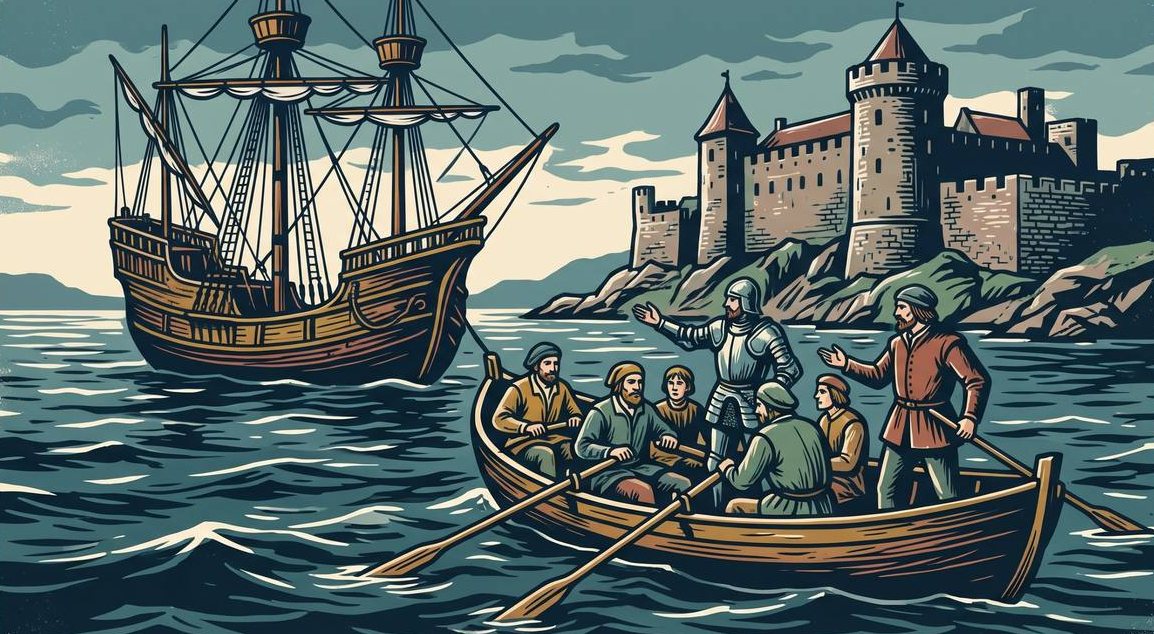
It is August 1502, and the ship of Henrik Krummedike, King Hans' feudal lord at Båhus, lies off Oslo, below the castle of Akershus. Knut Alvsson, the lord of Giske, goes aboard to negotiate. He has a promise of safe conduct, safe passage to and from the meeting, and he does not come ashore alive.
Akershus lies on a headland at the head of the Oslofjord, with the small bishop's town of Oslo behind it. The castle was the king's most important fortress in the eastern part of the realm, and whoever held it held the road into Romerike, Hedmarken by Lake Mjøsa and the border districts towards Sweden. Five years before, in 1497, Knut Alvsson had himself been commander there. In the summer of 1502 his men still held the castle, now against the king. In a letter of 24 July Knut writes to the Swedish magnate Svante Nilsson Sture that Krummedike had come «marching to Akershus and wanted to take it back», that he was beaten back, that many of his Scottish mercenaries fell, and that Knut's men took three ships from him. Krummedike himself then lay in the harbour at Marstrand, on the coast north of present-day Gothenburg.
Krummedike's ship thus came by sea from Bohuslän, the coastal land north of Gothenburg that then belonged to Norway. From Marstrand to Oslo is an estimated 120 to 140 nautical miles along the coast and up the fjord, a day or two with a fair wind in the vessels that were common at the time. August still lay within the sailing season. The King's Mirror, the merchant's textbook from the 1200s, advises sailing in summer and keeping off the sea in autumn.
The war was fought with other ships than in the time of the Arnlings. The Gulating Law had once required «Mørene», probably Sunnmøre, to provide 16 leidang ships (naval levy ships) of 25 rowing benches, built, equipped and manned by the farmers, with 80 to 100 men on board. That farmers' fleet no longer existed. The last known leidang fleet, four large ships manned by local noblemen, was defeated south of Bergen in 1429 by a German fleet of cogs, which then plundered the town. The Black Death had weakened the crews and the organisation, and larger ship types and gunpowder made the old ships obsolete. In the 1400s the leidang tax went in wartime to hired ships with experienced crews, according to Store norske leksikon. The letters do not say what kind of ships Krummedike and Knut's men fought over in the summer of 1502, but they were probably hired or private vessels of that kind.
Knut was the son of Alv Knutsson of Tre Rosor and Magnhild Oddsdatter of Finne in Voss. Around 1497 he took over the Giske estate from his father and the Finne estate from his mother. He was one of the largest landowners in Norway, and he had just as much to lose in Sweden. A division of inheritance in the Franciscan friary in the Swedish bishop's town of Skara in January 1500 shows that «Knut Alvsson in Giske» received property in Östergötland, Halland, Västergötland, Närke and Uppland from the daughters of King Karl Knutsson. Giske itself lay far away, a low and almost treeless island at the edge of the open sea off Borgund, the trading town by present-day Ålesund, in Sunnmøre. There bailiffs received the land rent in stockfish from the tenant farmers and sent it on to Bergen. A letter from around 1410 to 1420 shows the rhythm of that management. The owner Magnus Magnusson wrote to the estate bailiff Ivar Jonsson on Giske, asked for money and gold, forbade the sale of malt, flour and butter, and reminded him that the dues were to be in before the spring work and the fines before the nordfarers sailed.
The estate was large, but the rent was worth less than before. The Black Death in 1349 and the plagues that followed had emptied farms all over the country. Of some 60 000 farm holdings in the High Middle Ages, 36 000 to 37 000 lay deserted in the 1400s, and at the start of the 1500s the land rent was about a quarter of its level around 1350, according to Store norske leksikon. The population was probably a little under 200 000. Fisher farmers found it more profitable to fish than to grow grain, and the stockfish could be traded for grain in Bergen. Much suggests that outer Sunnmøre was therefore hit less hard than the inner fjord districts, but no source gives figures for deserted farms in Sunnmøre. The tenant farmers who paid to Giske took the skrei with handlines from open boats in winter and worked their farms the rest of the year. Grain was what they lacked.
The king was Hans, king of Denmark and Norway and from 1497 also of Sweden. He was 47 years old. The wars over Sweden cost money, the taxes were heavy, and in several places the farmers rose. The letters show how quickly circumstances turned. On 16 December 1497 Knut wrote from Akershus to Krummedike at Båhus, the castle on the Göta älv where Kungälv lies today, that the common people south of the mountains had made «a great uprising», and proposed that the two should meet in Borgarsyssel, present-day Østfold, with «two hundred horses or more» and put it down together. Four years later they were enemies. Krummedike had inherited about 240 farm holdings and parts of farms in Norway in 1476 and gathered 178 more, mostly in Båhuslen, according to Store norske leksikon. At the king's court of justice in Konghelle on the Göta älv in 1498 he was the king's man when the farmers who had killed Knut's bailiff Lasse Skjold got off with a mild sentence. According to Mona Ringvej's book on Erik Valkendorf, just before Christmas the same year Krummedike also received most of Viken as a fief for life, while Knut received nothing. In the summer of 1499 Knut lost Akershus. Before he rode across to Sweden, he pledged land to Archbishop Gaute for ready money.
In August 1501 King Hans complained from Stockholm that the Swedish magnates Sten Sture, Svante Sture, the bishop-elect of Linköping and Knut Alvsson were sending him threatening letters, and that Knut wanted the Danish bailiffs in Norway removed. The demand shows the discontent among Norwegian great men that fiefs and offices went to Danish and German noblemen. King Hans had promised otherwise. In the Halmstad Recess of 1483, the conditions the Norwegian Council of the Realm set when he was elected at Halmstad in Halland, it was stated that the fiefs were to be given to native-born men. The same month, in August 1501, Knut entered into alliance with Sten Sture, Svante Nilsson and Bishop Hemming Gadh in Sweden. In September Knut sent the king a letter of renunciation, the formal way a nobleman renounced his allegiance before going to war. The king answered at once from Gotland. He took the fiefs from Knut and told the bailiffs to seize his inherited estate, and it was this that put the Giske estate in play for decades to come. In December the king asked Krummedike to find a crafty peasant fellow who could bring a fabricated letter to Knut and listen for news from Stockholm. As early as 10 January 1502 he wrote that the Council of the Realm and the lawmen were to judge according to Norwegian law in the crown's claim against Knut's estate. The letter shows that the king wanted a judgment in place seven months before the killing.
In the summer of 1502 the war had reached the border country by the Göta älv, the river that flows out at present-day Gothenburg. The young Prince Christian, 21 years old and later King Christian II, besieged Älvsborg, the castle at the river mouth, with horsemen, landsknechts, Scottish mercenaries and Danish courtiers. The castle bailiff gave up the castle. Knut writes that the common people in the camp at Lerum, east of present-day Gothenburg, became so angry that they killed Erik Eriksson Gyldenstjerne while he was in Knut's custody. The king burnt the castle and withdrew to Båhus. Between old Lödöse, a town farther up the Göta älv, and the castle lay so many dead horsemen, writes Knut, that «there is a strong stench of them». He ends by saying that the time had now come to repay the king for the harm he had done Norway and Sweden «with murder, robbery and burning».
Then a meeting was arranged. Lawman Herlog of Viken, the land around the Oslofjord, writes on 16 August that Knut was to negotiate with the Council of the Realm at «a peaceful meeting», agreed by letter, on the Friday after St Lawrence's Day. Herlog had himself been with Krummedike in Oslo and received a promise of his friendship, and he left before the meeting. The killing is usually dated to 18 August. Sandberg writes, with reference to Benedictow, that Knut was killed on board Krummedike's ship. The sources disagree about whether he died on board or on land, and about who gave the order. Ole Jørgen Benedictow went through the sources in Historisk tidsskrift in 1970.
Eight days later, on Friday 26 August, the lawmen of Oslo and Tunsberg, present-day Tønsberg, and two mayors were gathered in the square in Oslo. The letter of judgment repeats the terms of the safe conduct: Knut was not to come with a following of more than a hundred men, those who were in the castle were to stay there, and he was not to gather the common people. Krummedike and six esquires presented what they called evidence that Knut himself had broken the safe conduct. He was said to have robbed the bishop of Hamar in his own residence, held back the king's man Anders Amundsson, gathered farmers and ridden into the town with a following, and used «many ugly words» about the king. Among the accusers was the esquire Knut Knutsson, about whom the king the year before had asked Krummedike to send word on how he should conduct himself. The lawmen took to themselves three dozen, 36 men of good standing. That was the old, solemn number for a sworn judgment in great cases. They declared Knut and his following outlaws, outside the protection of the law, with all their property «movable and fixed» forfeit to the king. The killers were declared free of guilt. The king himself was to decide what should be done with the body. Knut received no Christian burial. The law said that a traitor to the country was not to be buried in the churchyard. According to the Danish historian Arild Huitfeldt the body lay above ground at Akershus for twelve years, and another Danish chronicle says eleven. Store norske leksikon writes that according to tradition it was displayed in the Knut Tower. According to Mona Ringvej's book on Erik Valkendorf the head stood on a stake outside the castle. The historian Ole Jørgen Benedictow points out that the judgments were passed on a dead man, which the law hardly allowed, and that the court was not composed of noblemen of equal rank as the Halmstad Recess required. The king therefore had the Council of the Realm pass a new judgment for treason later. On 29 July 1515 Knut's son Karl Knutsson made a settlement with Krummedike and got his father's estate back. At about the same time Knut was finally laid in consecrated ground, and Krummedike founded an altar in St Mary's Church in Oslo where masses were to be read for Knut's soul. Benedictow thinks that the altar in particular, together with the settlement, points to Krummedike as the one chiefly responsible.
The judgment came after the killing, and it was Krummedike who conducted the case. That Knut broke the safe conduct first is Krummedike's own account. Two dates stand side by side: the king's letter about a judgment on the estate in January, and the judgment in the square in August.
The same autumn Vasco da Gama sailed on his second voyage to India, and Europe's spice trade began to take other routes than before. In Norway the struggle was about land and fish. The estate was broken up. Archbishop Gaute of Nidaros, present-day Trondheim, held Bjørøya in Namdalen, in northern Trøndelag, in pledge from Knut for 200 mark, and in 1505 the king let the pledge pass to the cathedral. The following year Bjarkøy, the old seat in northern Troms, went the same way. In 1504 King Hans promised Knut's children in Copenhagen that they would get their father's and mother's estates back. After a new meeting of the Council of the Realm at Kalmar in southern Sweden in 1505 the promise was withdrawn, and by spring 1506 at the latest Giske lay under the crown. The estate was now run by the king's bailiffs. Knut's widow, Mette Dyre, married in 1504 Svante Nilsson, who the same year had become regent of Sweden. The king's enemy in Stockholm was thus married to the widow of the lord of Giske. Mette was no quiet widow. The historian Randi Bjørshol Wærdahl shows that after Knut's death she sent word to Norway to get men to rise, and that in 1515, after Svante's death, she seized one of her stepson's ships together with her nephews, with the king's approval.
People: Knut Alvsson
Sources
DN 2/997; DN 8/451, 8/452, 8/456, 8/458, 8/461; DN 15/130; DN 12/269; DN 1/1015; DN 1/1019; SDHK 34159 (1500); Benedictow, «Drapet på Knut Alvsson og dommene over ham», Historisk tidsskrift 48, 1969, s. 181 til 219; Sandberg (utg.), Gørvel Fadersdatters regnskap 1563 (1986); prosjektnotatene «Giskebrevene 6», «Giskegodset 1563» og «Havner, seilaser og mat»; DN 14/37; Gulatingsloven, utgjerdsbolken kap. 22; SNL (leidang, ødegård, landskyld, Norges forsvar før 1600); prosjektnotatene «Båtbygging, seil og leidang», «Jordbruk i Norge 800 til 1650» og «Fiske og fiskeredskap».