Timeline · The king's in-laws
The fall of Magnus Barefoot in Ulster
1103
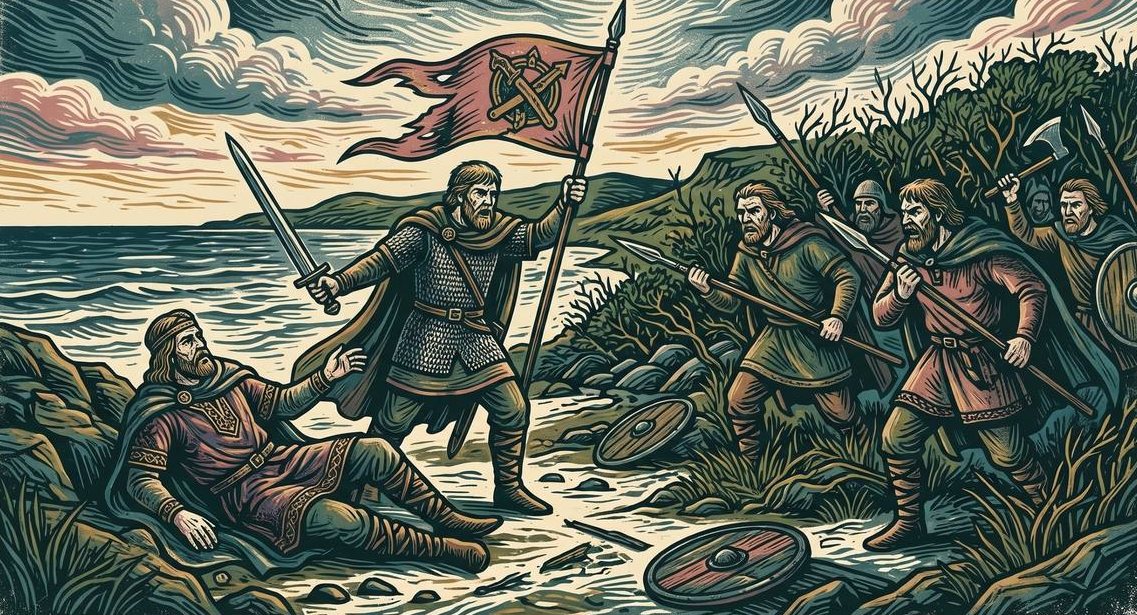
On 24 August 1103 King Magnus Barefoot, king since 1093, goes ashore on the coast of Ulster, the north-eastern part of Ireland, with part of his army. He is waiting for cattle he has been promised for the fleet. Irish warriors come out of the scrub. The king's man Torgrim Skinnhue throws his shield onto his back and runs for the ships. Vidkunn Jonsson from Bjarkøy in Troms, of the family from Giske, stands his ground.
Bjarkøy is an island north of Harstad in Sør-Troms, far north in Hålogaland, the old name for Northern Norway, and it was the seat of one of the most powerful families in the north. Tore Hund, who fought against King Olaf the Holy (St Olaf) at the battle of Stiklestad in Verdal in Trøndelag in 1030, had lived there. The wealth came from fish, furs and the tribute from the Sami, and from voyages to Bjarmaland by the White Sea in northern Russia. As early as around 890 Ottar from Hålogaland told King Alfred in England that the Sami paid tribute in, among other things, ship's ropes of whale and seal hide, and that walrus hide was very good for ship's ropes. Ottar also said that one could hardly sail from Hålogaland to Skiringssal in Vestfold in a month, camping each night and with a fair wind every day. All the goods from the north had to pass Hustadvika, Breisundet by Giske and Stad on the way south, and it is reasonable to see it this way: the family on Giske and the family on Bjarkøy sat at either end of the same sea route. The skrei (spawning cod) came in to Lofoten in winter, and it was taken with hand lines from open boats and dried on wooden drying racks. Stockfish from the north was already a trade good; Store norske leksikon dates the export to England to around the 1100s, and a few years after Ulster, Magnus' son King Øystein and his brothers required every man who fished at Vågan in Lofoten to give the king five fish. Heimskringla says that Øystein also had fishing huts and a church built at Vågan, while Store norske leksikon mentions only the church. Vidkunn was the son of Jon Arnesson, who had married into Bjarkøy with Ranveig Sigurdsdatter, and the grandson of Arne Arnesson, one of the brothers from Giske. According to Store norske leksikon and the local history «Borgund og Giske», volume I, Ranveig was the granddaughter of Tore Hund through his son. Others make her father Tore Hund's brother.
Magnus Barefoot was about thirty and had been king for ten years. He was the son of King Olaf Kyrre, king 1067 to 1093, and the grandson of Tora Torbergsdatter from Giske, so the king Vidkunn followed had a paternal grandmother from Giske himself. Snorri Sturluson calls Tora queen; Store norske leksikon thinks she was probably a frille, an unmarried concubine. Magnus wanted to win power in the west. In 1098 he had brought Orkney north of Scotland, the Suderøyene, today called the Hebrides, and the Isle of Man in the Irish Sea under his rule, and he had made his son Sigurd king over the isles. In 1102 he came back and made an alliance with Muirchertach Ua Briain, the king of Munster in southern Ireland. Sigurd, who was about thirteen, was married to Muirchertach's daughter. The saga tells that Magnus stayed in Ireland over the winter. Ireland was a land of many petty kings, and Dublin was the Vikings' old trading town. Ulster in the north-east was a green, hilly land where wealth was measured in cattle.
The voyage west went across the sea to Orkney, the same way King Harald Hardrada's fleet had sailed 36 years earlier, on its way to England in 1066. From Bergen to Kirkwall in Orkney is roughly 500 kilometres, around two days and nights with a fair wind. Further south the fleet had to pass the Pentland Firth, the strait between Orkney and the Scottish mainland, where the tidal stream can run at up to twelve knots, and in among the Hebrides. A fleet that lay long in a foreign land needed food. The fleet was a leidang (naval levy), built on the farmers' duty to provide ships, men and food for the king. The Gulating Law, the old law for Western Norway, gives a leidang crew without food the right to slaughter two cattle from a farmer at a fixed payment, and the cattle Magnus was waiting for in Ulster were probably meant to provision the fleet before the journey home. No source says so directly. The Gulating Law counts two months as the usual leidang service and forbids keeping the fleet out longer than until half a month's food is left. Magnus stayed in the west over the winter, far beyond what the law reckoned with, and the fleet probably had to live on what it could buy, demand or take ashore.
The king fell in the ambush. Before the battle Snorri has him say the words «Til frægðar skal konung hafa, en ekki til langlífis»: a king exists for honour and has no claim to a long life. Snorri also tells that before he died Magnus mentioned that he had outlawed Vidkunn's brother Sigurd Hund. Vidkunn fought on until the king had fallen. He received three wounds, and he carried the king's banner and the sword Leggbit back to the ships. To save the banner and the king's sword was an honour. To flee from the king was a disgrace. Torgrim Skinnhue and Vidkunn Jonsson stood in the same ambush.
The king's death is mentioned in Irish annals, while the story of Vidkunn is told in the sagas. According to tradition, the place where Magnus fell is near Downpatrick in present-day Northern Ireland. The local history says that the banner bore a lion, but the reading is uncertain, and the lion in the Norwegian royal arms is first known from the 1200s. More than two hundred years later, Vidkunn's descendant Erling Vidkunsson, who governed the realm as drottsete (steward of the realm) for the young King Magnus Eriksson from 1323, bore a lion in his seal, and that seal is the model for the Giske lion in the coat of arms of Giske municipality. The generations of the Bjarkøy family from around 1140 to 1250 are disputed.
After Magnus fell, his sons Øystein, Sigurd and Olav became joint kings. In England Henry I was king, and the crusader states in the Levant, on the eastern shore of the Mediterranean, were being built up. Vidkunn became one of the leading men in the north and was later foster father to Magnus the Blind, later king and son of Sigurd the Crusader, the same Sigurd who had been married in Ireland.
The local history «Borgund og Giske» sees a pattern in what happened: Magnus treated the Arnlings, the chieftain family from Giske that both Vidkunn and Tora descended from, unjustly, and yet it was Arnlings who risked their lives for him. In the same year that Vidkunn fought at the king's side in Ulster, Skofte Ågmundsson, the chieftain on Giske, died in Rome on a crusade to Jerusalem, having left the country to escape that same king.
People: Vidkunn Jonsson
Sources
Snorre, Magnus Berrføtts saga; Annals of Ulster; Ottars beretning; Gulatingsloven, utgjerdsbolken kap. 8 og 9; bygdeboka Borgund og Giske, bind I; Store norske leksikon (norsk fiskerihistorie, lofotfisket, Øystein 1. Magnusson); Vikingeskibsmuseet; prosjektnotatene «Slektsoversikt, rettet», «Båtbygging, seil og leidang» og «Fiske og fiskeredskap»; prosjektrapporten «Havner, seilaser og mat, kontrollert»; prosjektrapporten «Funn i Møre og verden»; prosjektsidene «Slektsbånd» og «Makten i riket».