Timeline · The Arnlings
Magnus is fetched from Gardarike
1034 to 1035
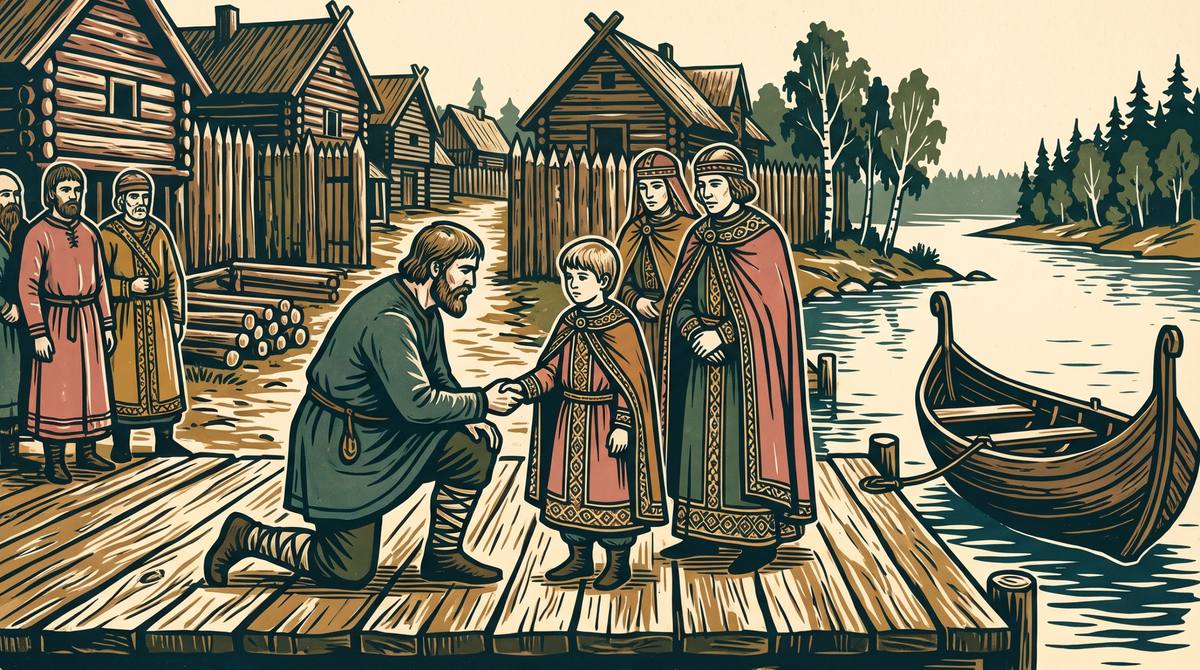
Four years after the battle of Stiklestad in Trøndelag in 1030, Kalv Arnesson, son of the lendmann (the king's landed vassal) Arne Arnmodsson from Giske and one of the leaders of the farmers' army there, travels east to fetch the son of the king he fought against, Olaf Haraldsson, later called the Holy. Magnus is around ten years old and lives with Grand Prince Jaroslav in Gardarike (Kievan Rus'). Kalv wants to make him king and become his foster father himself.
Gardarike was the land along the great rivers east of the Baltic. The Scandinavians named it after the gardar, the fortified trading places that grew up where the routes crossed. Holmgard, present-day Novgorod, lay on the river Volkhov just north of Lake Ilmen. Archaeologists have found log houses, merchants' yards and streets paved with logs, and the oldest log streets have been dendro-dated to the 950s. The prince resided on an islet in the river, and the name Holmgard probably comes from that. Furs of marten, beaver and squirrel went south and west together with wax and honey. Back came silver, silk and spices. Thralls were still traded along the river routes.
The flow of Arabic silver through the river routes had largely stopped before the year 1000, and Store norske leksikon places the end of the imports after 970. Svein H. Gullbekk estimates that perhaps a billion dirhams, Arabic silver coins, came into the Viking world between 800 and 950. A little of the silver reached Møre. In Sunndal in Nordmøre, weights, hacksilver and fragments of Arabic and German coins have been found, and whether the silver came by sea or over the mountains from the east, no one knows. In the Nordic hoards from Kalv's time German and English coins dominate, many of them from England under Cnut the Great, who was king of England, Denmark and Norway. Gardarike was nevertheless rich, and the route further south from Kiev to Constantinople was open. In these very years Harald Sigurdsson, Olaf's young half-brother, later called Hardrada, served in the emperor's Varangian Guard in Constantinople after he had fled from Stiklestad.
The saga tells that Kalv and Einar Tambarskjelve, the two most powerful magnates in Trøndelag, took the land route over Kjølen and on to Sigtuna in Sweden, north of present-day Stockholm. There lived Olaf's widow Astrid, and Snorri Sturluson tells that she backed them and later gathered men for Magnus. From Sigtuna the usual route went across the Baltic and into the Gulf of Finland, up the river Neva, where St Petersburg lies today, to Lake Ladoga and on up the Volkhov past Aldeigjuborg, present-day Staraya Ladoga. At the rapids on the Volkhov the cargo had to be carried or the boats hauled past. Norwegian ships sailed these waters. The cargo ship Skuldelev 1, built of pine in Sognefjorden around 1030, was later repaired with oak and lime wood in the Oslofjord and eastern Denmark before it was sunk in Roskilde Fjord on Zealand. From Trøndelag to Holmgard is an estimated 1,600 to 2,000 kilometres, depending on the route, and in summer the journey probably took four to six weeks or more. Both figures are estimates. The saga says little about the journey itself, and whether it went by ship in summer or by sledge over the ice in winter is not clear from what the sources tell.
What the travellers brought with them, the saga does not say either. The Viking Ship Museum has, on the basis of the sagas and the Oseberg find, described the food on voyages as porridge, flour, dried fish, butter and bread, rarely boiled or roasted meat, and water to drink. Stockfish withstood long journeys. Cod hung to dry in cold wind lost about 70 per cent of its water and kept for a long time. Cod bones from the Lofoten stock have been found in the trading town of Haithabu, near Schleswig in present-day northern Germany, in Viking Age layers, and researchers cannot tell whether the fish was a trade good or provisions for a journey.
The boy they came to fetch was called Magnus Olavsson. He was born around 1024, son of Olaf and Alvhild, a concubine (frille) at the court. Snorri tells that Sigvat the skald baptised him Magnus after Karlamagnus, the emperor Charlemagne, because he thought it the best name in the world. Olaf had left him behind with Jaroslav and Ingegjerd in 1030. Ingegjerd was the daughter of the Swedish king and had once been promised to Olaf himself.
Jaroslav hesitated to hand the boy over to the men who had stood against his father. In the end the magnates swore loyalty to Magnus, and Kalv became his foster father. What the sources do not say for certain is where this happened. The sources disagree about whether Magnus was fetched in Holmgard or in Kiev. Both cities were under Jaroslav, who ruled from Kiev and had Novgorod as his old princely seat.
The journey home, according to the saga, went through Sweden and over Kjølen to Trøndelag, the same way Olaf had gone five years before. Svein Alfivasson, Cnut's son, who ruled Norway for his father together with his mother Alfiva, did not hold out. Svein went south to Denmark, and Magnus was acclaimed king at Øreting, the thing (assembly) in Nidaros, present-day Trondheim, in 1035. He was around eleven years old, the age of a child in the last years of primary school today. The King's Mirror, written around 1250, gives the rule for seafaring by season: sail in the best part of the summer, and keep away from the sea in autumn. In Norse time reckoning that corresponded to the period from sommermål in mid-April to vinternetter (the winter nights) in October. This is an interpretation, for the book names no months. In autumn the ship was to be tarred and preferably stand through the winter with the tar on. A journey that also went overland, over mountains and rivers, was less bound by that rule and more by the ice and snow.
Cnut the Great died in England on 12 November 1035, and the rule of Svein and Alfiva in Norway collapsed for good. Cnut's sons divided and lost the realm around the North Sea within a few years. Kalv was now the most powerful man in Norway, foster father of a boy king and leader of the same magnates who had defeated the boy's father. His power rested on loyalty, and Cnut's silver had shown that loyalty could be bought. The king gave veitsler (royal grants of revenues) and power, and the king could take them back. Around him the memory of Stiklestad lived on, and Olaf, the king who fell there, had become a saint. A few years later the foster son had turned against him, and Kalv himself had to go west into exile.
People: Kalv Arnesson
Sources
Snorre, Magnus den godes saga og Olav den helliges saga; Orknøyinga saga; Kongsspeilet; Tore Skeie, Hardråde; bygdeboka Borgund og Giske, bind I; Store norske leksikon; Vikingeskibsmuseet, Sea fare and menu; Star m.fl. 2017 (University of Cambridge); rapporten «Havner, seilaser og mat langs kysten», kontrollert utgave; prosjektnotatene «Båtbygging, seil og leidang» og «Fiske og fiskeredskap»; SNL, vikingtiden; Gullbekk, sciencenorway.no 2025; Dahle, Vemmestad og Stavik, Primitive tider 21 (2019); siden «Makten i riket»; prosjektrapporten «Funn i Møre og verden».