Timeline · The family become lendmenn
The marble church on Giske
c. 1130 to 1170
Below the left-hand window on the south wall of Giske church, on the island of Giske, the render is missing from a small patch. There you can see what the church is built of: dressed marble. On 9 June 2021 geologists took six samples of the marble on Giske, and the answer came five years later.
Giske is a low sandy island of 2.67 square kilometres, roughly two and a half kilometres each way. The highest point, Ørnebakken, lies 23 to 26 metres above sea level, and the sources give the height differently. In the middle of the island lies bog. Closer to the sea lie cultivated fields and pasture, and sandy beaches run almost all the way round the island. No source describes woodland on Giske, and the island was probably treeless in the 1100s too, with heather moorland and pasture as elsewhere on the outer coast. Across the sound to the west, Godøya rises to 497 metres. The church stands on the south coast, by the landing place. Giske has no sheltered harbour, and NIKU, the Norwegian Institute for Cultural Heritage Research, believes that ships were moored or drawn up on the beach below the church. Close to the church, archaeologists have found a ploughed-out burial mound of about nine metres, a field of cooking pits dated 540 to 680, cultivation layers from 650 to 760 and 680 to 870, animal bones dated 660 to 880, and a seal-oil oven whose lower part is dated 900 to 1020, before or at the same time as the chieftain family of the Arnlings, according to the sagas, came to Giske. About 500 metres east of the church, at the place the 2011 report from the University of Bergen (UiB) calls Røysane, a double grave from the Viking Age yielded a silver ring, a balance scale, a spearhead and two oval brooches. The balance scale shows that silver was traded by weight on the island. Older texts call the place Reinabakken, and it is uncertain whether the names refer to the same place. On the south side of the island also lay the burial mound Mjeltehaugen, with graves from the Bronze Age and rock carvings of ships. Much suggests that the same part of the island was used by the powerful for over a thousand years, and it is reasonable to think that the first Christian chieftains placed the church by the old graves on purpose. The Arnlings may have built on an older seat, or they may have been newcomers who placed their seat by an old burial ground to borrow dignity from it. Continuity in the use of the site is demonstrated. Continuity of family is not demonstrated and cannot be demonstrated archaeologically.
The main sea route along the coast runs through Giskesundet, between Giske and Godøya. Outer Sunnmøre lies between the two most dangerous stretches of open sea on the coast, Stad to the south and Hustadvika to the north, and ships between Bergen and Trøndelag had to pass Giske. About ten kilometres to the south-east lay the trading place Borgund kaupang (trading town) by Katavågen, east of present-day central Ålesund, first mentioned in connection with the events after the battle of Bokn in Rogaland in 1027 or 1028, where the magnate Erling Skjalgsson fell. The excavations there have yielded around 45,000 objects according to the UiB project, while Walker and co-authors in 2025 give 51,000. The oldest hen from Borgund is dated 887 to 986, and the archaeologist Gitte Hansen believes the place must have existed already towards the end of the 900s, with most activity in the 1200s. So the kaupang grew up in the same generation as the Arnlings, according to the sagas, came to Giske. In the kaupang stood three or four marble churches. Along the route the stockfish went south, and Store norske leksikon (SNL) dates the export of dried fish to England to around the 1100s. The fishery was a winter fishery that could be combined with farming. Summer was the time for sailing, haymaking and building.
The fishery followed the skrei, the spawning cod that came in to the coast in winter. In Borgundfjorden, between Ålesund and the island of Sula, the spring cod fishery ran, according to later sources, from Candlemas on 2 February to Lady Day at the end of March. The archaeologist Sørheim believes that the fishery there became commercial precisely in the 1100s, when new settlements grew up on the outermost coast near the fishing grounds, and he regards the Borgundfjorden fishery as just as important as the Lofoten fishery later became, because the fish was dried closer to Bergen. That is a scholarly assessment. The trade may be older: five cod bones from Haithabu (Hedeby), the Viking Age trading town in present-day northern Germany, dated 800 to 1066, have the genetic signature of the skrei that spawns off Lofoten, but the sample is too small to decide whether the fish was a trade good or provisions for a journey. The fishermen used hand lines, on Sunnmøre called dypsagn, from open rowing boats, one line per man. The longline came to Møre only several hundred years later. The cod was hung on wooden drying racks and dried in wind and cold, and the racks on the treeless island also probably had to be built of timber from the fjords. The church followed the fishery. A papal letter from 1161 to 1172 allowed herring fishing on Sundays and holy days when the herring came in close to land, and the church took a tithe, a tenth, of the catch.
On the island itself the farm was a mixed farm with grain, cattle and outfield. By the church, cultivation layers from the Merovingian period and the Viking Age have been found, and pollen shows that barley was grown on Giske as early as the Neolithic. The sandy soil was easy to work, but poor in nutrients and exposed to sand drift. The field was probably scratched up with the ard, an implement with a symmetrical share that throws the soil to both sides. Water mills came into use only in the 1200s, and the grain on Giske was therefore probably ground on a hand quern. The outfield on the outer coast was heather moorland, burnt regularly, grazed by sheep all year round and mown for winter fodder, and seaweed and kelp were used for fodder and manure. No source describes the farming on Giske in particular, so the picture builds on what is known from the coast elsewhere. Who did the work was changing. The Frostating Law, the old law for Trøndelag, mentions a farm with twelve cows, two horses and three thralls as compensation to a man who had been blinded, and SNL interprets this as meaning that a couple of thralls was usual on good farms in the Viking Age. In the 1100s slavery was on its way out, and between the 1000s and the 1200s the majority of farmers went from being freeholders to being tenant farmers, legally free people who rented the land. Before 1350 the land rent, the annual rent to the landowner, may have been about one sixth of the harvest, but that is an estimate. Grain was the scarcest commodity out by the sea. Nils Hybel has found five great famines in the 1100s in northern European annals, against two in the 1000s, and in bad years bark bread was baked from dried and ground inner bark mixed with a little flour.
No contemporary source says when the church was built, and the datings diverge. Øystein Ekroll gives c. 1130 in Store norske leksikon, the SNL article on the island gives 1130 to 1140, and a report from Bergen Museum from 2012 gives c. 1170. In 1862 Nicolaysen wrote only «probably older than 1200». The isotope study from 2026 places the church generally in the 1100s. C. 1130 is best anchored in the scholarly literature. In that year King Sigurd the Crusader, king since 1103, died, and the period of civil wars began when his son Magnus and Harald Gille, who said he was Sigurd's half-brother, were to share the realm. Five years later Magnus was blinded by Harald Gille. If the late dating holds, the church was raised while the magnate Erling Skakke governed for his son Magnus Erlingsson, the first king to be crowned in Norway. Between the two datings the archbishopric in Nidaros, present-day Trondheim, was founded in 1152 or 1153, and Sunnmøre was probably then placed under the archbishop. Out in Europe churches and cathedrals were rising in the Romanesque style, and in 1147 the Second Crusade set out. For Giske, around 150 years had then passed since the Arnlings, according to the sagas, came to Giske, and around a hundred years since King Olaf the Holy (St Olaf) fell at Stiklestad in 1030. From the building of the church until today is about 30 generations, counted as an estimate.
Who built it is unknown. Two names have been proposed: Pål Skoftesson, chieftain on Giske after his father Skofte, whom a text from Nordmøre Museum links to the year 1135, and his son Nikolas Kuvung. Neither proposal has support in the sources, and the builder depends on which dating is correct. The oldest written testimony about its origin came over 200 years later. In 1345 Pope Clement VI wrote that the chapel on Giske was dedicated to the Virgin Mary, John the Evangelist and Nicholas the Confessor, and that the forefathers of the knight Erling Vidkunsson, who was then lord of the family estate, «fundasse et construxisse dicuntur», are said to have founded and built it. The pope repeats what he has been told, and the letter does not say when. Nicholas was the saint bishop, the patron saint of seafarers. Outside the south wall of the chancel lies a recumbent marble slab shaped like a coffin lid, with an upright stone at each end. SNL believes the builder was buried there, and the only parallel in Norway stands at Stødle church in Sunnhordland, the estate church of Erling Skakke. The priest and naturalist Hans Strøm saw the monument in the 1760s and called it «Skiøn Valborgs Grav» (Fair Valborg's grave), after a tradition he himself thought was «af liden Troeværdighed» (of little credibility). The grave had been dug up «af Nysgierrighed» (out of curiosity) a few years before, and three to four ells down lay a coffin put together from six stones. On the recumbent slab ran a line of runes, almost worn away. The runic database has a grave slab from Giske, N 440, with only a few legible characters and no interpretation. It has been suggested that Nikolas Kuvung lies in the grave, and the sources disagree about who it is. Claims of a church on Giske from 1070 or an older stone church from 1030 have no known basis in the sources and belong to tradition.
The marble, on the other hand, has been given an answer. In July 2026 Tom Heldal, Per Storemyr and four co-authors published a study in Boletín Geológico y Minero in which the stone in Giske church and the churches in Borgund is compared with 12 marble deposits on Sunnmøre. The marble from the various quarries is too similar to tell apart by eye, so they used isotopes of carbon, oxygen and strontium. The conclusion for Giske reads: «we consider it likely that the Magerholm quarry could have been the source for all Giske samples». Magerholm lies by the Storfjord, east of Ålesund. Borgund got most of its marble from Humla, only about four kilometres away. So the ships to Giske sailed past Humla and Blindheim on the same marble belt and fetched stone an estimated 25 kilometres away. This suggests that the builder on Giske organised his own supply of stone, independently of the kaupang, although no source says so directly. He may have lacked access to Humla, owned Magerholm, or found better stone there. Who owned the quarries in the 1100s is unknown. A letter of 19 April 1344 shows that Ogmund Eiriksson gave the island of Humla, 15 månedsmatsbol (a land-rent unit) in St Peter's parish in Borgund, to Erling Vidkunsson in return for board on Giske for the rest of his life (DN 5/171). It is very probably the same Humla, and if so, the family on Giske owned from 1344 the quarry from which the Borgund churches were built. The claim in a church leaflet of marble «from Norway and Italy» has no scholarly support.
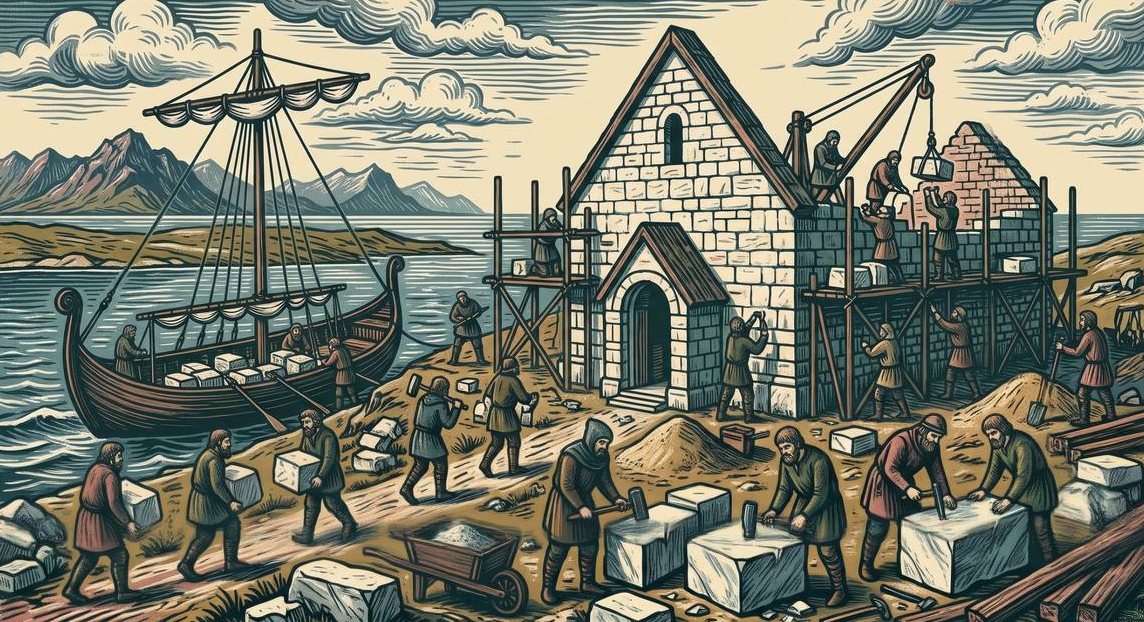
No source describes the transport, and the figures that follow are estimates. The most likely ship is a western Norwegian knarr. Norwegian finds show that such ships carried stone. The Klåstad ship, a knarr from 998 of an estimated 20 to 22 metres, was found near Larvik with a cargo of whetstones from Eidsborg in Telemark. A cargo ship of western Norwegian build is Skuldelev 1, built in the Sognefjord around 1030 and found in Roskilde Fjord in Denmark, 15.8 metres long and 4.8 metres wide, with six to eight men. The Danish replica Ottar takes around 20 tonnes of cargo, makes about 10 knots under sail and only one and a half knots under oars. The sea route from Magerholm out the fjord, through Borgundfjorden and past the kaupang to Giske is an estimated 25 kilometres, or 13 to 14 nautical miles. With a fair wind all the way a laden knarr could make the trip in three and a half to five hours. The route turns from west to north-west, and if the wind dropped, rowing took 11 to 15 hours. A round trip with loading, unloading and waiting for weather took an estimated three to four days. The dimensions of the ashlars at Giske have not been published. Judging by the stones in the marble church at Gildeskål in Nordland, south of Bodø, an ordinary ashlar weighed around half a tonne and the largest one to two tonnes, and 450 to 550 tonnes of rough blocks probably had to be carried from the quarry for the outer shell alone. That gives 23 to 28 knarr loads. With no harbour, the stone was probably loaded and unloaded from beach or rock at low tide, with logs, rollers and ramps. On board, the crew lived on what the Viking Ship Museum, drawing on the sagas, sums up as ordinary sea fare: porridge, flour, dried fish, butter and bread, with water to drink.
Sailing followed the year. The King's Mirror, written in Norway around 1250, advises the merchant to make his ship ready «at the beginning of summer» and to keep away from the sea in autumn. In Norse reckoning this means the summer half of the year, from sommermål in mid-April to vinternetter in the second half of October. Lime mortar cannot withstand frost before it has set, and it is probable that masonry work on Sunnmøre was therefore done from about May to September. In winter people could quarry and dress stone, while the fishery took the men out to sea. With haymaking and fishing taken into account, one knarr could manage an estimated 25 to 30 round trips in a good summer and 15 to 20 in a poor one. The ashlars then took one or two seasons.
The ship was itself a great work. Skuldelev 1 was built of thick pine planks, and dendrochronology shows that the timber came from the Sognefjord. The great ship from Bryggen in Bergen, built of pine felled in the winter of 1187/88 and probably cut in Sogn, shows that the same timber was in use a few decades after the marble church was raised. Pine from the western fjords was the main timber in the ships of Western Norway, while oak dominated in Denmark and Ireland and in the burial ships from Vestfold. Keel and stems were set up first, the planks were split from long, straight trunks and clinched with iron rivets, and the overlaps were caulked with tar and wool. The Danish replica Ottar was built by eight boatbuilders in 1999 and 2000. The accounts for another Danish replica, Roar Ege, show that only about five per cent of the raw timber ended up in the hull, because only straight, knot-free trees could be used. Skuldelev 1 had a woollen sail of about 90 square metres, the same size as the sail Saga Oseberg was given in Tønsberg in 2012, woven from the wool of sheep in Vestfold. The estimates of how much wool and work such a sail required diverge widely, but all correspond to the flocks of several farms for one year and one to several years' work at the loom, most often reckoned as women's work. The Maritime Museum in Museum Vest regards the sail as just as valuable as the ship. A hull lasted an estimated 20 to 30 years, and on Roar Ege the rivets had to be replaced about every 15 years because the rust split the planks. The King's Mirror advises tarring the ship in autumn and leaving it to stand over the winter with the tar. A great farm like Giske probably had to build or acquire a new ship about once a generation, and the ship timber had to be fetched from the inner fjords through the family's own estates, the king's forests or exchange.
The Gulating Law, which was probably written down between the end of the 1000s and the middle of the 1100s, made the ships a farmers' duty. The leidang was the farmers' duty to provide ships, men and food for the king's fleet. Under the utgjerdsbolken (the section on the levy), every skipreide (ship district), a district along the coast, was to build, equip and man one leidang ship, and «Mørene», probably Sunnmøre, was to provide 16 ships of the large type with 25 sesser, rowing benches. With two oars per bench and two men per oar, SNL's crew figures give 80 to 100 men per ship, and at a full levy an estimated 1300 to 1600 men from Sunnmøre. The calculation is an estimate. The farmers were to build the boathouse together, and anyone who did not do his share paid a fine of 3 marks to the king. The sail was to be sewn by the farmers within the helmsman's deadline, with a fine for every ell that was missing, and when the ship had come home, the sail was to be kept in the church. On Giske the church and the landing place lay side by side, so a leidang sail in the church and a ship in a boathouse on the beach below fit with what archaeology has found. That is a possible interpretation, and no source says that a Sunnmøre leidang ship was kept on Giske.
Norway had no tradition of its own for building in stone in the 1000s and 1100s. A stone church required quarrymen, stone dressers, masons, lime burners and lime slakers, and smiths of their own for the tools. In Western Norway the sources point to England. The church on Selja, the monastery island by Stad, was probably built with «English craftsmen», and in Stavanger the first generation of craftsmen were probably also English. SNL links the ashlar masonry and the Attic base at Giske to the churches in Bergen. The specialists at Giske may have come from an English-influenced milieu in Western Norway, perhaps via Bergen. Carrying, rowing and digging could be done by people from the farm and the tenant farmers. No Norwegian source mentions thralls in church building, and slavery was on its way out. The lime was probably burnt from marble from the same belt, and the shell sand on Giske was suitable for the mortar. By an estimate, the church needed around 24 tonnes of burnt lime. No medieval lime kiln has been found on Sunnmøre. The work has been estimated at 20 to 40 man-years and 3 to 10 building seasons, and converted using Morten Stige's figures for Værnes church in Stjørdal it may have cost in the order of 55 to 130 marks of silver. For comparison, Erling Vidkunsson paid 30 marks of burnt silver for the farm Bleike in Asker in 1327, almost 200 years later. The figures show only the order of magnitude.
The church that was completed was small. The nave measures c. 12.3 by 8.8 metres and the chancel c. 7.6 by 6.2 metres. The whole outer face is built of marble ashlar, with a core of what is probably mostly rubble. Above the south portal a tympanum shows the Lamb of God with the cross. The chancel has no portal from the Middle Ages, and Ekroll explains this by the priest belonging to the household. The Gulating Law distinguishes between herredskirker (district churches), which the farmers built together, and høgendeskirker (private churches), which one man built, «either a lendmann or a farmer». If such a church fell down, the builder had a deadline to restore it, otherwise the land went to the king. At the consecration the bishop was entitled to board and lodging for himself and 15 men for three nights. Giske fits as a høgendeskirke and private estate chapel for the lendmann family, the family of the king's foremost men in the district, but no source says that the church was one. The papal letter of 1345 calls it «capella», and scholars place it alongside the private chapels at Austrått in Ørland in Trøndelag and other noble seats. The first mention in a Norwegian letter is in the will of Bjarne Erlingsson, the lord of Giske and Bjarkøy, from 1308 or 1309, in which Giske church receives 12 månedsmatsbol in Skodje, east of Ålesund. The church still stands by the beach on Giske. The name of the man who had it built is found in no source.
Sources
Heldal m.fl. 2026, Boletín Geológico y Minero; Ekroll, Stige og Havran 2000, Kirker i Norge 1; SNL, «Giske kirke» og «Giske (øy)»; Hatling 2012; NIKU Oppdragsrapport 168/2013; Strøm 1766; Gulatingsloven, utgjerdsbolken kap. 11, 14 og 22; Frostatingsloven; Kongsspeilet; SNL, Klåstadskipet; Christensen 2002, Deutsches Schiffahrtsarchiv 25 (Bryggen-skipet); Stiftelsen Nytt Osebergskip (Saga Oseberg); Vikingeskibsmuseet (Ottar, Skuldelev 1); EXARC Journal (Roar Ege); Sjøfartsmuseum Museum Vest; SNL, «trell», «ard», «kvern», «lynghei», «leidang» og «barkebrød»; Hybel, Historisk Tidsskrift (DK); Sørheim; Star m.fl. 2017; pavebrev 1161 til 1172 (Regesta Norvegica I nr. 143); DN 1/294, DN 5/171, DN 15/1, DN 1/190; prosjektnotatene «Slik ble Giske kirke bygd», «Steinfrakten til Giske», «Giske kirke: marmorkapellet, slekta og arkivene», «Giske: landskap, beliggenhet og jordbruk», «Båtbygging, seil og leidang», «Jordbruk i Norge 800 til 1650» og «Fiske og fiskeredskap»; rapporten «Havner, seilaser og mat» (kontrollert); UiB, Giske 2011; Walker m.fl. 2025; Hansen (Borgund kaupang); prosjektrapporten «Funn i Møre og verden».