Timeline · The last century
The accounts from Giske
1563
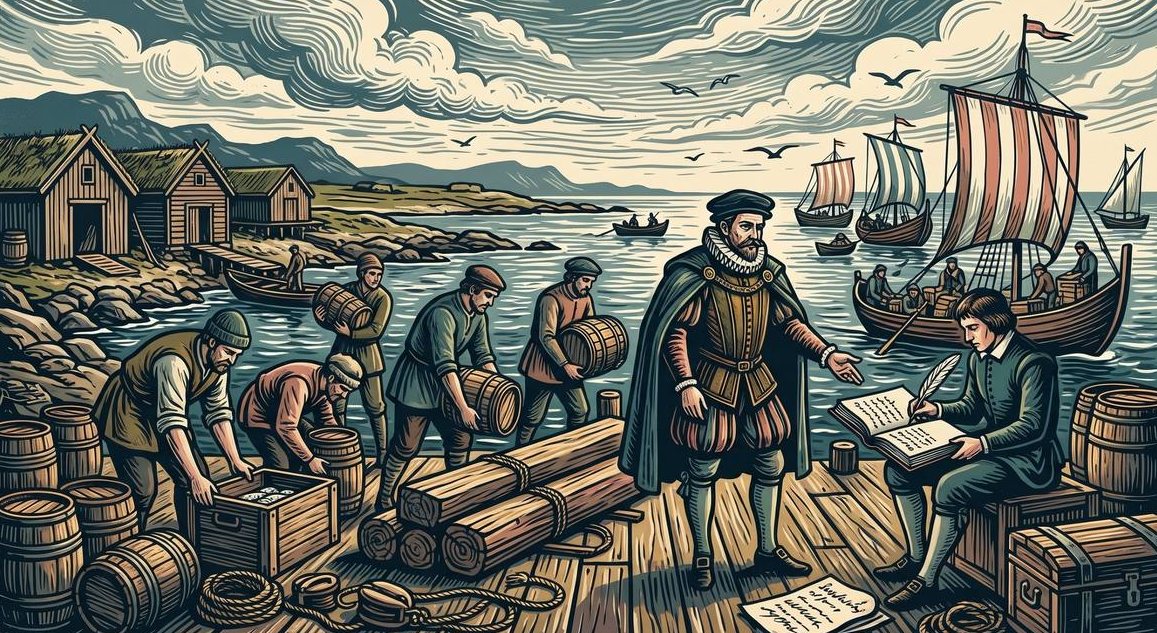
In 1563 the estate bailiff (gardsfut), the manager of the estate, sits on Giske keeping the accounts for fru Gjørvel Fadersdatter, who owns the Giske estate. He notes that 493 våger of stockfish have been sold in Bergen that year, roughly 8.9 tonnes. It is the fullest picture we have of the estate at work.
Giske is a low island of 2.67 square kilometres, about two and a half kilometres in each direction. The highest point, Ørnebakken, lies 23 to 26 metres above sea level, depending on which source one follows. The ground beneath is fine sand. In the middle of the island lies bog, and nearer the sea cultivated land and pasture, with sandy beaches almost all the way round the island. To the west Godøya rises with Storhornet at 497 metres. No source describes forest on Giske, and the island was probably treeless. Timber had to come from the sawmills in the fjords. The outlying land was heather moor, a landscape created by people, which was burnt regularly, grazed by sheep all year round and mown for winter fodder, with seaweed and kelp for fodder and manure. No source describes farming on Giske in particular, but it is likely that the island was farmed in this way. It is documented that grain was grown by the chieftain's seat throughout the Middle Ages, but the sand is poor in nutrients, and the account from 1563 shows that the grain was not enough. Borgund, the old trading town (kaupang) by Katavågen, lay about ten kilometres to the south-east and is mentioned for the last time in 1570.
The account is written in a single hand in Gothic cursive on 24 of 30 folio sheets, a fair copy made from a draft. The sheets were never bound. The heading says that it concerns Sir «Laffue Brade till Krogholm» and his wife fru «Giøruell Fadersdotthir», and her estate north of the mountains in Norway, «Som er boude Giedske Oc Giedske godtz» (which is both Giske and the Giske estate). The editor, Per-Øivind Sandberg, believes that such a copy was sent every year to «mynn herre i Københafn» (my lord in Copenhagen). The writer was probably Jens Skriver, whom a judgment from 1578 calls estate bailiff on Giske in 1565. The original is in the Rigsarkivet (Danish National Archives) in Copenhagen.
Gjørvel was the daughter of the lawman Fader Nilsson (Sparre) and Bodil Knutsdatter, daughter of Knut Alvsson, the councillor of the realm who owned Giske and was killed in 1502. The sources disagree about the year of her birth. Sandberg gives around 1510, the Swedish biographical dictionary of women gives 1517, so in 1563 she was between 46 and 53 years old. She had been married three times, to Peder Nilsson (Grip), to Truid Ulfstand and to Lage Brahe, and lived in Scania. Thirty years earlier, at the herremøte (council meeting) at Bud in Romsdal in 1533, the Council of the Realm had declared that she stood next after the maiden Karine Alvsdatter, Knut Alvsson's sister, as heir to Giske. According to Store norske leksikon she visited Norway only once, in 1552. Sandberg reckons that she owned around 600 farms in Norway, while Store norske leksikon gives «mer enn 600 eiendommer eller eiendomsparter» (more than 600 properties or shares of properties). The difference probably depends on whether the shares are counted. The Giske estate was the largest holding, with 104 properties paying land rent in Sunnmøre and 50 in Romsdal. The estate was densest on the islands from Ona on the outer edge of Romsdal to Herøy in south-western Sunnmøre. Andreas Holmsen believed it was the largest single estate in the country in the 1500s.
The estate was still growing. The letters from 1544 show that Jens Jyde, Truid Ulfstand's officer in charge on Giske, bought Heggebakke and two parts of Valle in Skodje east of Ålesund and two thirds of the deserted farm Lade in Sykkylven by the Storfjord. At the sale of Heggebakke the seller's brother gave his consent, for close relatives had the right to redeem odal land. In 1548 Lage Brahe bought a share in Myklebostad in Søvde. Truid Ulfstand died in 1545, and in 1546 Gjørvel was paid 347 double ducats and 261 angels by her stepsons in Lund, the settlement for the morning gift he had given her. The farmers on the estate were tenant farmers, who rented the farm they worked. They paid land rent, a yearly rent in goods, and tredjeårstake, a fee every third year, had to keep houses and fences in repair and paid førstebygsel to get the farm, a fee that was fixed by law in 1514. From 1539 the land rent could only be raised by decision of a lagrette, a panel of farmers at the thing (assembly). The tenant system lasted longer in Sunnmøre and Northern Norway than in most other places in the country. The Reformation of 1536 and 1537, when the king introduced the Lutheran church order, had shifted land and power. The Council of the Realm was gone, the bishops' estates had gone to the crown, and the feudal lords of the fiefs, who governed the king's fiefs (len), were the king's officials, often Danish noblemen. In 1661 only about 20 per cent of the landed property was owned by farmers.
The fish was the money. The land rent from Romsdal brought 123 våger and from Sunnmøre 309 våger of stockfish, a total of 432 våger or roughly 7.8 tonnes. The farm's own farmhands caught 30 våger over the year. The spawning cod (skrei) spawn off Møre in winter, and the spring cod fishery in the Borgundfjord by Ålesund lasted from Candlemas on 2 February to Lady Day at the end of March. The fishery fell in winter and could be combined with farming for the rest of the year. Store norske leksikon writes that in the 1500s the men did the fishing while the women to a large extent ran the smallholding. The gear was the handline, in Sunnmøre called djupsogn, held down with a sinker and worked from open boats. The åttring, a handline boat with four rowing spaces, has its oldest dated description from 1591, and the fembøring appears in the middle of the 1500s. Twelve years before the account, in 1551, two Englishmen were given permission to fish with longlines off Møre and Trøndelag, on condition that they trained young Norwegians. Even so, the longline did not break through in the Norwegian fishery in Møre until the 1600s. The outermost farms facing the sea were the largest fishing farms. In the land register of 1642, eighty years later, Haram paid 22½ våger, Ulnes 18 and Fjørtoft 14½. The account converts everything else into fish: an øre was half a våg, a kyrlag two and a half våger, a hide one våg. In Voss the land rent was paid in butter and grain. According to the surveys of the herring fishery, the years 1540 to 1570 were a rich herring period from Karmøy to the Trondheimsfjord, with a sharp decline in western Norway after 1560. The account does not mention herring.
The fish was collected on Giske and shipped by jakt to Bergen. The jekt was the open, clinker-built cargo ship of the coast, and it was built «i de fleste fjorder med nok tømmer» (in most fjords with enough timber), writes Store norske leksikon. The freight cost 7 dalers, and the bailiff himself spent 4 dalers in town. From Giske to Bergen it is roughly 140 to 150 nautical miles inside the skerries and past Stad, the weather-beaten headland south of Sunnmøre, three to seven days when night harbours and waiting for weather are included. The fish was sold for 4 guilders a våg, and 493 våger brought 1762 dalers. That is roughly 8.9 tonnes of stockfish, which converts to about 50 tonnes of cod as caught. The sale was larger than the land rent of 432 våger, and much suggests that the difference came from the fish from Senja in Troms and Helgeland in Nordland and from the farmhands' own 30 våger. The account does not name the buyers, but it is reasonable to think they were merchants of the Hanseatic League at Bryggen. Much was settled without money. For two våger of fish the bailiff got three new oxen, two scythes and two sickles. Bergen at this time exported several thousand tonnes of stockfish a year. Knut Helle cites a scholarly estimate, probably after Arnved Nedkvitne, of over 4500 tonnes in the late 1500s, and by that measure the sale from Giske was roughly 0.2 per cent. Store norske leksikon describes how in the course of the 1500s the fishermen got less and less flour for the same fish.
The estate had other income. The leasehold fees (bygsel), the fee for being allowed to rent a farm, brought 27 dalers from Romsdal and 39 from Sunnmøre. The property Dreggen in Bergen brought 2 dalers and 1 Bergen guilder in rent. For the Shetland estate a steward called «Vechenntius aff Skadesta» paid 66 dalers a year. The salmon trap at Festøya, by the Hjørundfjord south of Ålesund, yielded 6 barrels of salmon. Of old, catching salmon from the shore was a right of the landowner, and a salmon fishing place could be traded as real property. The sawmill at Solnør in Skodje, by the Storfjord east of Ålesund, cut 123 tylfter (dozens) of boards, which were sold for 72 dalers to buyers in Trondheim and Copenhagen, and 2 tylfter went to building the parish church. That works out at about 0.6 dalers per tylft. The water-powered frame saw was new in the country. Store norske leksikon dates its introduction to around 1520, while the overview from Stiftelsen Bryggen says just before and just after 1500. A royal letter of 16 March 1545 required sawmill owners to give the king every tenth board, and the fief accounts record a sawmill tax from 1560. In Sunnmøre there are no certain sources for sawmills before 1550, but in 1617 there were 58 flood saws. Small flood saws in western Norway usually cut 30 to 40 boards a day. With six to eight weeks of running in the flood season, that gives roughly 1200 to 2200 boards a year, and Solnør, with 1476 boards, lies in the middle of that range. The sakefall, the fines, brought 27 dalers. Oluf Bjørnelandt paid 3 dalers for having moved a living house off the estate without permission, and John Lagdt 10 dalers for having sown land without permission. Several tenants paid 6 lodd of silver for having let their houses fall into disrepair.
The account also shows everyday life on the main farm. The farm's own harvest gave 28 sold of grain. Ten sold went to seed corn and one as tithe to the priest. The people on the farm, at the sawmill and at the salmon trap ate 37 sold, more than the farm grew. The harvest was about 2.8 times the seed, an estimate because it is uncertain how much a sold was. The historian Hans Jacob Orning reckons that a normal yield in the High Middle Ages was around four times the seed, against 20 to 30 in modern farming. When consumption, seed corn and tithe are added together, around 20 sold are missing, and the grain probably came from the tenants or was bought. The bailiff tried to get grain from the farms near Giske. For slaughter there were four old cows, two oxen from Ertenøya, fifteen sheep and lambs and five pigs. 42 ells of white and 14 ells of grey vadmel (homespun woollen cloth) were woven and a new rye (pile rug) made. Weaving was women's work. In the time of the leidang, when the farmers had to provide ships for the king's fleet, the farmers in each ship district (skipreide), the district that provided one ship, were obliged to sew the sail for the leidang ship, and the Gulathing Law set a fine for every ell of sailcloth missing. A mainsail of about 100 square metres was woven in pieces of about 11 metres, and by an estimate such a sail would have occupied the looms of a farm like Giske for several years. That tools had to be bought suggests that the outer coast lacked both iron and stone for millstones. The bailiff bought bay salt for the fish, barrels, hops, hemp, linen, a new sheep rope, two axes, two scythes, two sickles, millstones, tar and flax, and the mason Rasmus was paid 1 daler for repairing the chimney, the malt kiln and the brewing pan.
Six farmhands and five women are named. Gutorm Olsen received 3 dalers a year. Iver Arnesen, Arne, Anders, Lille Knut and Erik received 2 dalers each, and each of them also received 6 ells of vadmel, 12 ells of linen and a tanned hide. A farmhand's cash wage of 2 dalers was less than the roughly 3.6 dalers a våg of stockfish fetched in Bergen the same year. Food, clothes and lodging were the real wage. The women were paid in cloth and shoes and no money: Berit «radzkonne», Anne «bodey», that is dairymaid, Kjersten, Margrete and Syrre Arnesdatter. After the expenses of 42 dalers had been deducted, Gjørvel was left with 2089 dalers a year. In addition, skipper Laurits took 2 barrels of Bergen fish, 4 barrels of venison, 3 barrels of salmon and 1 barrel of seal blubber to Copenhagen, by sea southwards round Lindesnes and in through the Kattegat.
The farm was vulnerable to bad years. On the outer coast of Sunnmøre a bad year struck in two ways: a poor harvest on the farm's own fields and dearer grain that had to be bought with fish. This is a reasonable assumption, but no source documents a particular bad year in Sunnmøre in these years. In bad years bark bread was baked from dried and ground inner bark of pine, birch or elm, mixed with a little flour and stretched with chaff and straw. The plague also returned. In Bergen, the town where the fish from Giske was sold, Absalon Pederssøn's notes on burials suggest that at least 20 per cent of the people died in 1565 and 1566, perhaps 30 to 40 per cent. The population of the country was nevertheless rising, from an estimated 150,000 in 1520 to just over 400,000 around 1650, and the farms deserted after the Black Death were cleared again.
The king was Frederick II, king of Denmark and Norway from 1559 and son of Christian III, who had carried out the Reformation. The account was kept 26 years after the last archbishop fled from Nidaros, and roughly 15 generations before our time. The same year the account was kept, the Nordic Seven Years' War broke out between Denmark and Sweden. In the winter of 1564 Swedish troops marched into Trøndelag and took Trondheim for a short time. The war reached the farmers through the old leidang. The Gulathing Law had once required «Mørene», probably Sunnmøre, to provide 16 ships with 25 rowing benches. Now the leidang obligations were used to conscript peasant soldiers, and in 1564 the beacons were lit to call the farmers to the thing in Bergen, according to Store norske leksikon. For the tenants, though, it was the land rent, the fishing and the price of flour in Bergen that decided how the year turned out. Lage Brahe, the man the account was sent to, died in 1567.
People: Gjørvel Fadersdatter (Sparre)
Sources
Gjørvels regnskap 1563 (Sandberg 1986); DN 12/604, 12/605, 12/608; DN 1/1105; DN 12/621; Giske jordebok 1642 (Digitalarkivet 76953); SNL (norsk fiskerihistorie, Görvel Fadersdotter); prosjektnotatene «Giskegodset 1563», «Fisk som valuta», «Fiskeværene og Giskegodset», «Giske: landskap, beliggenhet og jordbruk» og «Havner, seilaser og mat»; Gulatingsloven, utgjerdsbolken kap. 14 og 22; Helle 2019, AmS-Skrifter 27; SNL (leilending, landskyld, line, åttring, oppgangssag, barkebrød, svartedauden, jekt, laksefiske, Norges forsvar før 1600); Stiftelsen Bryggen, Oppgangssagene i Norge; prosjektnotatene «Giskegodset og produksjonen», «Jordbruk i Norge 800 til 1650», «Fiske og fiskeredskap» og «Båtbygging, seil og leidang»; Orning, «Gårdslivet i middelalderen», norgeshistorie.no; Ringvej, Et kongerike foran undergangen; prosjektsiden «Makten i riket».