Timeline · The heirs fight over the estate
Sigurd Jonsson takes over Giske
1425
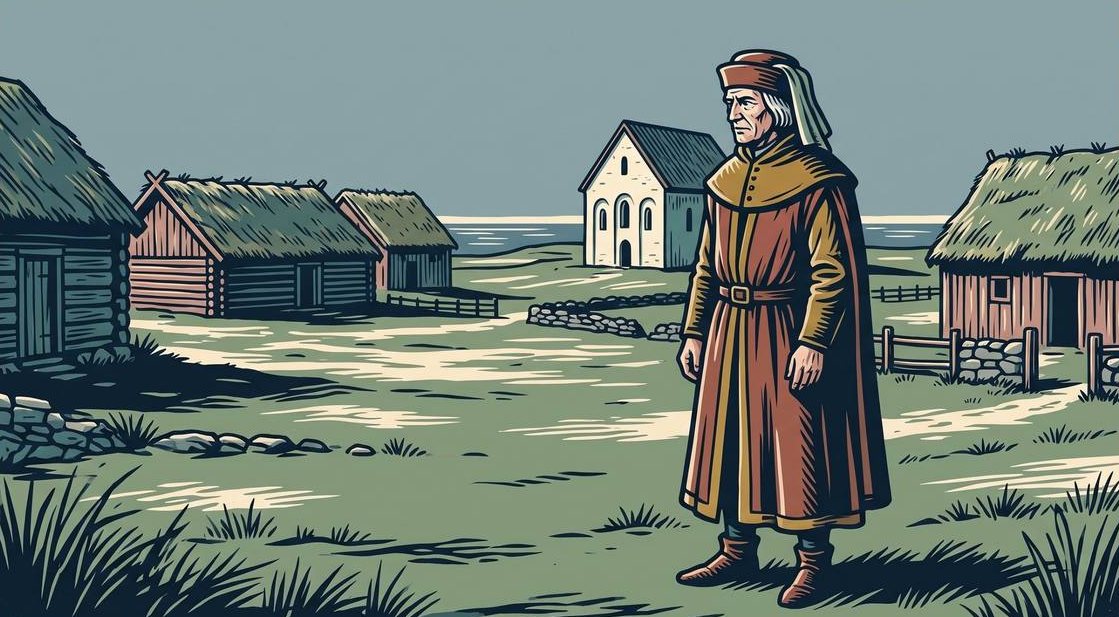
Friday 20 July 1425, on Giske. Sigurd Jonsson, sister's son of the late owner Håkon Sigurdsson, calls on Håkon's widow Sigrid Erlendsdatter or her lawful representative. No one comes.
The island lies low and open in the summer light. The fields by the church on the south side stand green, and archaeologists have found cultivation layers there that show grain was grown at the manor throughout the Middle Ages. The outlying land on the outer coast was heather moorland, and the sheep probably grazed on Giske and the neighbouring islands as they did elsewhere in western Norway. The heather was burnt regularly, grazed all year round and cut for winter fodder, and seaweed and kelp were used for fodder and fertiliser. Salmon fishing belonged to Giske in 1354, and in 1563 the salmon trap on Festøya by Storfjorden gave six barrels of salmon. The sailing route runs through Giskesundet between Giske and Godøya, and ships between Bergen and Trøndelag must pass here. Five men stand with Sigurd: Steinar Steinarsson, Arne Pålsson, Finn Olavsson, Arne Bårdsson and Erlend Utamsson.
Sigurd brought forward two witnesses, Harald Olavsson and Jusse Knutsson. They swore on the book that this was the Friday to which Sigurd had summoned Sigrid, with three weeks' summons to her home from Bergen to Giske, so that she should hand over the inheritance. The letter says that she held the inheritance «on behalf of her maternal uncle», and that does not fit with what we otherwise know. It may be a mistake or a family connection that does not appear. Sigurd waited, and for a long time no one came to answer him. Then he took Giske farm and the Giske estate into his possession, with the reservation that if Magnus Magnusson, Sigrid's second husband, has a better right, he is ready to appear before the king, the archbishop, the Council of the Realm, lawman and councillors. Sigurd Martinsson received the testimony, and five men set their seals to the letter.
Four weeks before, Sigurd had stood in Bergen. At a meeting in Nidaros in November 1424 Archbishop Eskil had set the day for the law assembly at St Botolph's Day, and for three working days Sigurd appeared in the court hall on Breiallmenningen, one of the open public lanes in Bergen. Provost Peter Boasson of the Church of the Apostles, four canons, the realm's man Svale Jonsson, lawman Einar Endridesson, ten councillors and six members of the law court sat in the court. Sigrid came, and so did Guttorm Jonsson. He had a letter from Magnus read out, but refused to take on the commission, and said that he had not accepted any commission from Magnus «either with a yes or with a handshake». Sigurd called many times for Magnus or his lawful representative. No one came. The court found that neither Sigrid nor Guttorm was a fully valid representative. Sigurd was awarded 54 løper, and the lawman added to it according to the law book, so the sum became 108 løper. Magnus was to pay within a month of coming home and hearing the letter. A løp was a measure for butter and grain. Reckoned in butter, at about 15 kilos per løp, that comes to an estimated 1.6 tonnes. Butter was a common means of payment. On the Giske estate the fjord farms in Norddal, Tafjord and Muldal at the head of Storfjorden paid their land rent in butter, and the whole estate gave 432 våger (c. 18 kg each) of stockfish in land rent in 1563, about 7.8 tonnes. Where Magnus was, the letter does not say.
From Bergen to Giske is an estimated 140 to 150 nautical miles along the sailing route, and with night harbours and waiting for weather such a voyage took an estimated three to seven days. The voyage went past Stad, the peninsula just south of Sunnmøre, one of the two most dangerous stretches of sea on the coast. According to the King's Mirror high summer was the best time for sea travel. Sigurd must have travelled quickly, for on 18 August he was back in Bergen and, together with his brother-in-law Jens Hjerne, confirmed a sale of the farms Pettevik and Ramsvik in Lofoten, land that was valuable because the cod fishery lay there and the owner could demand landvare from the boats that rowed out from the fishing village.
The case was still not over. On Saturday 6 July 1426 sixteen men met in the bishop's residence in Bergen to judge between Sigurd and Magnus. Among them were lawman Torbjørn Herbjørnsson, three esquires and several councillors. They found the case «great and difficult» to judge so hastily, especially because the Church had not yet settled the will and the gifts that Håkon Sigurdsson was said to have made «in sound mind». The bishops had referred the question to the archbishop, and Magnus said that he would go to him himself. The sixteen asked the parties to put the case to a friendly settlement by six men from each side. The parties would not. Everything was therefore to stand as it stood, until word or letter came from Nidaros, present-day Trondheim, about how the letter of testament was to be understood.
No final judgment survives. That Sigurd kept Giske appears from later letters, and in 1464 his son could put Giske in pledge. The son, Junker Hans Sigurdsson, died childless in 1466, and in 1490 the inheritance was divided in three in Bergen. The dispute had lasted seventeen years, from the lawman's first judgment in 1409. It shows how much a widow's right through will and marriage settlement could mean for a large collection of estates, and how important it was to turn up. Sigrid Erlendsdatter had received gold and pearls from Håkon in the first years of their marriage. Whether she kept any of the estate, we do not know.
Life around Giske went on. In February 1429 a letter was written in Aslaksgården in Borgund about the sale of land at Synes on Vigra, the neighbouring island north of Giske, for 17 mark bøggild. Borgund kaupang lay about ten kilometres south-east of Giske and in 1384 was counted among «the small market towns». The year after Sigurd took Giske, the Hanseatic towns went to war against King Eric, and in 1428 and 1429 Bergen was plundered by privateers in their service. The same year the last known leidang fleet, the ships the farmers provided for the king, four large ships manned by local noblemen, was defeated south of Bergen by a German fleet of cogs, which then plundered the town. Under the Gulating Law, Mørene, probably Sunnmøre, had once been obliged to provide 16 ships of 25 rowing benches, two oars to each bench and 80 to 100 men on each ship. From around 1200 the king received part of the provisions every year whether or not the fleet went out, and from the end of the 1200s the leidang was reckoned by the farm's land rent. The Black Death weakened the system, and in the 1400s the tax went in wartime to hired ships with experienced crews.
Sigurd became one of the most powerful men in the Nordic countries. Around 1435 he married Philippa, daughter of Count Hans of Eberstein, who served King Eric. In 1436 he took part in agreeing a truce with the rebel leader Amund Sigurdsson. In September 1439 King Eric of Pomerania, who had by then been deposed in Denmark and Sweden and sat at Visborg on Gotland, appointed him drottsete (steward of the realm), the highest officer of the realm, with full royal powers. The letters of the Council of the Realm from this time ended with «God and St Olaf». When King Christopher of Bavaria died in 1448, he ruled as regent, the ruler of the realm between two kings, and was considered as a candidate for the throne, but he supported Christian of Oldenburg, later Christian I. According to a later tradition that SNL repeats, he is said to have declared that he would drive the German merchants out of Norway, even if he had to drink water for the rest of his life. The words gain meaning from the trade. Much of the trade in Bergen consisted of the Hansa exchanging stockfish for grain, and German merchants had held privileges on grain imports since 1277. Without grain there was no malt for ale either, and the expression may have played on that. The Council of the Realm nevertheless forced him to confirm the Hanseatic privileges in 1445 and 1447.
The king was Eric of Pomerania. Sigurd Jonsson was around 35. The same year the university of Leuven in present-day Belgium was founded.
People: Sigurd Jonsson, Sigrid Erlendsdatter
Sources
DN 1/706; DN 1/705; DN 2/684; DN 1/713; DN 1/724; DN 1/537; DN 16/219; DN 2/323; prosjektnotatene «Giskebrevene 4», «Giskebrevene 5», «Giske: landskap, beliggenhet og jordbruk», «Båtbygging, seil og leidang», «Jordbruk i Norge 800 til 1650» og «Giskegodset og produksjonen»; Gulatingsloven kap. 22; Gjørvel Fadersdatters regnskap 1563 (Sandberg 1986); rapporten «Havner, seilaser og mat» (kontrollert); SNL, Sigurd Jonsson, leidang, lynghei og hansaforbundet; nettsidens sider «Makten i riket» og «Slektsbånd»; Njåstad, Opsahl og Sunde 2022 (Historisk tidsskrift 101); prosjektnotatet «Giskefolket i arkiver og kilder» (SDHK 23266; Opsahl i SNL).