Timeline · The Arnlings
The Battle of Stiklestad
1030
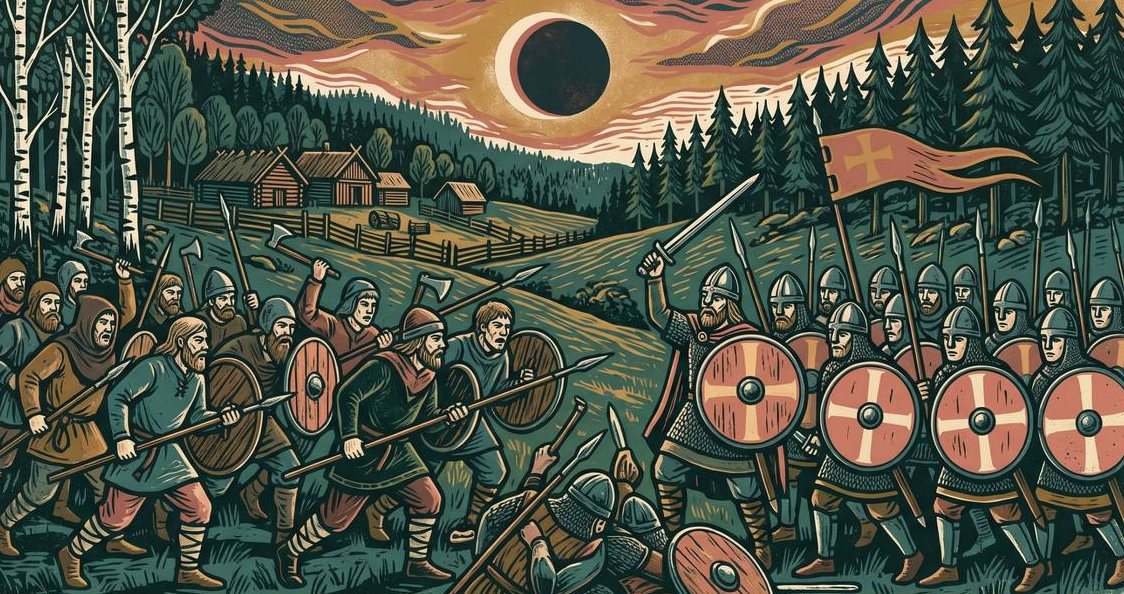
In the summer of 1030 two armies face each other at Stiklestad in Verdal. King Olaf Haraldsson, later called the Holy, comes from the east over the mountains to win back his kingdom. The farmers' army that meets him is led by, among others, Kalv Arnesson, son of the lendmann (the king's landed vassal) Arne Arnmodsson from Giske. On the king's side stand Kalv's brothers Finn, Torberg and Arne.
Verdal lies at the inner end of Trondheimsfjorden, a broad and fertile valley with fields, meadows and forest. It was one of the richest farming districts in the country, and the farmers there had much to lose under a king who demanded obedience, taxes and a new faith. Six years earlier King Olaf, king from 1015, had issued church laws at the Moster thing in Sunnhordland, and what they contained is disputed. The farms were run as mixed farms with grain, livestock and summer pastures, and the work was done by household members and servants, on the great farms probably also by thralls. Thraldom was in decline, and in Magnus the Lawmender's national law of 1274 thralls are gone as a group. The weight of Trøndelag also shows in the leidang (naval levy). In the Gulathing Law, the law for western Norway, as it survives from a later time, the Trønder were to provide 80 ships of the smaller type with 20 sesser (rowing benches), while Mørene were to provide 16 of the large type. Olaf had driven out or killed several of the magnates in Trøndelag, and many had accepted silver from Cnut the Great, king of Denmark and England. From Giske to Nidaros, present-day Trondheim, is an estimated 145 to 160 nautical miles along the route, a voyage of four to eight days when night harbours and waiting for weather are taken into account.
Kalv had himself been the king's man. The saga tells that Olaf had had the magnate Olve of Egge near Steinkjer killed because he led sacrifices to the old gods, and that the king gave Kalv both Egge and the widow Sigrid Toresdatter. Sigrid was a sister of Tore Hund of Bjarkøy, an island north of Harstad in Troms. Snorri has her urge Kalv against the king in the years that followed. When Olaf had to flee the country, Kalv stayed behind and went over to Cnut, who according to the saga promised him power and land.
The flight went past Giske. Snorri tells that the king went into Steinvågen between Hessa and Aspøya outside present-day Ålesund and lay there for the night, with twelve ships according to a local booklet. The magnate Aslak Fitjaskalle, who had killed Erling Skjalgsson of Sola near Stavanger, the most powerful man in western Norway, at the battle of Bokn in Rogaland, steered into the trading place Borgund, in present-day Ålesund, and was killed there by Vigleik Arnesson in revenge for Erling. Snorri has the king say of Erling's killing that with that blow Aslak had struck Norway out of his hand. The farmers' fleet of 25 ships went on the outside, while the king kept to the inner sounds, inside Nyrfi and Hundsver, through Vegsund east of present-day Ålesund and past Skotet in Storfjorden, the long fjord running inland from Ålesund, and on into Valldal. From there he went over the mountains and out of the country. The route is disputed. Local historians think the waters at Vegsund suit a war fleet poorly, and the dating varies between the autumn of 1027 and 1028. The sources also disagree about the year Erling fell. By one dating the flight fell in the time of year when the King's Mirror, written around 1250, advises seafarers to keep away from the sea. Ships were usually hauled ashore around the end of October, tarred and put in boathouses for the winter.
Kalv's brothers Finn, Torberg and Arne followed Olaf into exile in Gardarike (Kievan Rus'), the land along the great rivers east of the Baltic, where Prince Jaroslav and Princess Ingegjerd received him. Early in 1030 Olaf went west again, through Sweden and Jämtland, the province east of Trøndelag, and over Kjølen, the mountains on the border. He came down into Verdal with an army gathered on the way. His half-brother Harald Sigurdsson, later called Hardrada, fifteen years old, was with him. Sigvat the skald, the king's poet, was not there. He was on pilgrimage to Rome.
Snorri tells that the king's men advanced on the farmers' army with the battle cry «Fram, fram, Kristmenn, krossmenn, kongsmenn!» ("Forward, forward, Christ's men, cross men, king's men!") The king fell in the battle. Snorri writes that three men gave him his death wounds: Tore Hund with a spear, Torstein Knarresmed with an axe and a Kalv with a sword. He adds that there was disagreement over whether this Kalv was Kalv Arnesson or his kinsman Kalv Arnfinnsson. Who dealt the king his death wound was thus unclear already to Snorri. Harald Sigurdsson was wounded, got away and fled east. Many years later he married Torberg's daughter Tora.
After the battle Kalv walked over the battlefield and found his brothers wounded. The saga tells that he had them tended and took them under his protection. It also tells that Finn threw a weapon after him and called him treacherous to the king. Their brother-in-law had also stood against the king. Hårek of Tjøtta in Helgeland, married to their sister Ragnhild Arnesdatter, was one of the chieftains in the farmers' army. Two lines descended from the same father had stood on opposite sides, and both had acted according to what the age called duty: loyalty to the king they had sworn to, and loyalty to the districts, the kinsmen and the new lord who paid.
The date is disputed. Snorri places the battle on 29 July, and he also tells that the sun went dark while they fought. The known solar eclipse that year was on 31 August. Both days fell in the summer half of the year, when armies could make their way over mountains and fjords, and when the farmers should really have been haymaking.
Cnut the Great now ruled a realm around the North Sea: England, Denmark and Norway. In Constantinople Romanos III was emperor. Cnut did not keep his promise to Kalv. He set his son Svein and Svein's mother Alfiva to rule Norway, and the new laws on taxes and duties became so hated that the period was later called Alfivatiden, Alfiva's time. Already the following year Olaf's body was dug up in Nidaros, and Bishop Grimkjell had him proclaimed a saint on 3 August 1031. The king who fell gained more power dead than alive. In 1152 or 1153, around 120 years after the battle, Nidaros got an archiepiscopal see by his grave, for a church province that included Norway, Iceland, Greenland, the Faroe Islands, Orkney, Shetland and the Isle of Man in the Irish Sea. In Latin texts from the same time Olaf is called rex perpetuus Norvegiae, Norway's eternal king.
People: Kalv Arnesson, Finn Arnesson, Torberg Arnesson
Sources
Snorre, Olav den helliges saga; Sigvat skald; Kongsspeilet; Gulatingsloven, kap. 22; Fjord kommune, hefte om Olav den heilage; Storfjord1.no; Sunnmiddelalder.net; den svenske Heimskringla-utgaven med fotnoter; bygdeboka Borgund og Giske, bind I; Tore Skeie, Hardråde; Store norske leksikon, trell og leidang; rapporten «Havner, seilaser og mat langs kysten», kontrollert utgave; prosjektnotatene «Båtbygging, seil og leidang» og «Jordbruk i Norge 800 til 1650»; siden «Makten i riket» (Olavs lov og erkesetet) og siden «Slektsbånd».