Timeline · The king's in-laws
The Battle of Niså
1062
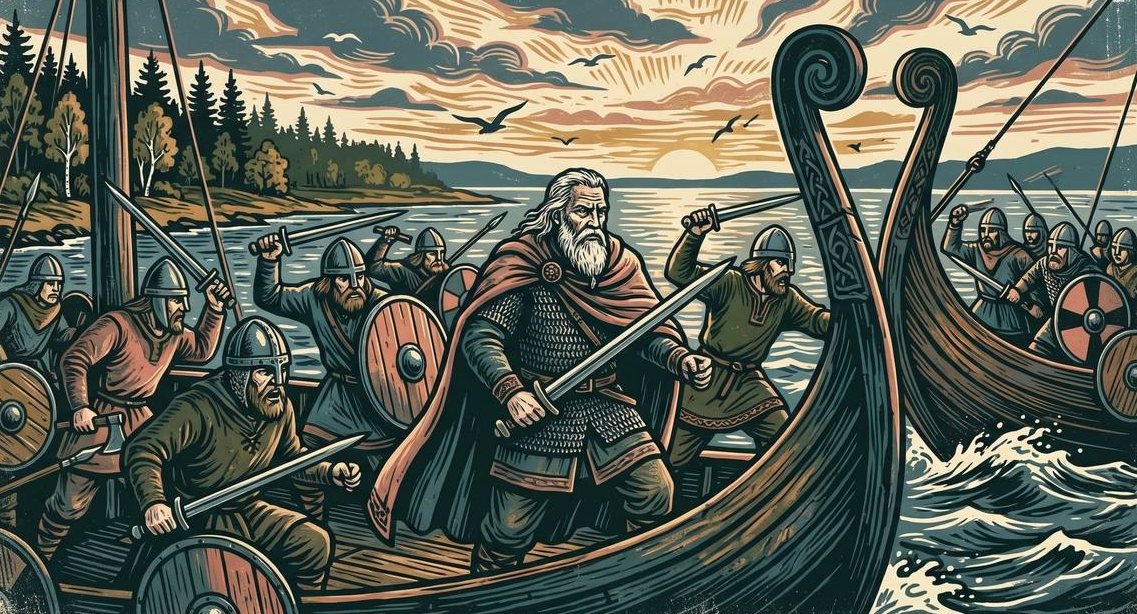
It is evening in August 1062, and the river mouth at Niså in Halland is full of ships. In the middle of the Danish fleet fights an old man who can barely see any more. He is jarl over this landscape. His name is Finn Arnesson, and he was born on Giske.
Halland is a flat and open coastal land between Scania and Viken, the land around the Oslofjord, with beech woods on the plains and four rivers flowing out into the Kattegat: Lagan, Nissan, Ätran and Viskan. Hallands kulturhistoriska museum describes the 11th century as a time of new clearing and growing population, when people moved further inland. The magnate's farm at Slöinge near Falkenberg, with a hall and imported goods, went out of use around the time Finn came. The thing (assembly) for all of Halland was probably held at Getinge north of Halmstad. A couple of kilometres up from the mouth of the Nissan lay Övraby with an 11th-century wooden church. Halland had no town and no mint; the right to mint lay with the king in Lund, Roskilde and the other Danish towns. The land was a border march between the Danish king and the Norwegians in Viken, and the route from the Oslofjord to the Øresund ran along the coast. Southern Halland lies near the zero point for land uplift, and by an estimate the sea stood only a few tens of centimetres to a metre higher than today. No battle site has been identified by the Nissan, and sea battles rarely leave traces on land.
Finn was the son of Arne Arnmodsson and brother of Torberg on Giske. He had been a member of the hird (royal retinue) of Olaf the Holy and had followed him into exile in Gardarike (Kievan Rus'), the land along the great rivers east of the Baltic. After the battle of Stiklestad in 1030, where King Olaf fell, he lived at Austrått at the mouth of Trondheimsfjorden, a seat which, like Giske, lay where ships had to pass. He was married to Bergljot Halvdansdatter, niece of both Olaf and Harald Hardrada, who became king of Norway in 1046. Harald was thus the uncle of Finn's wife and married to Finn's niece Tora Torbergsdatter from Giske.
The sources give two explanations for why he left Norway. Snorri Sturluson writes that Finn left because Harald had failed his brother Kalv, who was killed in Denmark around 1051 while fighting for Harald. Ågrip writes that the dispute was over the veitsler (royal grants of revenues): Harald wanted to take back the revenues he had given Finn, and Finn sailed to Denmark with seven longships and many kinsmen. Both may be true. For a lendmann (the king's landed vassal) the veitsler were both livelihood and honour, and a slain brother demanded redress. Seven longships were a great fortune. The Gokstad ship from Vestfold, with timber felled around 890, is 23.80 metres long and built of oak, with 16 strakes on each side and 32 oars, and the stem is hewn from a single curved oak log. How long such a ship took to build, only Danish figures can tell us. When the Viking Ship Museum in Roskilde built Havhingsten (the Sea Stallion), a replica of the longship Skuldelev 2 from Roskilde Fjord, around 44,000 working hours went into the hull. The museum reckons that in the Viking Age the work would have taken about seven months with one master shipwright and ten ship smiths, in addition to people who felled and split timber, forged rivets and carried. The ship required around 20 large oaks, 250 naturally curved pieces for frames, 8,000 iron rivets and 600 litres of tar. The planks were split from whole, straight trunks, and only a small part of the timber ended up in the hull. The sail came on top of this, and the Maritime Museum in Museum Vest reckons it was as valuable as the ship itself. The grave ships from Vestfold are built of oak, and oak was also the main timber in Denmark and Ireland. In western Norway ships were mainly built of pine. The sagas rarely name the builders. The exception is Torberg Skavhogg, who according to Snorri was master builder of Olaf Tryggvason's Ormen lange (the Long Serpent) at Ladehammeren by Nidaros, present-day Trondheim. Otherwise the sagas say that the king or jarl «bygde» ("built"), meaning that he was the one who had it built.
Svein Estridsson, Harald's enemy, gave Finn the title of jarl and set him over Halland. Snorri writes that he «lenge var jarl og verget landet mot nordmennene» ("was long jarl and defended the land against the Norwegians"). Svein was king of Denmark from 1047 to 1074, Harald of Norway from 1046 to 1066, and they were at war for almost twenty years. Adam of Bremen, the only near-contemporary source, writes only that the two kings fought all their lives. The war was about control of the coast from Viken to the Øresund and the trade through the Danish waters. Harald had burned Hedeby, near Schleswig in present-day northern Germany, the largest trading town in the North, and ravaged the Danish coasts. Cod bones from Hedeby derive genetically from the stock that spawns in Lofoten, so stockfish from northern Norway had reached the town long before Harald set fire to it. An exiled Norwegian magnate who knew Harald and his men was useful as a guardian of the border.
Finn was now probably around seventy and had poor sight. It was 32 years since Stiklestad, where he had fought on the king's side while his brother Kalv stood in the farmers' army, and where Harald, then fifteen, had been wounded. Snorri tells that the battle began late in the day and lasted all night. The sagas say that Svein had around 300 ships and Harald 150, and that the Danes lashed their ships together into fixed platforms. We can form a picture of the warships in Denmark at this time through Skuldelev 2, a longship of around 30 metres built in the Dublin area around 1042 and sunk in Roskilde Fjord in Denmark. During the night many of Svein's men rowed ashore and fled, and by dawn the battle was lost. Svein got away. Snorri tells of a farmer, Karl, who helped him, and local tradition links Karl to Söndrum north of Halmstad. Finn would not flee. The skald Tjodolv writes that he was captured in the middle of the battle line. The laws of the 12th and 13th centuries reckon with around 308 leidang (naval levy) ships along the coast from Viken to Hålogaland, the old name for northern Norway, and 150 ships would then probably correspond to about half the levy. The sagas' fleet figures are uncertain.
The sources disagree about almost everything apart from the outcome. The Danish historian Saxo tells of the battle in detail in Gesta Danorum around the year 1200. Finn is not in his account. In his version it is the Danes who are fewer, the Zealander Skjalm Hvide fights and is taken prisoner, and an oarsman named Aslak boards an enemy ship with an oak club. Saxo says he has the story from Archbishop Absalon, Skjalm's grandson. No Danish or Swedish source from the Middle Ages mentions Finn by name, so the office of jarl is known only from the sagas. The date 9 August is not in Snorri. It is used in modern scholarship, and Swedish tradition places the battle on the night before St Lawrence's Day, 10 August. At the same time the Normans were busy conquering Sicily.
When Finn was brought before Harald, Tora was on board the king's ship. The saga tells that Finn called the king a dog and Tora a mare. Harald let him live and set him free. Merchants bound for Halland took him with them. We know the cargo ships of this time from Norwegian and Danish finds. The Klåstad ship, a Norwegian knarr from 998 found near Larvik in Viken, was an estimated 20 to 22 metres long and carried whetstones from Telemark. Skuldelev 1, a knarr of around 16 metres with six to eight men, was built of pine in Sognefjorden around 1030 and sunk in Roskilde Fjord. A ship like that had only four oars and was a sailing ship: the Danish replica Ottar makes up to 10 knots under sail and 1.5 knots with the oars. Harald stayed in Oslo the following winter. Danish accounts place the peace between the kings in 1062, Norwegian ones in 1064. Finn probably died around 1065.
His daughter Ingebjørg was married to Torfinn, Earl of Orkney, the islands north of Scotland, and her sons Pål and Erlend became earls there. She was called «Jarlemor» ("Mother of Jarls"). King Malcolm III of Scotland married an Ingebjørg, and their son Duncan became king in 1094. Orkneyinga saga says she was Torfinn's widow, that is, Finn's daughter. Others think she was Torfinn's daughter. The sources disagree. Four years after Niså, Finn's two grandsons sailed with Harald Hardrada against England.
People: Finn Arnesson
Sources
Snorre, Harald Hardrådes saga; Ågrip; Tjodolv Arnorsson; Saxo, Gesta Danorum bok XI; Adam av Bremen; bygdeboka Borgund og Giske, bind I; Store norske leksikon; James R. Neal, Scandinavian Studies 2023; Hallands kulturhistoriska museum; von Heijne 2004; Star m.fl., PNAS 2017; prosjektnotatet «Arnesønnene i ikke-norrøne kilder»; Kulturhistorisk museum, Vikingskipshuset (Gokstad); SNL, Klåstadskipet; Vikingeskibsmuseet (Havhingsten, Ottar); Sjøfartsmuseum Museum Vest; Snorre, Olav Tryggvasons saga; Store norske leksikon (leidang); prosjektnotatet «Båtbygging, seil og leidang»; Orknøyinga saga; siden «Slektsbånd».