Timeline · The king's in-laws
The Battle of Stamford Bridge
1066
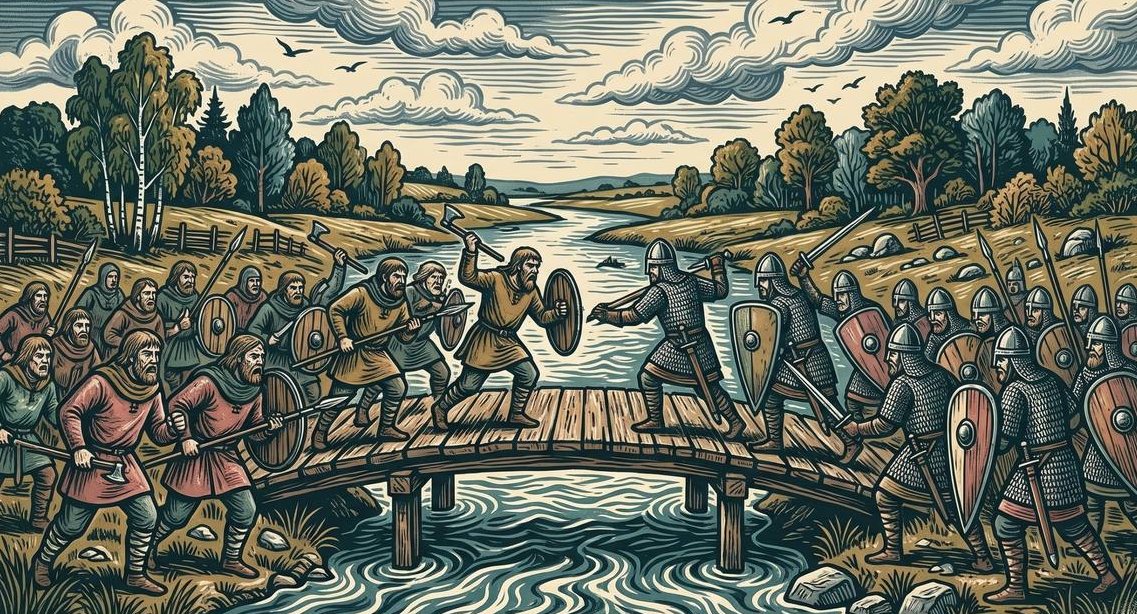
Monday 25 September 1066 is warm in Yorkshire. King Harald Hardrada of Norway has gone ashore by the river Derwent with two thirds of the army, and the men have left their mail shirts behind at the ships. At the ships the lendmann (the king's landed vassal) Øystein Orre from Giske waits with the rest of the army.
Øystein was the son of Torberg Arnesson and brother of Tora Torbergsdatter, who had borne King Harald two sons. He was a great-grandson of Arnmod, who according to the sagas fought at Hjørungavåg 80 years before. Snorri Sturluson calls him the most worthy of all lendmenn and the one the king loved most. He was betrothed to Harald's daughter Maria. Torvard Kråkenebbs tått, a short Icelandic tale, tells how he received a guest on Giske. The Icelander Torvard had offered King Harald the sail from his ship, and when the king declined, he gave it to Øystein, who thought it the finest sail he had seen. Øystein paid on Giske over several days. First Torvard received a richly embroidered tunic of new scarlet, and Øystein said it was not the payment for the sail. Then he received a cloak of grey fur covered with scarlet, and with that the sail was paid for. Finally he received a gold ring, because Øystein could not reward him as a king would have done. The tale is retold from an English translation, and the wording of the Old Norse text may differ. Scarlet was a fine and costly imported woollen cloth, and the fur came from the north. The gifts show that a good sail was reckoned on a par with luxury goods, and which goods a lendmann in Sunnmøre had to hand. Øystein was now around 53, Harald around 51.
The sail was worth so much because it demanded so much work. A large ship needed 100 square metres of woollen cloth or more, woven in long lengths on a warp-weighted loom. Saga Oseberg, the replica of the Oseberg ship launched in Tønsberg in 2012, was given a sail of about 90 square metres, woven from the wool of sheep in Vestfold. The Maritime Museum in Museum Vest reckons about 3.5 person-years of work for a sail of 150 square metres, and the Danish Viking Ship Museum estimates that the sail of the knarr replica Ottar, around 90 square metres, required wool from around 200 sheep and the work of five people for one year. The estimates vary widely. A large sail probably corresponded to the flocks of several farms for one year and one or more years' work for the women of a farm. A woollen sail could last an estimated 30 to 50 years and outlive the hull it was fitted to.
Edward the Confessor died in January 1066, and Harold Godwinson became king of England. Harald Hardrada laid claim to the kingdom on the basis of an agreement between Magnus the Good, king of Norway 1035 to 1047, and the Danish king Harthacnut. William of Normandy also laid claim. The exiled Tostig, brother of the new English king, was looking for allies, and he joined the Norwegians.
Harald gathered a large leidang fleet. The leidang was the naval levy in which the districts provided ships, crews and food for the king. Snorri gives him over 200 ships besides supply ships, while two versions of the Anglo-Saxon Chronicle have 300. The sources disagree. From Sunnmøre the leidang was, according to the Gulathing Law, the law for western Norway, to provide 16 ships of the large type with 25 sesser (rowing benches). There were two oars at each bench and two men at each oar, that is, 80 to 100 men on each ship, and at full levy that gives an estimated 1,300 to 1,600 men from Sunnmøre. Each skipreide, the district that provided one ship, was to build, equip and man its ship, keep the boathouse and sew the sail, and the sail was to be kept in the church between voyages. The ship was to be built on crown land if possible, otherwise in a man's forest. Giske had no woodland, and in 1647 the timber for the estate came from sawmills in Romsdal and Storfjorden, the fjords east of Ålesund, and it is reasonable to think that ship timber for Sunnmøre ships had to be fetched from the inner fjords. A ship lasted an estimated 20 to 30 years, and a ship district would then probably have to build a new one about once in every generation. The lendmann sent out the budstikke, the summons baton, and held the weapons thing. Whether Øystein was helmsman of a Sunnmøre leidang ship is not stated in the sources, and the law text was written down later than 1066.
The saga has the fleet gather in Solund, the islands at the outermost mouth of Sognefjorden, and cross the sea to Shetland and Orkney, the island groups north of Scotland. How the ships were built is shown by Norwegian and Danish finds. The Gokstad ship, the largest surviving Viking ship in Norway, is 23.80 metres long and has 32 oars. The replica Viking sailed in 1893 from Bergen across the Atlantic to Chicago, and Captain Magnus Andersen measured a speed of 10 to 11 knots. The largest ships were longer. Skuldelev 2, a longship of around 30 metres from around 1042, was found in Roskilde Fjord, and the Danish reconstruction Havhingsten (the Sea Stallion) has 60 oars and 65 men. Draken Harald Hårfagre, built in Haugesund and launched in 2012, is 35 metres long with 25 pairs of oars and sailed across the North Sea to England in 2014. It is scaled up from Gokstad according to Snorri's descriptions and is a hypothesis, and historians, among them Eldar Heide, have criticised calling it a Viking ship because it is not based on a find. From Giske to Lerwick in Shetland is an estimated 460 kilometres, which in a good wind could be sailed in a day and a half to two and a half days. From Shetland to Orkney was a long day's leg, and from Orkney to the mouth of the river Tyne in northern England an estimated 500 kilometres, or two days and nights in a good wind. The time in harbour was often longer than the time at sea. When Havhingsten was to cross the North Sea in 2007, the ship lay for almost two weeks waiting for an east wind that never came, and in the end it had to be towed. The King's Mirror, written in the 13th century, advises merchants to sail in summer and keep away from the sea in autumn. Harald sailed late in the summer, and a voyage home the same year would probably have fallen in the season the advice warns against.
On board the men ate porridge, flour, stockfish, butter and bread, and they drank water. Ale belonged on the ships of kings and chieftains. The Gulathing Law, as written down later, says that the farmers were to send «to månadsmatar av kvart» ("two months' food of each kind") to each hamle, that is, each oar place, that the crew were to cast lots for who would be cook, and that a crew that had run out of food could «saklaust slakta to naut hjå ein bonde» ("slaughter two cattle from a farmer without penalty") for a fixed payment. Many of those who rowed in the ships from Sunnmøre were probably leidang men from the districts around Giske, but no source says so directly. According to the law, lauskarer, men without a farm of their own, were taken first, then farmers with labourers, and the usual leidang service was two months. A fleet that went west late in the summer could hardly expect to be home within that time.
In Orkney Queen Ellisiv, Harald's wife from Kiev, and the daughters Maria and Ingegerd stayed behind. The earls Pål and Erlend joined the fleet. They were sons of Ingebjørg Finnsdatter, grandsons of Finn Arnesson, and four years earlier the king they now followed had taken their grandfather prisoner at Niså in Halland, on the west coast of present-day Sweden. The fleet went into the Humber estuary and up the river Ouse and landed at Riccall, south of York. On 20 September the Norwegians defeated the northern English earls at Fulford just south of the city, and York surrendered.
Five days later Harold Godwinson came unexpectedly overland from the south with a large army. Snorri has him offer his brother Tostig a third of the kingdom, and Harald Hardrada seven feet of English ground, or as much more as he was taller than other men. Harald Hardrada sent word to the ships. Øystein led the reinforcements on a forced march in the blazing sun, and many threw off their mail shirts on the way. When they arrived, the king had fallen, struck by an arrow in the throat. Tostig had taken his place under the banner, and he too had fallen. Øystein took the king's banner, Landøyda (Land-waster), and attacked. Snorri calls the fight Orre-ria, Orre's storm. The men were exhausted after the march, and most had no mail. Øystein fell together with almost all the Norwegian magnates. The saga tells that Maria died the same day in Orkney.
Harald's son Olaf, Tora's son, had stayed behind at the ships. The English king let him and the Earl of Orkney go home after they had sworn peace. The sources disagree about the number of ships. The Anglo-Saxon Chronicle (version D) says 24, John of Worcester 20. The Chronicle mentions Olaf and the Earl of Orkney, and John of Worcester mentions «Paul, earl of Orkney», Finn Arnesson's grandson. No English source mentions Øystein. The sources also disagree about where the ships lay. Snorri has the fleet go up the Derwent, while English sources and modern scholarship place the ships in the Ouse at Riccall and the battle at the Derwent. Olaf became king in Norway together with his half-brother Magnus, who had stayed at home. Both had Tora from Giske as their mother, and the family that had lost Øystein at Stamford Bridge was now the kings' maternal kin.
Three weeks after the battle of Stamford Bridge, the bridge over the Derwent east of York, on 14 October, Harold Godwinson fell at Hastings on the south coast of England against William of Normandy, who was crowned in London on Christmas Day. The battle also tied the families together. Tostig's grandson Åsolv of Rein in Rissa in Trøndelag later married Tora Skoftesdatter from Giske, and from them came the Rein family (Reinsætta), the family of King Inge Bårdsson and Duke Skule.
People: Harald Hardråde, Øystein Orre
Sources
Snorre, Harald Hardrådes saga; Torvard Kråkenebbs tått (engelsk gjengivelse); Anglo-Saxon Chronicle (D); John of Worcester; Kongsspeilet; Gulatingsloven, utgjerdsbolken (kap. 6 til 22); Kelly DeVries, The Norwegian Invasion of England in 1066 (1999); Kulturhistorisk museum, Vikingskipshuset (Gokstad); Magnus Andersen om Viking 1893; Stiftelsen Nytt Osebergskip (Saga Oseberg); Viking Kings AS (Draken Harald Hårfagre) og Eldar Heides kritikk; Vikingeskibsmuseet (Havhingsten, Ottar, ullseil); Sjøfartsmuseum Museum Vest; EXARC Journal (Roar Ege); Store norske leksikon (leidang, skipreide); bygdeboka Borgund og Giske, bind I; prosjektrapporten «Havner, seilaser og mat, kontrollert»; prosjektnotatene «Båtbygging, seil og leidang» og «Giske: landskap, beliggenhet og jordbruk»; siden «Slektsbånd» (Rein og Tostig) og siden «Makten i riket».