Timeline · In the government of the realm
The Black Death
1349
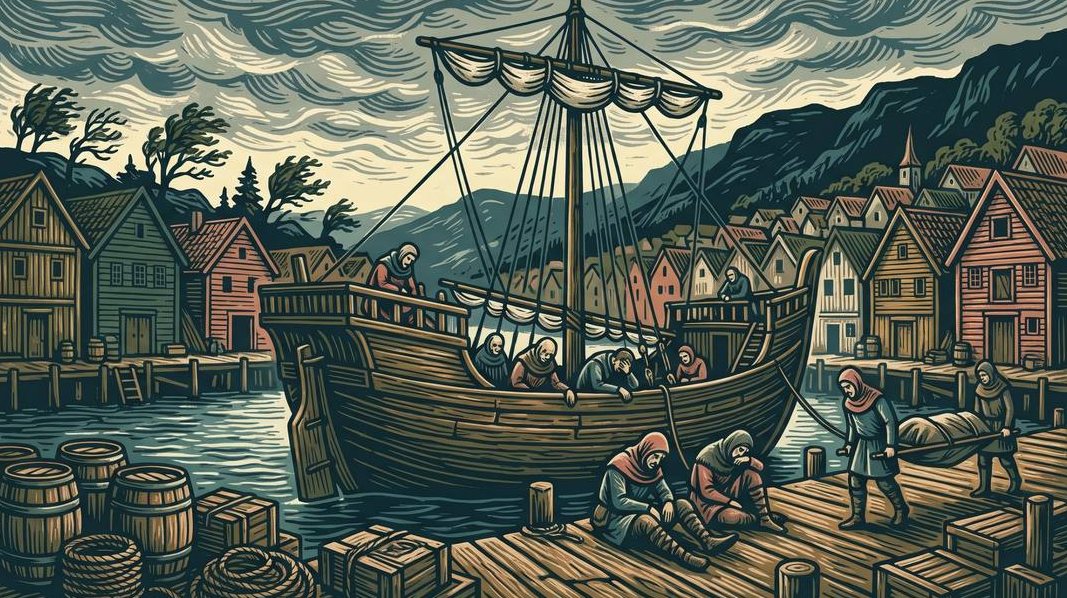
At some point in 1349 a cog from England moors at the wharves in Bergen. According to the Icelandic priest Einar Hafliðason, the plague came with it. Within a year it has spread across the whole country.
Bergen was Norway's largest town and the hub of trade across the North Sea. Along Vågen, the harbour bay in the middle of the town, the town yards lay close together, with wooden houses, wharves and storehouses where the stockfish from the north was kept before it went on to England and the German towns. Ships came and went all through the summer half of the year. Around 1300 the population of Bergen is estimated at about 7000, against about 3000 in Nidaros, present-day Trondheim. Most people in the country lived their whole lives on the farms. From the town the sailing route ran north past the Stad peninsula and Giske to Trøndelag and Hålogaland, the old name for northern Norway, and south and east to Viken, the land around the Oslofjord.
The plague had been moving across Europe since 1347, from the port towns of the Mediterranean northwards through France and England. In many towns more than half the people died. In Norway it spread from Bergen along the coast and into the valleys. How many died in Norway is disputed. Einar Hafliðason wrote that only a third or a quarter of the people survived, and that is regarded as an exaggeration. Store norske leksikon estimates that the population may have fallen by 30 to 45 per cent, while Ole Jørgen Benedictow reckons that about 220 000 people, around 60 per cent, died within a few months. The plague returned, more than twenty times up to 1654 according to Store norske leksikon and about fifteen times according to Benedictow. Of around 60 000 farm holdings, 36 000 to 37 000 lay deserted in the 1400s. It was the smallest and most remote farms that were abandoned, and land prices and land rents fell while wages rose. At the start of the 1500s the land rent was about a quarter of its level around 1350. The fisher farmers on the outer coast could trade stockfish for grain, and outer Sunnmøre was probably hit less hard than the inner fjord districts. No source, however, gives figures for Sunnmøre. According to Nils Hybel's survey, reports of famine disappear from the annals of northern Europe from around 1320 to around 1500, and this is probably connected with the plague having removed the pressure on the land.
Erling Vidkunsson, the owner of Giske and former drottsete (steward of the realm), the highest officer of the realm under the king, was around 57. From 1347 he was sysselmann (royal district officer), the king's officer, in Sunnmøre, and in March that year he had conducted a land case in the hall at Bjarnegarden on Veøy, a small island in Romsdalsfjorden. According to Knut Helle in Norsk biografisk leksikon, he went on pilgrimage to Rome after the Black Death, from 1349 to 1351, was taken prisoner in England and ransomed by Archbishop Olav of Nidaros. In thanks he gave Tjøtta and Tilrem in Brønnøy in Helgeland to the archiepiscopal see. The source is probably the land register of Archbishop Aslak Bolt from the 1430s. The year 1350 was a jubilee year in Rome, when pilgrims could receive a plenary indulgence. The letters from Giske fit poorly with such a long journey. In April 1350 Erling was party to a settlement on Giske, and whether he was there himself or had an estate steward, the letter does not say. Here the sources are out of step.
The letter of 5 April 1350, the Monday after Easter week, tells that Kolbjørn Simonsson came to terms with Erling after dealing two blows to Gudløg Aresson and Jon Dode and breaking the Easter peace. Violence in a holy time of peace was punished more severely than at other times. Kolbjørn paid with four månedsmatsbol at Mo in Ørskog, by Storfjorden east of Ålesund, and Erling bought two more bol in the same farm. One he paid for with six såld of grain and goods worth two mark, the other with five marks' worth of cloth, probably in Bergen the same summer. The letter does not say a word about the plague.
In August 1351 Kolbein Toresson wrote that he owed the canons at the Church of the Apostles in Bergen 22 mark for an office he had held for them, and that he was unable to pay. Erling paid for him and received 7 månedsmatsbol on Gudøy in the parish of St Peter's Church in Borgund, east of central Ålesund. Two years later, on 28 October 1353, Erling showed him on Giske that the houses on the farm were not as good as they should be, and Kolbein gave him one more bol. This may be connected with many farms falling into disrepair and many people being in debt in the years after the plague, but the sources do not say so directly.
The plague also struck trade. With fewer fishermen and fewer tenant farmers, the land rent fell, and the landowners had less fish to send to Bergen. Vágar in Lofoten lost its position after the middle of the 1300s, and the fish went straight to Bergen instead. There the German merchants gained a firm grip on the stockfish trade through the German Kontor (Hanseatic office), the office of the Hanseatic merchants on Bryggen, which was organised around 1360. Bergen never fully recovered after the plague. Exports of stockfish may have fallen to about half by the end of the 1300s, while the price rose noticeably in the second half of the century. It is likely that fewer fishermen and a higher price were connected. The plague also weakened the leidang (naval levy), the system under which the farmers provided ships and crews for the king. Fewer people meant fewer crews and less tax, and larger ship types made the farmers' fleet obsolete. The last known leidang fleet, four large ships manned by noblemen, was defeated south of Bergen in 1429 by a German fleet of cogs.
In these years Erling lost his son. Bjarne Erlingsson the younger was a knight, had been at the king's court and sat on the king's council. In January 1347 he was among the judges in Oslo who established that the brothers Sigurd and Jon Havtoresson had no right to Borgarsyssel, the area around Sarpsborg in present-day Østfold, five years after Sigurd Havtoresson had been betrothed to Bjarne's sister Ingebjørg. Bishop Håkon in Bergen had written him warm letters. In December 1338 the bishop asked him to «think diligently on the honourable kin you are descended from» and reminded him of the verse «Quicquid agas prudenter agas et respice finem», whatever you do, do it wisely, and consider the outcome. The following year he asked him to win through with patience and wisdom, without haste. Bjarne had also laid claim to the fishing village of Grip far out in the sea off Kristiansund, which the archbishop held that the church of Nidaros had long owned.
When Bjarne died is unclear. The sources disagree between 1349 and 1353, and Helle reckons with 1353. The deed of gift in which Erling gave Giske to his daughter Ingebjørg in January 1354 speaks of his «last hour», and that may suggest it was not long since. Whether he died of the plague, we do not know. He was childless, and with him the male line of the Bjarkøy branch died out, the family from Bjarkøy in Troms to which Erling belonged.
Others sought comfort from the pope. In July 1351 Sigurd Havtoresson, Ingebjørg's husband, together with four bishops, another knight and a canon, received the right to choose his own confessor, who in the hour of death could give them forgiveness for all sins. After the plague many applied for such letters, for death came suddenly, and many died without a priest. King Magnus Eriksson still ruled both realms. In the following decades the royal line died out on the male side, and Norway got kings who lived elsewhere. When Eric of Pomerania was crowned union king over Norway, Denmark and Sweden at Kalmar in 1397, it was 48 years since the plague came to Bergen.
People: Bjarne Erlingsson den yngre
Sources
DN 2/280; DN 2/306; DN 1/326; DN 1/338; DN 1/303; DN 8/117; DN 8/124; DN 9/108; DN 7/229; Islandske annaler; Norsk biografisk leksikon (Helle); Store norske leksikon («Svartedauden», «norsk fiskerihistorie», «ødegård», «landskyld», «leidang»); Benedictow (anmeldt i Tidsskrift for Den norske legeforening 2003); Hybel (Historisk Tidsskrift, DK); Helle 2019 (AmS-Skrifter 27); prosjektnotatene «Jordbruk i Norge 800 til 1650», «Fiske og fiskeredskap», «Båtbygging, seil og leidang», «Giskebrevene 2», «Fiskeværene og Giskegodset» og «Giskefolket i arkiver og kilder»; nettsidens sider «Makten i riket» og «Slektsbånd».