Timeline · The Arnlings
Arne Arnmodsson, lendmann
c. 1015 to 1025
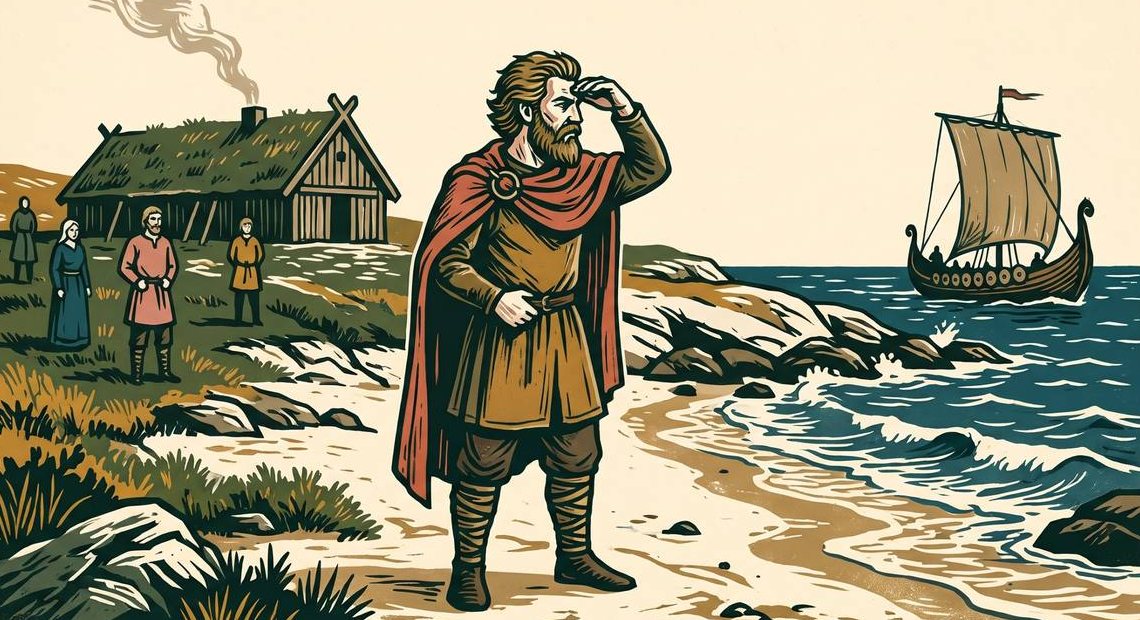
The saga writer Snorri Sturluson writes of him in one sentence: «Arne var lendmann, mektig og gjæv og ein god ven til kong Olav.» ("Arne was a lendmann, mighty and worthy, and a good friend to King Olaf.") Arne Arnmodsson is the first in the family who, by all accounts, sat on Giske, and the first to serve a king over all Norway, Olaf Haraldsson, later called the Holy, king 1015 to 1028.
From the southern shore of Giske he could see the ships coming in through Breisundet, the approach from the sea to Ålesund, and gliding through Giskesundet beneath the neighbouring island of Godøya. The island lies low, and the view was what it had to offer. Giske had no sheltered harbour, and the ships were probably hauled up or moored by the shore below the chieftain's seat, where the church was later built. Where the boathouses stand today, south of the church, archaeologists in 1992 and 1993 found lime-mortared walls of a stone house from the late 12th or the 13th century. The excavator Larsen first interpreted it as a stone boathouse or a sea storehouse, but the plaster on the walls and the door between two rooms fit better with a two-storey stone house. NIKU, the Norwegian Institute for Cultural Heritage Research, believes that much of the stone was removed when the newer boathouses were built, and that the building stood there because this was where the boats could land. Boathouses from the Viking Age have not been found. At the seat archaeologists have found thick cultivation layers from the Viking Age, and barley and oats were sown in the light sandy soil. At the same place stood an oven for rendering seal oil, with a well-preserved seal flipper, and the lower part of the oven is dated 900 to 1020, to Arne's lifetime or just before. The cooking pits at the church site, dated 540 to 680, show that people had been there for over 300 years before Arne's time. The soil dried quickly in spring, but it was poor in nutrients and prone to sand drift, and seaweed and kelp were used for manure and fodder. The fields were ploughed with an ard. The work was done by the household and probably by some thralls. The Frostathing Law, written down later, counts three thralls as part of a good farm, and Snorri tells that Erling Skjalgsson at Sola near Stavanger, father-in-law of Arne's son Torberg, had 30 thralls at home. The figure was written down about 200 years after Erling's death. It is likely that the grain on the island was never enough, and that fish was what kept the farm going.
Fishing was done with handlines from open boats. In Sunnmøre the deep handline was called dypsagn, and it was held down with sinkers. The spring cod came into Borgundfjorden off Ålesund, outside Giske, from February until the end of March, and because the fishing fell in winter, it could be combined with farm work for the rest of the year. The archaeologist Sørheim dates the transition to commercial fishing on the coast to the 12th century. Most of the catch in Arne's time therefore probably went to the household's own use, to feasts and to gifts. The surrounding farmers were still mostly freeholders. The majority became tenant farmers, farmers who rented the land they worked, between the 11th and the 13th centuries, and the power of a chieftain on Giske in Arne's time rested mostly on kinship, alliances and control of the sailing route.
About ten kilometres south-east of Giske, by Katavågen in Borgund, in present-day Ålesund, lay a small kaupang, a trading place. The excavations there from 1954 covered 5,300 square metres and produced about 45,000 objects and a body of bone material of the same size. Borgund is first mentioned in written sources in connection with the events after the battle of Bokn in Rogaland in 1027 or 1028. The sources disagree about the year. According to the local history, the lendmann on Giske had oversight of the kaupang, and from the island he could follow the traffic in and out. Stockfish, skins and whetstones went south. Grain, clothing, wine and silver came back. A Norwegian cargo ship from Arne's youth has been found at Klåstadkilen in Tjølling near Larvik and dated to 998. The keel is 16.25 metres, and the ship was an estimated 20 to 22 metres long and 4.5 metres wide, with a bottom of oak and upper planks of pine. It was found with a cargo of whetstones from Eidsborg in Telemark, the same kind of goods that went through Borgund, and is today at the Slottsfjell Museum in Tønsberg. The nearest ship find to Borgund is the Kvalsund ship from Herøy, south-west of Ålesund, a ship of about 18 metres with ten pairs of oars. It is older than Arne's time, and its dating is disputed, c. 690 plus/minus 70 or 780 to 800. A full-size replica stands at Sunnmøre Museum in Ålesund. The ships that sailed past could also have resembled Skuldelev 1, a knarr built of thick pine planks in Sognefjorden around 1030 and later sunk in Roskilde Fjord in Denmark. It is just under 16 metres long and 4.8 metres wide and could be sailed by six to eight men. The Danish replica Ottar, built by eight boatbuilders in 1999 and 2000, takes around 20 tonnes of cargo and has reached about 10 knots under sail, but only 1.5 knots on four oars. In calm weather a ship like that lay and waited. Pine from the western fjords was the main timber in the ships of western Norway. Giske had no woodland, and it is reasonable to think that a chieftain on the island had to fetch ship timber from the inner fjords, from his own estates, through exchange or from the king's forests.
Arne was born around 960 to 970, and when Olaf Haraldsson became king in 1015 and 1016, he was probably between 45 and 60 years old. By the same estimates he was between 16 and 26 when his father Arnmod, according to the sagas, fought in the battle of Hjørungavåg in Sunnmøre in 986. From Arne's birth to today is about 35 generations, reckoning 30 years per generation, an estimate. He married Tora, daughter of a Torstein Galge about whom the sagas say nothing more. They had at least seven sons and a daughter: Kalv, Finn, Torberg, Åmunde, Kolbjørn, Arnbjørn, Arne and Ragnhild. Ragnhild married the chieftain Hårek of Tjøtta in Helgeland, in old Hålogaland in the north. The sons were spread out across the country. Kalv got the great farm Egge near Steinkjer in Inntrøndelag, Finn came to Austrått at the mouth of Trondheimsfjorden, and Torberg married a daughter of Erling Skjalgsson at Sola, the most powerful man in western Norway, and the sagas tell that Arne's son Arne also got one of Erling's daughters. Erling's wife Astrid was a sister of King Olaf Tryggvason, king 995 to 1000. The local history calls it a consistent marriage policy: the chieftains on Giske married into the highest families in the land, while the other great families of Sunnmøre married within the region. Through these marriages the family had friends and kinsmen from Rogaland to Hålogaland.
No saga says outright that Arne lived on Giske. What is certain is that his son Torberg sat there, and that Torberg's wife came from Sola. The local history therefore reckons that the farm came from Arne or from his wife. No source says so directly. Arne died after the conversion and, according to the local history, was probably buried at a church. The bauta stone on Ørnebakken, the burial cairn north of the church on Giske, can therefore hardly be his.
Around the year 1000 there was no state in Norway as we think of one. Power lay with the chieftains on the great farms, who had land, ships, kinsmen and men who followed them, and who were listened to at the thing (assembly). Most farmers still owned the land they worked. Being a lendmann meant governing a district for the king. Arne was responsible for the leidang and the beacons, collected the taxes, led the men in war and attended the thing. In return he received veitsler, revenues from the king's estates. The office required a man of old family, because only such a man had the respect needed to make the farmers obey the king. The Gulathing Law, the law for western Norway, was probably written down between the late 11th and the mid 12th century, and it shows what the leidang demanded of the districts. The lendmenn and the king's årmenn, the stewards of the royal farms, sent out the budstikker, the summons batons, and called up the crews, and they proclaimed the weapons thing in the autumn and held it in the spring. The ship itself was the farmers' responsibility. Each skipreide, the district that provided one ship, was to build, equip, maintain and man one ship, each manngerd, a group of farms, provided one man with weapons and food, and a helmsman appointed by the king commanded the ship. Mørene, probably Sunnmøre, was to provide 16 ships of the large type with 25 sesser (rowing benches). The boathouse was a shared duty, and anyone who did not build his part paid a fine of 3 marks to the king. The sail was to be kept in the church, and the helmsman set a deadline for sewing the sail, with a fine for every ell that was missing. Each man was to have an axe or sword, a spear and a shield, and the farmers were to provide 24 arrows and one bow for each thwart. The beacons were to be lit when five ships or more came. The farmers were to choose a cook by drawing lots, and they were to send «to månadsmatar av kvart» ("two months' food of each kind") to each oar place, in butter and flour and other items reckoned separately. If the food ran out, the crew could «saklaust slakta to naut hjå ein bonde» ("slaughter two cattle from a farmer without penalty") and pay two øyrar for the cow. How much a month's food was, we do not know. Much suggests that the lendmann on Giske called out the levy, held the weapons thing and commanded ships, in addition to the ships the family owned itself. No source says that a Sunnmøre leidang ship stood on Giske, and whether the law's arrangement applied in Arne's time is uncertain.
In Arne's time Christianity was introduced as the faith of the realm, and Olaf travelled around with priests and his hird (royal retinue) and punished those who held on to the old sacrifices. The local history believes Arne changed sides in time, from the old jarls and hersar to the king, the hird and the Christian priests. The sources say nothing concrete about what he did in the conversion itself. That the feasting place and the burial mounds at the seat on Giske later got a church close by is a finding that fits such a shift. Who built the first church on the island, no source says.
The dispute over trade shows why the king needed men like Arne. Snorri tells of Asbjørn Selsbane, a young magnate from Hålogaland. After bad years in the north the king forbade the export of grain from western Norway. Around 1022 to 1023 Asbjørn sailed south anyway to buy grain. The saga tells that he was allowed to buy from Erling Skjalgsson's thralls at Sola, because the king's ban did not apply to people who stood outside the law, and that the thralls farmed their own small plots. At Avaldsnes on Karmøy the king's steward (årmann) Tore Sel took the cargo and sailed off with it. The next year Asbjørn killed Tore Sel in the royal farm, and Erling Skjalgsson came with his army and forced a settlement. The historian Claus Krag considers the grain ban particularly unreliable, and the sources are therefore uncertain on this point. The story shows at any rate that the saga writers of the 13th century saw grain as a political commodity. Two great famines are recorded in northern European annals in the 11th century. Grain was power. Whoever decided who could buy it also decided who would get through the winter in the north. A lendmann by the sailing route stood in the middle of this, duty-bound to enforce the king's ban and with neighbours and kinsmen who lived off the same trade.
At the same time the North Sea became one realm. Cnut the Great became king of England in 1016 and of Denmark in 1018. In 1014 Irish kings had defeated the Vikings of Dublin at Clontarf, just north of the city, and in the German realm Emperor Henry II reigned. Cnut's power rested on his fleet, and Bergen Maritime Museum estimates that it may have needed up to a million square metres of sailcloth. Cnut laid claim to Norway too, and his silver reached the magnates along the coast. It would split Arne's sons, who in 1030 stood on opposite sides at the battle of Stiklestad.
People: Arne Arnmodsson
Sources
Snorre, Olav den helliges saga, kap. 110 og fortellingen om Asbjørn Selsbane; Gulatingsloven, utgjerdsbolken og kap. 22; Frostatingsloven; bygdeboka Borgund og Giske, bind I; UiB, Borgund kaupang-prosjektet; NIKU Oppdragsrapport 168/2013; SNL, Klåstadskipet; Nordeide, Bonde og Thun 2020 (Kvalsundfunnet); Sunnmøre Museum; Vikingeskibsmuseet, Skuldelev og Ottar; Bergens Sjøfartsmuseum; Sørheim; Hybel, Historisk Tidsskrift (DK); SNL, leidang, trell, ard, Asbjørn Selsbane og norsk fiskerihistorie; prosjektnotatene «Giske: landskap, beliggenhet og jordbruk», «Båtbygging, seil og leidang», «Jordbruk i Norge 800 til 1650» og «Fiske og fiskeredskap»; UiB, rapport fra Giske kirkested 2011 (seloljeovnen); siden «Makten i riket» og siden «Slektsbånd»; prosjektrapporten «Funn i Møre og verden».