Timeline · The family become lendmenn
The fire on Giske
1264
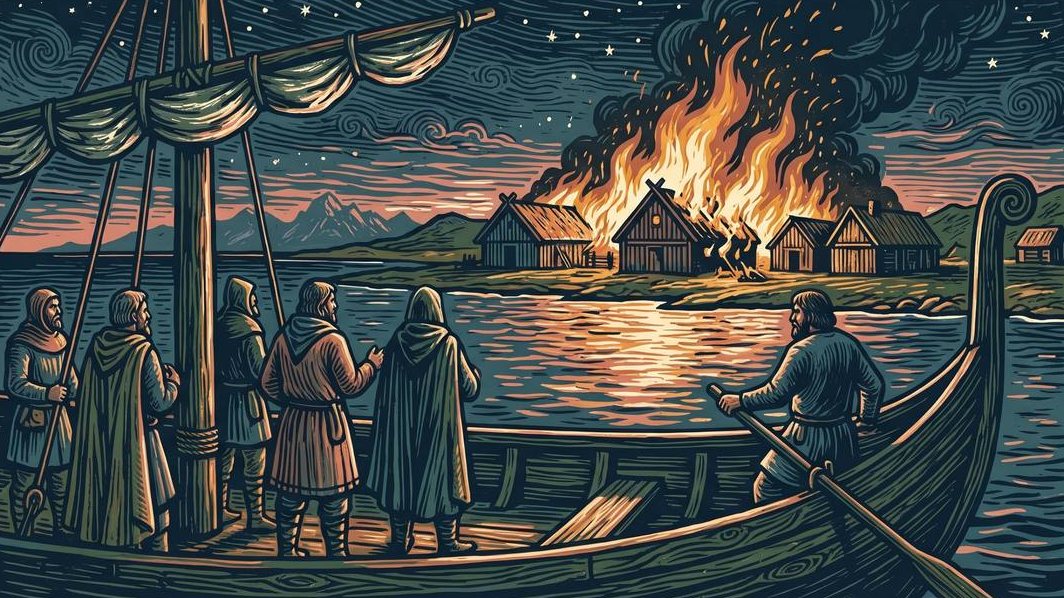
In the autumn of 1264 King Magnus Håkonsson, later called the Lawmender, lies with his ships in Steinvågen, on the way from Bergen to Nidaros. Across the water he sees a fire. It is the old farm on Giske, burning.
Steinvågen is, by the editors' identification, the bay between the islands of Hessa and Aspøya, where Ålesund lies today. The bay is mentioned in the land register of Munkeliv Abbey around 1200, according to a secondary source. Snorri Sturluson tells that Olaf Haraldsson, later called the Holy, lay here one night on his flight north in 1027 or 1028, and the sources disagree about the year. That same night the magnate Aslak Fitjaskalle was killed in Borgund, the kaupang (trading town) east of present-day central Ålesund. When two kings more than 230 years apart used Steinvågen on the same route, it is reasonable to think that it was a regular night harbour before ships went out past Breisundet, the sea strait west of Ålesund, and on towards Hustadvika in Romsdal. From Bergen to here the route is an estimated 140 to 150 nautical miles, and with night harbours and waiting at Stad, the peninsula north of Nordfjord, the journey took an estimated three to seven days. The next leg to Nidaros, present-day Trondheim, is an estimated 145 to 160 nautical miles. The King's Mirror, a Norwegian book of instruction written around 1250, advises seafarers to keep away from the sea in autumn and to tar the ship before winter, and the king followed the inner route between the islands. On board, the crew lived on porridge, flour, dried fish, butter and bread. On the king's ship there was also ale.
The saga of Magnus the Lawmender survives only in fragments. The 2013 report from NIKU, the Norwegian Institute for Cultural Heritage Research, gives the episode in Finn Hødnebø's translation. The king said that it was not fitting to sit still. The fehirde, the king's treasurer, Jon Tviskaven set off with two men from most of the half-rooms on the ships, with a poor wind. «They managed to save the new farm that Nikolas had had built, but the old one burned.» The distance from Steinvågen to Giske is an estimated five kilometres, a trip the crew could row the same evening. That same autumn Nikolas Petersson died, the lendmann (the king's landed vassal) on Giske and the last man of the old Giske family. Other accounts give 1265 as the year of his death, and the sources disagree.
Magnus was 26. He had been king together with his father since 1257 and had been crowned in 1261. The law of succession of 1260 had laid down that the realm was to pass from father to eldest legitimate son, and after the civil wars Norway had become a hereditary kingdom. His mother, Margrete Skulesdatter, was the daughter of Jarl Skule Bårdsson, who rebelled against Håkon Håkonsson in 1240, and descended through the Rein family at Rein in Rissa by the Trondheimsfjord from Tora Skoftesdatter of Giske. The genealogy suggests that the king and Nikolas Petersson were distant kinsmen. He had ruled alone for less than a year. The summer before, his father, King Håkon Håkonsson, had led the leidang fleet west, the ships the farmers were obliged to provide for the king. The saga of Håkon Håkonsson tells that the king lay at Herdla-ver on Askøy north-west of Bergen, went out from Solund at the outermost end of the Sognefjord at the beginning of July and was «two nights on the sea» before he reached Shetland with a large part of the army. UiB calls the levy of 1263 the largest leidang in Norwegian history, with 120 ships in all, and the king's own ship was, according to the saga, built in Bergen, of oak, with 37 rooms and a gilded dragon head. Under the Gulating Law, the old law for Western Norway, «Mørene», probably Sunnmøre, was to provide 16 ships with 25 sesser (rowing benches), each with room for 80 to 100 men, but whether Sunnmøre ships or men from Giske took part in 1263 is not stated in the sources that have been read. After the battle of Largs on the west coast of Scotland in October 1263 the fleet withdrew to Orkney, the islands north of Scotland, and there Håkon died in December. SNL believes the expedition showed that a large leidang levy could be beaten by smaller, trained forces with horsemen. At the same time Iceland had come under the Norwegian king in the years 1262 to 1264, and Greenland in 1261. In England the barons were fighting King Henry III, and in May 1264 Simon de Montfort defeated the king's army at Lewes in southern England. Two years after the fire, in 1266, Norway ceded the Hebrides and the Isle of Man to Scotland.
Magnus was soon to change the leidang. From around 1200 the king had received part of the leidang provisions every year as a tax, and from the end of the 1200s the tax was reckoned according to the farm's land rent, the annual rent to the landowner. Under Magnus, the farmers' contributions to ships, boathouses and equipment were to be paid in money and collected by three-man committees. The Code of the Realm (Landsloven) of 1274 gave the whole country one law, and in it the king swore to keep the laws of Olaf the Holy as they had been amended in agreement with «those who settle the land», that is, the thing (assembly). The law extended the leidang service from two to three months, and in it the thralls have disappeared as a separate group, except for the cooks on the leidang ships. The Gulating Law had required the farmers to send two months' food of each kind for every oar place, and a crew that had run out of food could slaughter two cattle from a farmer at 2 øre for a cow.
Archaeologists have found the traces of the chieftain's seat by the church. About 60 metres south-south-west of the church, by the boathouses, stand the walls of a stone house of two rooms with a doorway one and a half metres wide between them. The walls are bonded with lime and rendered inside, «it looks as if the walls have been slurried». One wall is 2.2 metres thick. The archaeologists Larsen and Reimers consider the character of the masonry typical of the end of the 1100s and the 1200s. The original floor is a burnt layer, and the C14 dates from it give 1160 to 1290 and 1000 to 1160. Outside lay burnt remains of timber houses that were in use at the same time as the stone house. Between the house and the churchyard lay a yard of cobblestones and a flagstone path. In the fill lay two bricks «of the medieval type». Larsen and Reimers link the burnt layer to the fire of 1264. The dates are so broad that an earlier fire is also possible.
West of the church, ground-penetrating radar in 2013 found a structure of compact material, probably stone, 49 metres long and up to 7 metres wide, with two almost square projections on the north side. It has the same orientation as the stone house. NIKU writes that it «may correspond to a building or building wing». For comparison, the main wing of the archbishop's residence in Bergen is around 60 by 12.5 metres. In 1823 Lorentz Klüwer wrote of a foundation wall «100 Alen lang og 50 Alen bred» (100 ells long and 50 ells wide) and a paved area between the wall and the church. Where «the new farm» stood is unknown. If the fire is the one of 1264, the stone house by the sea probably belonged to the old farm, and the new one must have stood elsewhere on the island. The area west of the church is a possible site, but only an excavation can decide.
Wood was a scarce commodity on Giske. No source describes woodland on the island, and the timber houses that burned and the boats by the beach were probably built of timber shipped from the inner fjords. Later sources show where the family obtained timber: in 1330 Valaberg in Sogn paid three barrels of tar a year to Erling Vidkunsson, a later owner of the Giske estate (DN 1/207), and in 1647 the estate's timber came from sawmills in Romsdal and by the Storfjord east of Ålesund. Timber was reused. In Bergen the great ship from Bryggen, built of pine felled in the winter of 1187/88, ended up as building timber in Gullskoen, one of the properties on Bryggen, after the town fire of 1248. On Giske the walls of a stone house from the 1100s or 1200s stand where the boathouses lie today, and NIKU believes the landing place was the reason the house was built exactly there. An older boathouse has not been demonstrated. Along the coast over 800 boathouse sites have been recorded, the largest up to 40 metres long, and under the Gulating Law the boathouse for the leidang ship was a shared duty, where anyone who did not build his share paid a fine of 3 marks to the king.
The 2011 excavation by the church shows what the farm lived on. A bone midden of around 40 square metres held over 9000 bones. About 30 per cent were fish, mostly cod, ling and saithe. Over 60 per cent were mammals: cattle, sheep or goat, pig and many bones of seal and horse. An oven with burnt bone, burnt hazelnuts and a well-preserved seal flipper has been interpreted as an oven for seal oil. The lower part is dated 900 to 1020 and the upper 1050 to 1230, so the oven was in use long before the fire. Around the farm barley and wheat were grown in the sandy soil, with manure, and one cultivation layer east of the church is dated 1200 to 1270. The many cod heads may suggest production of stockfish, but the osteologists consider the question open. The wealth came from the sea. The cod was taken with hand lines from open boats, one line per man, and the spring cod fishery in Borgundfjorden, between Ålesund and the island of Sula, ran, according to later sources, from Candlemas on 2 February to Lady Day at the end of March. The longline came to Møre only in the 1500s and 1600s. Later accounts show that the tenant farmers on the Giske estate paid their land rent in fish, and it may have been so in 1264 too. The stockfish from the north went past Giske to Bergen, and in 1250 King Håkon Håkonsson had concluded a trade agreement with Lübeck. German merchants received privileges for grain imports in 1277, and much of the trade in Bergen consisted of exchanging fish for grain. Around 1300 Bergen had an estimated 7000 inhabitants.
Who did the work on Giske in 1264, no source says. Slavery had by then almost disappeared, the Code of the Realm ten years later mentions both ard and plough, and water mills were built in their thousands along streams and rivers in the 1200s. Grain was nevertheless the scarcest commodity on the outer coast. The population of Norway had grown to an estimated 300,000 to 500,000 around 1300, and the land was hard pressed. Nils Hybel has recorded one great famine in northern Europe in the 1220s and one in the 1310s. SNL mentions tendencies for farms to be abandoned in the decades before 1350, especially in Western Norway and Northern Norway. The fishing districts were an exception, and much suggests that outer Sunnmøre, where fish could be exchanged for grain, stood stronger in bad years than the inner districts. A year in which both the fishery and the grain harvest failed would hit hardest, but no source documents such a year on Sunnmøre.
With Nikolas the male line on Giske died out. His father is known only through the name Petersson, and the family overviews place a Peter Pålsson between him and Pål Flida, son of the lendmann Nikolas Kuvung, although Peter appears in no source. The farm passed on through his daughter Margrete Nikolasdatter, who was sole heir. Around 1270 she was married to Bjarne Erlingsson of Bjarkøy, an island north of Harstad in Troms, born around 1248. The Bjarkøy family also descended from the Arnlings, the old chieftain family on Giske, and with the marriage the two branches were united again. Through the marriage Bjarne got the Giske estate, which according to the historian Knut Helle comprised about 40 free farms and scattered land on Sunnmøre and in Romsdal, probably the largest coherent estate complex in the country at the time. In 1264, the same year as the fire, an Erling bonde on Bjarkøy gave land to Bjarkøy church for the sake of his soul (DN 6/302). It is probably Bjarne's father Erling Ivarsson.
Life on Giske went on. Margrete died in 1307, and in his will from 1308 or 1309 Bjarne gave Giske church 12 månedsmatsbol (a land-rent unit) in Skodje, east of Ålesund, for the soul of himself, Margrete and their son Andreas, and Margrete had herself given the church land for her soul. In 1344 eight men were gathered «j steinda lofteno aa Gidzska», in the painted loft house on Giske, when Ogmund Eiriksson gave away the island of Humla (DN 5/171). Ogmund was to have board for the rest of his life as Erling's servants had it, and his sister board as the workers on the farm. In 1354 Bjarne's nephew Erling Vidkunsson handed Giske over to his daughter Ingebjørg with seal and egg grounds, salmon fishing, grain, livestock and horses (DN 2/323), a list that matches what the bone midden by the church shows. Whether the painted loft was raised after the fire, no source says.
People: Nikolas Petersson
Sources
Magnus Lagabøtes saga (Hødnebø 1979, s. 253), gjengitt i NIKU Oppdragsrapport 168/2013; Snorre, Olav den helliges saga; Håkon Håkonssons saga; Larsen og Reimers 1994; Hatling 2012; Kongsspeilet; Gulatingsloven, utgjerdsbolken kap. 6, 9 og 22; landsloven 1274; UiB Landslovjubileet; SNL, «leidang», «nausttufter», «trell», «ard», «kvern», «ødegård» og «Bjarne Erlingsson»; Christensen 2002, Deutsches Schiffahrtsarchiv 25; Hybel, Historisk Tidsskrift (DK); DN 6/302, DN 15/1, DN 5/171, DN 1/207, DN 2/323; prosjektnotatene «Ruinene på Giske: en drøfting», «Giske: landskap, beliggenhet og jordbruk», «Båtbygging, seil og leidang», «Jordbruk i Norge 800 til 1650», «Fiske og fiskeredskap», «Giskegodset og produksjonen» og slektsoversikten (rettet); rapporten «Havner, seilaser og mat» (kontrollert); UiB, Giske 2011; Njåstad, Opsahl og Sunde om Olavs lov; prosjektrapporten «Funn i Møre og verden»; prosjektsidene «Makten i riket» og «Slektsbånd».