Timeline · The heirs fight over the estate
The letter to the estate bailiff
c. 1410 to 1420
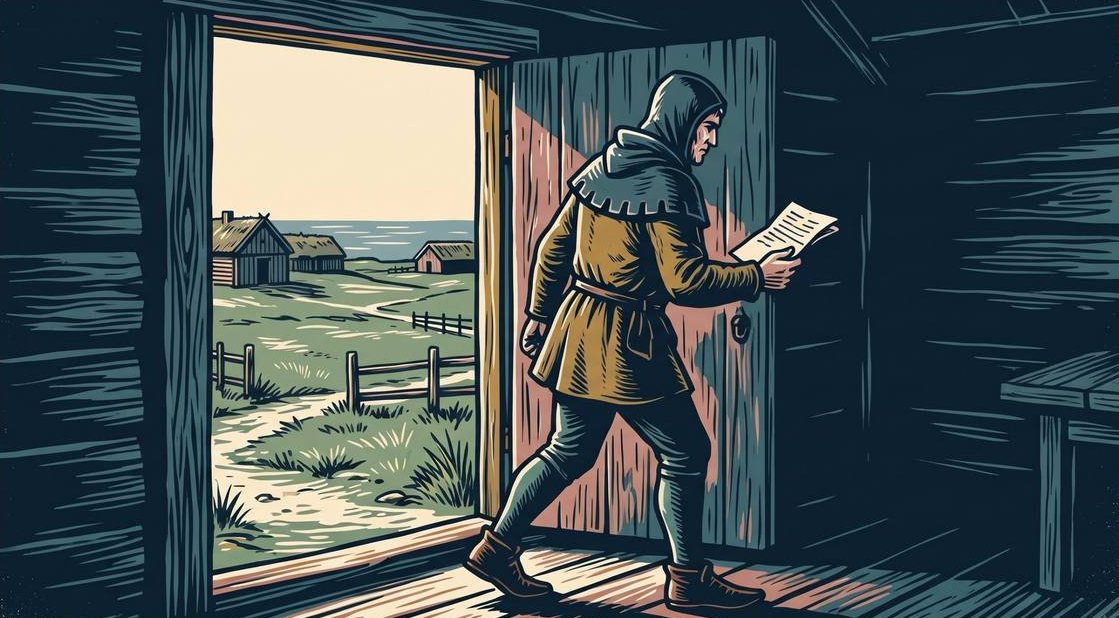
On the first Sunday in Lent, at some point between 1410 and 1420, Magnus Magnusson, the man who then holds Giske, has a letter written on Giske to the estate bailiff (gardsfut) Ivar Jonsson, his manager. He wonders greatly, he writes, that he has had no word from him since Erlend came home before Christmas.
Giske is a low island farthest out towards the sea north-west of Borgund, the old trading town (kaupang) east of present-day central Ålesund, 2.67 square kilometres in size and about two and a half kilometres each way. The highest point, Ørnebakken, lies only 23 to 26 metres above the sea, and the measurements disagree. In the middle of the island there is bog. Nearer the sea lie fields and pasture, and sandy beaches run almost all the way round the island. To the west the neighbouring island of Godøya rises with Storhornet at 497 metres, and through Giskesundet between the two islands runs the main sailing route. No source describes forest on Giske, and the island was probably treeless. By the church on the south side archaeologists have found cultivation layers dated 1300 to 1410, so grain was grown at the manor in these years. The marble church had stood there since the 1100s. Timber for houses, boats and drying racks had to be fetched from the inner fjords, and in 1647 the estate's timber came from saws in Romsdal, north-east of Sunnmøre, and by Storfjorden east of Ålesund.
Magnus Magnusson was Sigrid Erlendsdatter's second husband. She was the widow of Håkon Sigurdsson, the previous owner of Giske, who died without heirs of his body, and the two held Giske because they believed that Håkon had left the estate to her in his will. In August 1409 the lawman in Bergen had judged Håkon's sister's son Sigurd Jonsson to be the rightful heir, «until something truer is found», and Magnus and Sigrid held to that reservation. In 1416 Magnus acquired by exchange the farm Hundeid in Aura parish and all the deserted lands of Diderik Vistenakker and Margareta Eilivsdatter in Sunnmøre, in return for lower Eikenes on Osterøy, the island north-east of Bergen. This suggests that he was gathering land near Giske. Deserted lands were farms that lay unused, many of them since the Black Death in 1349. Of some 60 000 farm holdings in the country before the plague, 36 000 to 37 000 lay deserted in the 1400s according to SNL, and it was the smallest and most remote farms that were abandoned. The rent fell with them. At the start of the 1500s the land rent was about a quarter of its level around 1350. In 1423 Magnus called himself «with arms of Giske» in a letter of debt to the king in Copenhagen, in which he acknowledged that he owed 300 lødige mark (mark of fine silver) for the fief (len) in Trøndelag that he had administered for several years.
The letter to Ivar survives in the original and is the closest we come to everyday life on the farm in the late Middle Ages. Magnus asks Ivar to make sure he suffers no loss «for thin vngdom skyl», for the sake of your youth, so the estate bailiff was young. He wants money and gold, «thet mesta tu kant af stad komma», as much as you can raise. Malt, flour, butter and other foodstuffs Ivar is not to sell, for Magnus will need the food later. He sends three men, Tore Eriksson, Kyrning and a third whose name the editor cannot read with certainty. They are to have food and ale as needed, «eig med owerfløghod», not in excess. Ivar is not to neglect the herring fishery, «um gudh vil at sildin gaar til», if God wills that the herring comes in, and Tore has brought two nets with him. If Håkon wants Magnus's ship, he must come himself or send a reliable message. Jon Haldorsson is to make sure that the clothes in the fatbur, the clothes store, are not spoiled. Magnus asks for good servants and workers, as he has often asked before without anything being done, and he wants an answer as quickly as possible, probably by Mid-Lent at the latest. The reading of the last word is uncertain.
The letter follows the year. It is Lent, and by the rules of the Church people were to abstain from meat until Easter. A due that the editor reads as «gæninne», probably a due from the tenant farmers, is to be collected before the farmers begin sowing. The tenant farmers also paid tithe, a tenth of the harvest, and leidang. The leidang (naval levy) had once been the farmers' duty to build, equip and man ships for the king, but from the end of the 1200s it was a fixed tax reckoned by the farm's land rent. The sakøre, the fines, are to be in before the nordfarers sail. Who the nordfarers were, the letter does not say. The sources do not say so directly, but most likely they were those who carried fish between the north and Bergen in summer, and then there was money in circulation along the sailing route. The herring was uncertain. A papal letter from 1161 to 1172 permitted herring fishing on Sundays and holy days when the herring came in under the land, and in the 1300s herring was packed in barrels. Lent coincided with the spring cod fishery in Borgundfjorden, the fjord between Ålesund and Sula, which ran from Candlemas on 2 February to Lady Day at the end of March, with Borgundsund as the best harbour. The fishing was done with handlines from open boats. In Sunnmøre the deep handline was called djupsogn, and in the 1400s the åttringer, with four rowing spaces and four or five men, were handline boats. Sørheim, who has written about Borgund, thinks the Borgundfjord fishery was as important in the Middle Ages as the Lofoten fishery became in the 1500s and 1600s, because the fish was dried closer to Bergen. That is a scholarly assessment. The land rent on the Giske estate was paid in stockfish, and in 1563 the farmhands on the main farm themselves fished 30 våger (c. 18 kg each), an estimated 540 kilos.
That the food was not to be sold has to do with the soil. The sand on Giske is easy to work and dries quickly, but it is poor in nutrients, and the grain probably seldom stretched far enough. The accounts from 1563, a century and a half later, show that the people on the main farm ate 37 sold of grain, while the farm's own harvest was 28 sold, and that the bailiff tried to obtain grain from the farms near Giske. That gives about 2.8 times the seed sown, an estimate because the unit sold is uncertain. The grain was grown on small fields, probably with an ard, and water mills had been in use in the country since the 1200s. In 1563 the bailiff nevertheless had to buy millstones, scythes, sickles and axes, which suggests that the outer coast lacked both iron and stone for mills. Hunger came with short, hard shifts in the weather. In north European annals Nils Hybel finds two great famines in the 1000s, five in the 1100s, one in the 1220s and one in the 1310s, and no corresponding reports from around 1320 to around 1500. It is reasonable to think that the plague had taken the pressure off the land. For outer Sunnmøre a bad year struck in two ways, in a poor harvest on one's own fields and in dearer grain that had to be bought with fish. In years of need bark bread was baked from dried and ground inner bark mixed with a little flour. Malt was needed for ale, and ale was needed for feasts.
The letter does not say where Ivar was based. Magnus writes from Giske and sends people to him, so Ivar probably ran another farm in the estate. An estate bailiff collected the dues for the owner and ran the farming. The king's bailiffs did the same work on a large scale. In 1424 and 1425 the farmers of Rakkestad in Østfold complained about the bailiff Herman Molteke and asked for another bailiff, «one who will hold us to law and justice». The historian Ian Grohse has shown that such complaints concerned particular bailiffs and particular breaches of the law. In 1563 the bailiff lived on Giske, carried the land rent by jekt to Bergen, sold the fish there and paid the farmhands. The letter from Magnus shows the same work: money, food, people and fishing that had to add up before summer. Who did the work had changed since the time of the Arnlings, the chieftain family that sat on Giske from around 980. The thralls were gone as a group when the national law came in 1274, and most farmers had become tenant farmers, legally free people who rented the land. In 1344 Ogmund Eiriksson had given the island of Humla to Erling Vidkunsson, who then owned Giske, in return for lifelong board on Giske such as his sveiner had, and his sister was to have board like the other workers. In 1563 there were six farmhands and five women on the main farm, among them the dairymaid Anne. The farmhands received two or three daler a year and clothes, the women only cloth and shoes. After the plague land rent fell and wages rose, and that may explain why Magnus found it so hard to get «good servants and workers». The clothes in the fatbur were probably for the most part vadmel woven on the farm from the wool of the sheep on the heather moorland. In 1563, 42 ells of white and 14 ells of grey vadmel were woven on Giske.
Finally come the greetings. Sigrid has asked Magnus to say good night to Ivar. Margit has in mind that Ivar should be at her wedding after Easter, and Magnus reminds him that this calls for food, ale and money, «vm man scal eig ther af stora blygh haua», if one is not to have great shame of it. Who Margit was does not appear, and the same goes for the Håkon who wanted the ship. The word shame shows what was at stake. A feast was meant to show what the household commanded.
The letter has no year, and the editor estimates the time as 1410 to 1420. The king was Eric of Pomerania, union king over Norway, Denmark and Sweden, and after Queen Margaret died in 1412, he ruled himself. According to the historian Mona Ringvej he visited Norway only once, on his coronation journey. When the king was far away, the Council of the Realm became more important. He was in conflict with the counts of Holstein over Schleswig (Sønderjylland), the southern part of Jutland. At Constance on Lake Constance the Church council sat from 1414 to 1418 and put an end to the split between the popes. The dispute over Giske still lay some years ahead. In 1424 Magnus and Sigurd Jonsson stood before the archbishop in Nidaros, present-day Trondheim.
People: Magnus Magnusson, Håkon Sigurdsson
Sources
DN 14/37; DN 1/621; DN 2/639; DN 1/691; DN 5/171; prosjektnotatene «Giskebrevene 4», «Giske: landskap, beliggenhet og jordbruk», «Fisk som valuta: slik virket Giskegodset», «Fiskeværene og Giskegodset», «Jordbruk i Norge 800 til 1650», «Fiske og fiskeredskap» og «Giskegodset og produksjonen»; Gjørvel Fadersdatters regnskap 1563 (Sandberg 1986); rapporten «Havner, seilaser og mat» (kontrollert); Hybel, Historisk Tidsskrift (DK); SNL, ødegård, landskyld, trell, leidang, kvern, åttring og barkebrød; Vollan 1942; Grohse 2020 (Historisk tidsskrift 99); Ringvej, «Et kongerike foran undergangen»; nettsidens sider «Makten i riket» og «Slektsbånd».