Timeline · The Arnlings
The legend of Finnvid the Foundling
9th century
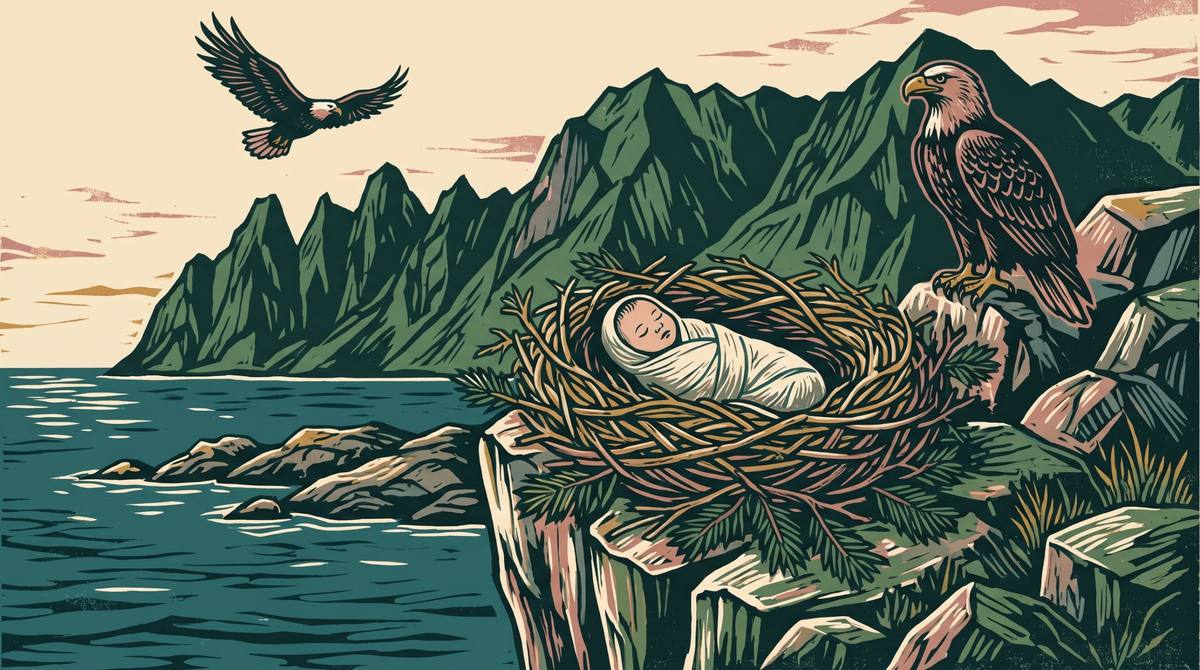
An eagle has built its nest on a mountain ledge above the sea, and in the nest lies an infant wrapped in silk. So begins Arnungatal, the genealogy of the family that later sat on Giske. The child was given the name Finnvid the Foundling (Finnvid funnen), and all that is said of him is: «Ingen kjenner ætta hans.» ("No one knows his kin.") The family that traced its descent from him is called Arnungane, the Arnlings, a name that can be read as the eagle's young or the eagle's children.
The story is a legend, and it is the only thing we have about him. Even so, to picture the landscape the legend belongs to, we must go out to Giske as the island was in the 9th century. Giske lies at the outer edge of Sunnmøre, covers 2.67 square kilometres and is barely 26 metres high at its highest point, at Ørnebakken. In the middle of the island lies bog. Around it lie sandy soil and pasture, and sandy beaches run almost all the way round. No source describes woodland on the island, and Giske was probably treeless throughout the period, with open heathland and shore meadow like the rest of the outer coast. The heathland was itself made by people. Pollen analyses show that the coastal heaths were once wooded, and they stayed open because people burned them regularly, cut them for winter fodder and let sheep graze there. In western Norway the heathlands are at least 4,000 years old. Just to the west, the neighbouring island of Godøya rises almost 500 metres straight out of the sea. In strong winds from the west or south, sudden downdraughts strike down from the mountain and out into the sound between the islands. It was an exposed place with mild winters and little snow, where the sheep could probably stay outdoors all year on heather and seaweed.
The main sailing route ran through Giskesundet, the sound by the island. Outer Sunnmøre lies between the two most dangerous stretches of open sea on the coast, the Stad peninsula to the south and Hustadvika off the Romsdal coast to the north, and ships travelling between western Norway and Trøndelag had to pass through these waters. The route already had a name. Around the year 890 the chieftain Ottar from Hålogaland, the old name for northern Norway, told King Alfred of Wessex in southern England that he lived furthest north of all Norwegians, and he described the voyage south along Norðweg, the way north. It is the oldest written description of the coast, and it shows that goods from the north, skins, walrus-hide rope and feathers, went south along this route in Finnvid's time. Ottar also said that the Sami paid tribute to him in, among other things, ship's ropes made of whale and seal skin, and that walrus hide was very good for ship's ropes. Rope for the ships was, in other words, one of the goods on the route. Fish may also have been. Cod bones from the trading town of Haithabu in southern Jutland, near Schleswig in present-day northern Germany, dated 800 to 1066, carry the genetic signature of the skrei, the spawning cod that spawns off Lofoten. The sample is small, and researchers cannot tell whether the fish was a trade good or provisions for a journey.
People had lived on Giske for several thousand years. At Giskegjerdet, an area on the island, archaeologists have found Stone Age settlement sites with over 14,000 finds, most of them flint, and barley pollen in the lowest layers, an early trace of grain growing so far out by the sea. The dates from the sites range from 3631 to 2139 BC. A barley grain from there is dated 2036 to 1889 BC, the oldest dated grain in Møre. From that grain to today is roughly 130 generations. Up to a metre of windblown sand lies over the sites. On the south side of the island lies Mjeltehaugen, a large burial mound with stone slabs carved with ships, among the oldest ship images in the Nordic rock-carving tradition. The dating is disputed. The archaeologists Melheim and Sand-Eriksen place the monument at c. 2500 to 2000 BC, while Store norske leksikon has the buried person die in 1300 to 1100 BC. Around the year 200 a woman was buried on top of the mound. Near the spot where the church was later built, a ploughed-out burial mound and cooking pits dated 540 to 680 have been found, along with animal bones dated 660 to 880. It is reasonable to think that the powerful on the island held feasts and sacrificial meals right there. About 500 metres east of the church, at Røysane, lies a Viking Age double grave with a silver ring, a set of balance scales, a spearhead and two oval brooches, and the brooches suggest that one of the dead was a woman. Hatling (2012) calls the place Reinabakken, and it is uncertain whether the two names refer to the same place. The scales tell us that someone on Giske weighed silver. Silver was paid by weight, in bars, rings and hacked coins, and whoever owned a set of scales was trading.
The farm was run as a mixed farm with grain, livestock and outlying land. The fields were ploughed with an ard, a tool that scratches up the soil and throws it to both sides, and on the early ards only the tip was iron. The work was done by the household and by thralls. How many thralls there were, no one knows. Based on conditions in England in the late 11th century, it has been guessed that they may have made up around ten per cent of the population, and the Frostathing Law, written down later, counts three thralls as part of a good farm. Thralls had no legal rights and were counted as chattels. No source mentions thralls on Giske, but it is likely that the chieftains there had some at work.
The ships on the slabs at Mjeltehaugen were carved in the Bronze Age or just before. The nearest large ship find to Giske is the Kvalsund ship, which was dug out of a bog in Herøy in 1920, a few hours' rowing south of the island. It was about 18 metres long, had rowlocks for ten pairs of oars and a removable side rudder, and it was deliberately broken up before it was laid in the bog, probably as an offering. The dating is disputed. A C14 date gave c. 690 plus/minus 70 years, while a dendrochronological dating by Nordeide, Bonde and Thun from 2020 places its building at c. 780 to 800, at the same time as the first raids westwards. Whether the ship had a sail is uncertain. A full-size replica stands at Sunnmøre Museum in Ålesund. The sail probably came into Nordic shipbuilding in the 8th century, and the oldest Scandinavian ship that certainly had a sail is the Oseberg ship, buried in Vestfold in the autumn of 834. It is 21.58 metres long and built almost entirely of oak, with 15 pairs of oar holes, and the frames are lashed to the planks with thongs through cleats. The sail is estimated at 80 to 90 square metres. The Gokstad ship, with timber felled around 890, is 23.80 metres long and has 32 oars, and its sail is estimated at about 110 square metres. Both ships were displayed in the Viking Ship Museum at Bygdøy in Oslo, which is now being rebuilt as the Museum of the Viking Age. In western Norway the Myklebust ship at Nordfjordeid in Nordfjord was burned in a grave late in the 9th century. It was an estimated 30 metres long and probably the longest Viking ship known in Norway, and the grave held at least 44 shield bosses, which have been interpreted as the crew's. The ships that passed Giske in Finnvid's time were probably built in the same tradition.
Arnungatal lists the generations after Finnvid: Torarin bullibak, Arnvid, Arnmod jarl and Arne, who was a lendmann (the king's landed vassal) under Olaf the Holy early in the 11th century. The name elements -arin and -arn mean eagle, and the family called themselves the Arnlings, the eaglets. The genealogy was written down around the year 1200, several hundred years after Finnvid is supposed to have lived, and it stood in the manuscript Fagrskinna B, a collection of kings' sagas. The manuscript itself burned in Copenhagen in 1728. The text survives in three 17th-century copies. Jomsvikinga saga tells a similar legend about the foundling Knut, who was found in the forest wrapped in costly clothes and became the forefather of the Danish royal line. The story of a child without parents, found with silk around it, gave a family an origin no one could check.
The local history «Borgund og Giske», volume I, suggests that the legend gave the family a romantic origin that their descendants liked to hear. No other source mentions Finnvid, and scholars regard him as a legendary figure. Torarin is only a name. About Arnvid the sources disagree. Snorri Sturluson, the Icelandic saga writer who wrote around 1230, tells that Harald Fairhair, who united the kingdom, defeated a Sunnmøre king called Arnvid, and several historians have linked him with the Arnvid in Arnungatal. The local history considers that the dates fit poorly, because Arnvid's son Arnmod was probably born around 930 to 940. The question is disputed. The first three links in the line therefore stand on weaker ground than the rest.
The sagas have Harald Fairhair unite the kingdom around 870 to 930, and Møre, according to them, was then ruled by Ragnvald Mørejarl, the king's man. Store norske leksikon regards Ragnvald as probably historical, dying around 900, and writes that no record survives of where he lived. The encyclopedia mentions Giske as a possible place but calls it a guess. The local history «Borgund og Giske», volume I, and the encyclopedia's article on Giske municipality point instead to Godøya, the neighbouring island. In the sagas, Harald's son Håkon the Good is credited with the leidang, the naval levy in which the coastal districts provided ships, crews and food for the king. Store norske leksikon dates the system to 945 in one article and to about 950 in another, and skaldic verse from the late 10th century mentions the leidang. Heimskringla tells that Håkon divided the coast into ship districts (skipreider), each of which was to provide one ship, «så langt laksen gikk» ("as far as the salmon went up"), and that he introduced the beacons. In Europe, Alfred the Great was king of Wessex from 871 to 899 and defended his kingdom against the Danish army. Vikings settled in Dublin, in Orkney north of Scotland and by the river Seine in France, where Normandy came into being. The same sea that carried goods south from Hålogaland carried war fleets west. Contact westwards reached Sunnmøre early. At Oseborg and Bjørke in Ørsta, at the head of Ørstafjorden south of Ålesund, a harness mount and an Anglo-Saxon book mount from the British Isles have been found, made into jewellery and placed in women's graves with brooches from c. 770 to 840. Whether they came as plunder, gift, trade or confiscated mission property is disputed.
North of Giske church, on the south side of the island, lie Ørnebakken and Arnehaugen. Ørnebakken is a burial cairn of 15 to 18 metres with a bauta, a standing stone. The stone was moved to Ålesund in the 19th century and put back in 1953. The names have led many to link the stone with the Arnlings, but the age of the stone is not known, and no source says who lies in the cairn. No letters survive from this period. The oldest letter that mentions a man on Giske is from about 1220, when Pål of Giske stood first among the witnesses in a royal letter to the archbishop in Nidaros, present-day Trondheim.
People: Finnvid Funnen
Sources
Arnungatal, i Finnur Jónssons utgave av Fagrskinna (1902 til 1903); Klaus Johan Myrvoll, Arkiv för nordisk filologi 2023; Jomsvikinga saga; Ottars beretning til kong Alfred; Frostatingsloven; Snorre, Håkon den godes saga; bygdeboka Borgund og Giske, bind I, s. 241 til 243; UiB, rapporter fra Giskegjerdet 2017 til 2020; NIKU Oppdragsrapport 168/2013; Hatling 2012; Star m.fl. 2017 (University of Cambridge); Bergens Sjøfartsmuseum; Nordeide, Bonde og Thun, Journal of Archaeological Science: Reports 29 (2020), om Kvalsundfunnet; Sunnmøre Museum (kopien av Kvalsundskipet); Kulturhistorisk museum, Vikingskipshuset (Oseberg og Gokstad); Universitetet i Bergen og forskning.no 2024 om Myklebustskipet; SNL, Giske, lynghei, ard, trell og leidang; Lokalhistoriewiki, Lynghei; DN 3/1; prosjektnotatene «Giske: landskap, beliggenhet og jordbruk», «Jordbruk i Norge 800 til 1650», «Fiske og fiskeredskap» og «Båtbygging, seil og leidang»; UiB, rapport fra Giske kirkested 2011 (Røysane); Melheim og Sand-Eriksen, Open Archaeology 2020 (Mjeltehaugen); SNL, Ragnvald Mørejarl og Giske (øy); Heen-Pettersen, European Journal of Archaeology 2019; Mikkelsen 2024; prosjektrapporten «Funn i Møre og verden».