Timeline · The king's in-laws
Skofte's voyage to Rome
1102 to 1103
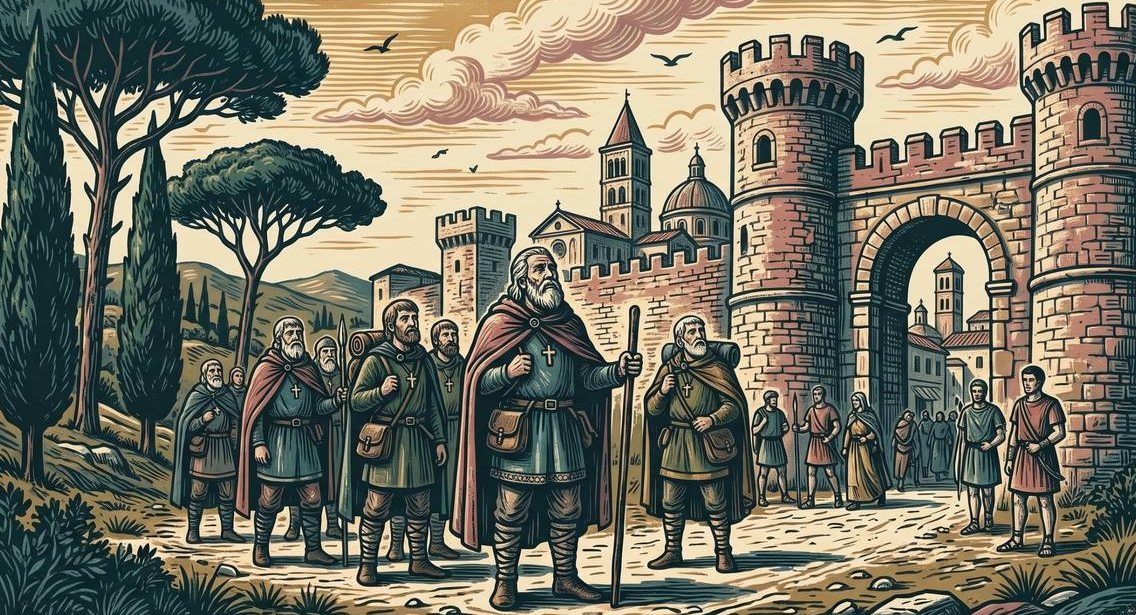
In the autumn of 1102 five longships put out from Sunnmøre. On board are Skofte Ågmundsson of Giske and three of his sons. He says he is going to the Holy Land. He never comes home.
Skofte was the son of Ågmund Torbergsson, who sat on Giske after his father Torberg Arnesson, and he was a nephew of Øystein Orre, who fell at Stamford Bridge in England. His mother was called Gudrun or Sigrid Tordsdatter; the sources disagree. She was the daughter of Tord Folesson, Olaf the Holy's standard-bearer, and through her Skofte descended from Håkon Jarl of Lade. He was a first cousin of King Olaf Kyrre, king 1067 to 1093, and in the long years of peace under Olaf the sagas say only that he was the king's dear friend. Skofte was now probably between 50 and 60 years old.
Under Olaf's son Magnus Barefoot, king from 1093, things were different. Magnus was a warrior king who wanted to win lands in the west. Skofte's sons Ågmund and Finn had both saved the king in war. But when Skofte in 1101 wanted to claim an inheritance he believed he had a right to, the king took it for himself. The king and Skofte were close kin, for Magnus's paternal grandmother, Tora Torbergsdatter, was Skofte's aunt. Snorri Sturluson calls Tora queen, while Store norske leksikon holds that she was probably a concubine (frille). Being the king's kinsmen gave power, but also danger. According to Ågrip, Skofte's great-uncle Finn Arnesson had quarrelled with Harald Hardrada over the veitsler (royal grants of revenues), the revenues he had received from the king's estates, and gone to Denmark. The king gave veitsler, and the king could take them back. Snorri tells that Skofte and his sons never met the king at the same time, for fear that he would take them all at once. The fear had reason. Skofte's brother-in-law, the lendmann (the king's landed vassal) Egil Aslaksson of Folland in Kvernes in Nordmøre, married to his sister Ingebjørg, had been hanged by the same king in 1094.
The crusaders had taken Jerusalem in 1099, and all over western Europe going on crusade counted as the most honourable thing a man could do. The pope was Paschal II, and in England Henry I was king. The Church required that a crusader's property be protected while he was away. For a man in conflict with the king, the journey gave both honour and protection for his estate. Skofte was the first Norwegian to go. The youngest son Pål stayed behind and took over Giske. His wife was called Sigrid or Ragnhild; the sources disagree. If it is Sigrid, she was Sigrid Torkjellsdatter of the Aurland family in Sogn, who was related to the Danish king Cnut the Holy.
Five longships were a large outfitting. The Gokstad ship has 32 oars, and the Danish replica of the larger Skuldelev 2 is sailed with 60 to 70 men. With 35 to 70 men per ship, five ships give an estimated 175 to 350 men. No source says who owned the ships, but they were probably the family's own. The Gulathing Law has a rule that anyone who built a longship without announcing the voyage had to provide a surety of 40 marks, and if he refused, a plank was to be hewn out on each side of the keel. The rule shows that the royal power kept watch on private longships. Whether it applied in 1102, we do not know. Where Skofte's ships stood in winter is unknown. By the boathouses south of the church stand the walls of a stone house that the excavator first interpreted as a stone boathouse, but it is from the time after Skofte, and a boathouse from his time has not been found. Elsewhere along the coast over 800 boathouse sites have been recorded, the largest up to 40 metres long. A ship lasted an estimated 20 to 30 years, and experience with the Danish reconstruction Roar Ege shows that the iron rivets had to be replaced about every fifteen years because rust split the planks.
The fleet left in autumn, in the season the King's Mirror, a Norwegian textbook from around 1250, would later warn against. Ships were usually hauled ashore towards the end of October and tarred for the winter, and the fleet from Giske set out as other ships were being laid up. It wintered in Flanders. Flanders was a rich land with weaving, wool trade and towns such as Bruges, and its count, Robert II, had himself come home from the crusade in 1100. On board the crew lived on porridge, flour, stockfish, butter and bread, with water as the usual drink and ale on the chieftain's ship. From Giske to Flanders is an estimated 1,300 kilometres by sea, and on to Rome around 4,000. Saga Oseberg reached about 10 knots under full sail in open sea towards Færder at the mouth of the Oslofjord in 2014. Over longer stretches in a good wind a longship could keep up five to seven knots, but with night harbours, rowing stages and waiting for weather the daily stages were far shorter, perhaps 100 to 150 kilometres. The voyage took many months. All these figures are estimates.
In spring the fleet sailed along the coast of France and the Iberian peninsula, where large parts of the land were under Muslim rule, and through the strait at Gibraltar in the summer of 1103. Snorri calls it Nørvasund. The local history «Borgund og Giske», volume I, suggests that the name may be borrowed from Nørvasundet in present-day Ålesund, by Borgund, a sound the men from Giske knew from the route at home. No source confirms this.
Skofte died in Rome and never reached the Holy Land. The sagas say that his sons Ågmund, Finn and Tord died on the journey, but the sources disagree about who died where. Snorri has Tord die in Sicily. Two of the sons died shortly after their father, and the cause may have been disease and the unfamiliar climate. The same year, 1103, King Magnus fell in Ulster in Northern Ireland.
At home Pål took over a farm in the midst of change. Thraldom was on the way out. The Church opposed Christians being held as thralls, fewer new thralls came in, and it became more profitable to let out land. Between the 11th and the 13th centuries the majority of farmers went from being freeholders to becoming tenant farmers, farmers who rented the land, and in Magnus the Lawmender's national law of 1274 thralls are gone as a group. On Giske in Pål's time there were probably unfree people, freedmen and tenant farmers alike. Fishing changed too. The archaeologist Sørheim dates the transition to commercial fishing in Borgundfjorden off Ålesund to the 12th century and links it to new settlements on the outermost coast, close to the fishing grounds. He believes the Borgundfjord fishery was as important as the Lofoten fishery later became, because the fish was dried closer to Bergen. That is a scholarly assessment. In northern European annals Nils Hybel has found five great famines in the 12th century, without Norway being mentioned specifically.
The men who came home were famous and told so much that many in Norway wanted to go. Around 1108 Sigurd the Crusader, Magnus Barefoot's son, went the same way. On Giske the family lived on through Pål and through Skofte's daughters. Tora Skoftesdatter married the lendmann Åsolv of Rein in Rissa by Trondheimsfjorden, and from her descend the Rein family (Reinsætta), Duke Skule Bårdsson and King Magnus the Lawmender, king 1263 to 1280. Åsolv's paternal grandfather was Tostig Godwinson, brother of King Harold of England. Tostig fell at Stamford Bridge in 1066, in the same battle as Skofte's uncle Øystein Orre. Ragnhild Skoftesdatter married Dag Eilivsson, a chieftain from eastern Norway, and became the mother of Gregorius Dagsson, one of the most powerful men of the civil war period in the 12th century. The local history «Borgund og Giske», volume I, describes a consistent marriage policy among the chieftains on Giske, who married into the highest families in the land, while the other great families of Sunnmøre married within the region.
People: Skofte Ågmundsson, Pål Skoftesson
Sources
Snorre, Magnus Berrføtts saga og Sigurd Jorsalfares saga; bygdeboka Borgund og Giske, bind I; Kongsspeilet; Gulatingsloven, utgjerdsbolken kap. 20; Kulturhistorisk museum, Vikingskipshuset (Gokstad); Stiftelsen Nytt Osebergskip (Saga Oseberg); Vikingeskibsmuseet om seilingsfart, skipskost og Havhingsten; EXARC Journal (Roar Ege); Store norske leksikon (nausttufter, trell, Norge i høymiddelalderen); Sørheim; Hybel, Historisk Tidsskrift (DK); prosjektnotatene «Slektsoversikt, rettet», «Båtbygging, seil og leidang», «Jordbruk i Norge 800 til 1650» og «Fiske og fiskeredskap»; prosjektrapporten «Havner, seilaser og mat, kontrollert»; Ågrip; prosjektsidene «Slektsbånd» og «Makten i riket».