Timeline · The Arnlings
The Battle of Hjørungavåg
986
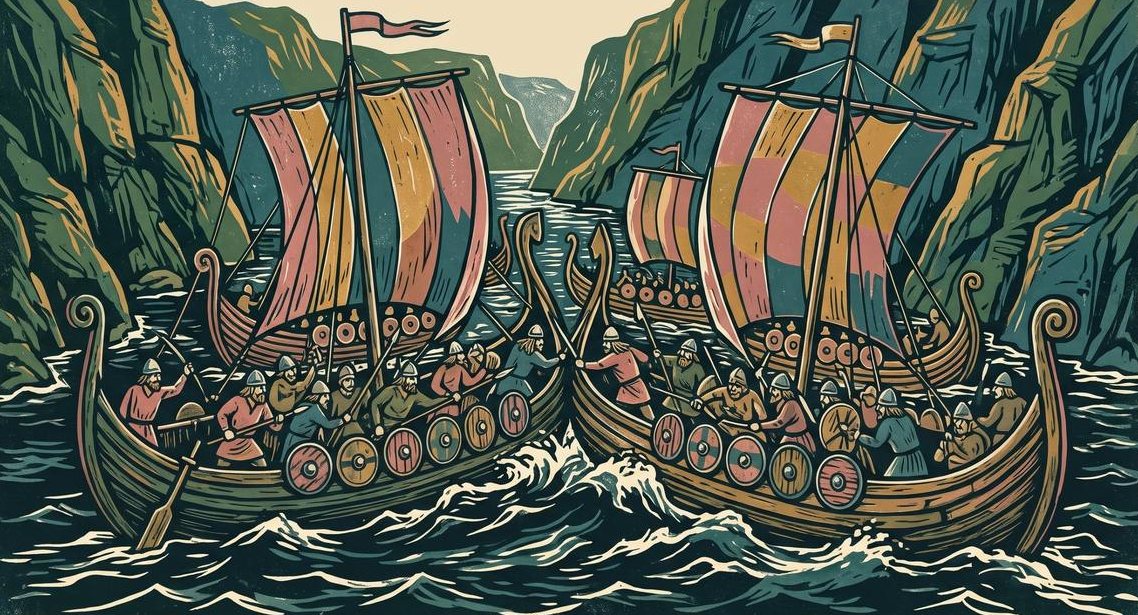
In a narrow bay in Sunnmøre two fleets lie lashed together, ship against ship. The Jomsvikings, a warrior band from the southern shore of the Baltic, have come north along the sailing route to drive Håkon Jarl, the most powerful man in the land, out of the country. Among the chieftains on the jarl's side, according to Jomsvikinga saga, stands Arnmod with his sons. It is the first time the family on Giske appears in a story about the great battles of the realm.
Sunnmøre at the end of the 10th century was a coastal land with fjords cutting deep in between steep mountains. Furthest out lay the low islands with heathland, shore meadow and small fields in the sandy soil. At the heads of the fjords there was woodland, more grain and more sheltered farms. People lived by the sea and lived off fish, livestock and grain, and most of them lived their whole lives without seeing a town. The nearest town of any importance was Nidaros, present-day Trondheim, which according to the sagas was founded a few years later. Closer lay Borgund, the trading place by Katavågen in present-day Ålesund, about ten kilometres south-east of Giske. The oldest dated hen bone from there is from 887 to 986, and the archaeologist Gitte Hansen believes the place must already have existed towards the end of the 10th century. Power lay with the chieftains on the great farms, and it showed in ships, crews and silver.
The man who ruled the coast was Håkon Jarl of Lade in Trøndelag, close to Nidaros. He had ruled from about 975 and had for a time been a vassal of the Danish king Harald Bluetooth. Then he broke with him, and the sagas tell that he gave up the Christianity Harald had imposed on him and returned to the old faith. Håkon ruled Nordvegen ("the north way"), the route along which stockfish, skins and furs went south, and whoever controlled the route could demand tax from everyone who used it.
The Jomsvikings were a warrior band based at Jomsborg at the mouth of the river Oder in present-day Poland, probably near the trading town of Wolin, where archaeologists have found a large harbour and workshops from the Viking Age. The sagas tell that their leaders, Sigvalde Jarl, Bue digre and Vagn Åkesson, had vowed at a funeral feast in Denmark to drive Håkon out of Norway, and that they came north along the route with a large fleet. According to the sources Håkon had about 180 ships and the Danes about 100, while Fagrskinna gives 60 Jomsviking ships. The figures are uncertain. At Hjørungavåg they met the jarl and his son Eirik. Where the battle was fought is disputed, and the site has never been identified. The name Hjørungavåg was given to Liavågen in Hareid in 1897, and the national monument at Ovraneset there was raised in 1986. Many point to Liavågen in Hareid, south of Ålesund, others to places in Hjørundfjorden, an arm of fjord cutting in between the mountains south-east of Ålesund. If it lies in Liavågen, the battlefield was an estimated twenty kilometres or so from Giske, on the other side of Breisundet, the approach from the sea to Ålesund.
Jomsvikinga saga tells that the battle went badly for the jarl, and that he went ashore and sacrificed his son Erling to Torgerd Hølgebrud, the goddess he worshipped. Afterwards a hailstorm swept in from the north, straight at the Jomsvikings. Sigvalde turned and rowed away with his ships. Bue digre jumped overboard with two chests of gold, and Vagn Åkesson was taken prisoner and spared. This is saga material, written down about two hundred years later, and Store norske leksikon regards the storm, the sacrifice, the gold chests and the pardon as legend. About the battle itself historians disagree. Contemporary skaldic poems, Vellekla and Eiríksdrápa, suggest a historical core, and critical historians regard the battle as probable or possible. Knut Helle believes the story may owe much to Icelandic heroic poetry. Håkon held power for almost ten more years.
The sagas say little about the ships in the battle, and none of them has been found. Norwegian finds nevertheless give a framework. The Kvalsund ship from Herøy, south-west of Ålesund, the nearest ship find to the battlefield, was about 18 metres long with ten pairs of oars. Its dating is disputed, c. 690 plus/minus 70 or 780 to 800, and by either date the ship was built two hundred years or more before the battle. A replica stands at Sunnmøre Museum in Ålesund. The Gokstad ship from Vestfold, with timber felled around 890, is 23.80 metres long, built of oak and has 32 oars. Gaia, a replica of the Gokstad ship, was built in the winter of 1989 to 1990 at Bjørkedal in Volda in Sunnmøre and was given 16 pairs of oars, 120 square metres of sail and a top speed of about 10 knots. The largest ships in a jarl's fleet were probably longer. The Myklebust ship at Nordfjordeid in Nordfjord, burned in a grave late in the 9th century, was an estimated 30 metres. Draken Harald Hårfagre, built in Haugesund and launched in 2012, is 35 metres long with 25 pairs of oars and 260 square metres of sail, the same number of sesser, rowing benches, as the large leidang ships in the Gulathing Law, the law for western Norway. The leidang ships were the ships the districts provided for the king's naval defence. Draken is a hypothesis, scaled up from Gokstad according to Snorri's descriptions, and historians, among them Eldar Heide, have criticised calling it a Viking ship because it is not based on a find. For building time only Danish figures exist. The Viking Ship Museum in Roskilde reckons about 44,000 effective working hours on the hull of Havhingsten (the Sea Stallion), a replica of the longship Skuldelev 2, which was built of Irish oak in the Dublin area around 1042 and is about 30 metres long and 3.8 metres wide. The museum estimates that in the Viking Age the work would have taken seven months with one master shipwright and ten ship smiths, in addition to people who felled and split the timber, forged rivets and carried. The list of materials was 20 large oaks for keel, stems, planks and keelson, 250 naturally curved pieces for frames, 35 pines for oars, 8,000 iron rivets and 600 litres of tar. Only a small part of the timber ended up in the hull. When the smaller Danish replica Roar Ege was built, it was under five per cent, because the planks were split from whole, straight, knot-free trunks.
The grave ships from Vestfold are built almost entirely of oak, while pine was the main timber in western Norway. The cargo ship Skuldelev 1, found in Roskilde Fjord in Denmark, has been dendro-dated to pine from Sognefjorden around 1030. On the outermost islands of Sunnmøre there was no woodland, and the ship timber probably had to come from the inner fjords. In winter the ships stood in boathouses. Over 800 boathouse sites are recorded in Norway, the largest up to 40 metres long, and the oldest large boathouses, at Avaldsnes on Karmøy, Hafrsfjord near Stavanger and Lista and Spangereid in southern Norway, are interpreted as signs of a maritime organisation linked to the chieftains. The sail demanded almost as much as the hull. Bergen Maritime Museum estimates that a longship needed about 120 square metres of sail, and regards the sail as just as valuable as the ship itself. Gaia was given a sail of that size. Saga Oseberg, the replica of the Oseberg ship launched in Tønsberg in 2012, was given a sail of about 90 square metres, woven from the wool of sheep in Vestfold. The figures for the work on the cloth are Danish. For the knarr replica Ottar, also with about 90 square metres of sail, the Viking Ship Museum estimates wool from around 200 spælsau sheep and the work of five people for one year. Other estimates are higher, and the figures vary widely. Spinning and weaving were most often regarded as women's work. Much suggests that the fleets that met in Hjørungavåg rested on the flocks of sheep in the heathland and on the work at the looms on the farms along the coast.
Arnmod was then probably between 45 and 55 years old, based on the estimate in the local history «Borgund og Giske» that he was born around 930 to 940. Jomsvikinga saga mentions him and his sons. Bjarne Kolbeinsson, bishop of Orkney, the islands north of Scotland, calls him «Arnmod jarl» in the poem Jomsvikingadråpa from around 1170. Snorri lists many of the chieftains in the battle but mentions neither Arnmod nor his sons. The sources, in other words, are late, and they disagree about who took part. That the families descended from him called themselves Arnmødlinger nevertheless suggests that he was a man of importance. His son Arne Arnmodsson was probably born around 960 to 970 and may have been between 16 and 26 years old. It is likely that he was among the sons who fought.
The warriors on both sides came with their own ships and the food they had brought. The leidang was probably already in use. Skaldic verse from the late 10th century mentions it, and the sagas have Harald Fairhair's son Håkon the Good organise it around 950. In the Gulathing Law, as it survives from a later time, Mørene, probably Sunnmøre, was to provide 16 ships of the large type with 25 sesser (rowing benches). With two oars per bench and two men per oar that gave around 100 men per ship, and an estimated up to 1,600 men from Sunnmøre at full levy. Whether the system looked like this in 986, we do not know. The Viking Ship Museum has, on the basis of the sagas and the Oseberg find, described the food on board as porridge, flour, dried fish, butter and bread, rarely boiled or roasted meat, and water to drink. Ale belonged on the ships of chieftains and kings. The Gulathing Law says that the farmers were to send «to månadsmatar av kvart» ("two months' food of each kind") to each oar place when the leidang was called out. A jarl's army in 986 was probably supplied in a similar way, with butter, flour and fish from the farms along the coast.
The year 986 is the most common, but some scholars reckon with a year or two before or after. That same year or the year after, Harald Bluetooth died, after a rebellion led by his son Svein Forkbeard. Otto III was a boy king in the German realm. In 987 Hugh Capet became king of France, and in 988 Grand Prince Vladimir of Kiev converted to Christianity and married a sister of the emperor in Constantinople. In the North the old faith and the new stood side by side, and a jarl who sacrificed to Torgerd could still gather the chieftains along the coast behind him.
For a chieftain in Sunnmøre, the victory meant that he had stood on the stronger side. Håkon controlled the route and the taxes until he was killed in 995, the same year Olaf Tryggvason came to the country and became king. Snorri tells that Olaf soon afterwards had Tranen (the Crane) built in Nidaros, with 30 rowing benches (rom), and some years later Ormen lange (the Long Serpent) at Ladehammeren by Nidaros, with 34. The master builder of Ormen lange was Torberg Skavhogg, one of the few shipbuilders the sagas mention by name. Snorri wrote around 1230, and the archaeologist Jan Bill points out that he probably describes shipbuilding as it was early in the 13th century. Arnmod disappears from the sources after Hjørungavåg. Arnmod's son Arne would come to serve Olaf Haraldsson, later called the Holy, a king who wanted to gather all Norway under one faith.
In 2024 archaeologists from Møre og Romsdal County Council probably found a longhouse and a grave from the Viking Age at Hjørungavåg, a few hundred metres from the place tradition links to the battle. Project leader Arve Eiken Nytun believes the site may have been a centre of power in the Iron Age. It appears that around the year 1000 Møre had several such centres of power side by side: the temple at Ose in Ørsta, the boat graves detected with ground-penetrating radar on Edøy on Smøla, the trading places Borgund and Veøy in Romsdal, and Giske. No scholarly source says where the jarls of Møre sat. The finds say nothing about the battle itself, but they show that Hjørungavåg was an inhabited and probably important place long before and around the time the sagas place the battle.
People: Arnmod
Sources
Jomsvikinga saga; Bjarne Kolbeinsson, Jomsvikingadråpa; Snorre, Olav Tryggvasons saga; Gulatingsloven, utgjerdsbolken og kap. 22; Vikingeskibsmuseet, Sea fare and menu, Sea Stallion og Ottar; EXARC Journal, Roar Ege; Bergens Sjøfartsmuseum; Nordeide, Bonde og Thun 2020 (Kvalsundfunnet); Sunnmøre Museum; Kulturhistorisk museum, Vikingskipshuset (Gokstad); Universitetet i Bergen om Myklebustskipet; Stiftelsen Nytt Osebergskip (Saga Oseberg); Viking Kings AS (Draken Harald Hårfagre) og Eldar Heides kritikk; Gaia (Bjørkedal, Volda); SNL, leidang og nausttufter; bygdeboka Borgund og Giske, bind I; Store norske leksikon; prosjektnotatet «Båtbygging, seil og leidang». NTB/forskning.no 4.11.2024; SNL, Slaget ved Hjørungavåg og Ragnvald Mørejarl; Walker m.fl. 2025 (høner i Borgund); Gitte Hansen, sciencenorway.no; Stamnes og Dahle 2024 (Veøy); NIKU, Edøyskipet; prosjektrapporten «Funn i Møre og verden» og prosjektnotatet «Makt på Sunnmøre før Arnungene».