Timeline · The heirs fight over the estate
The dispute over the will
1424
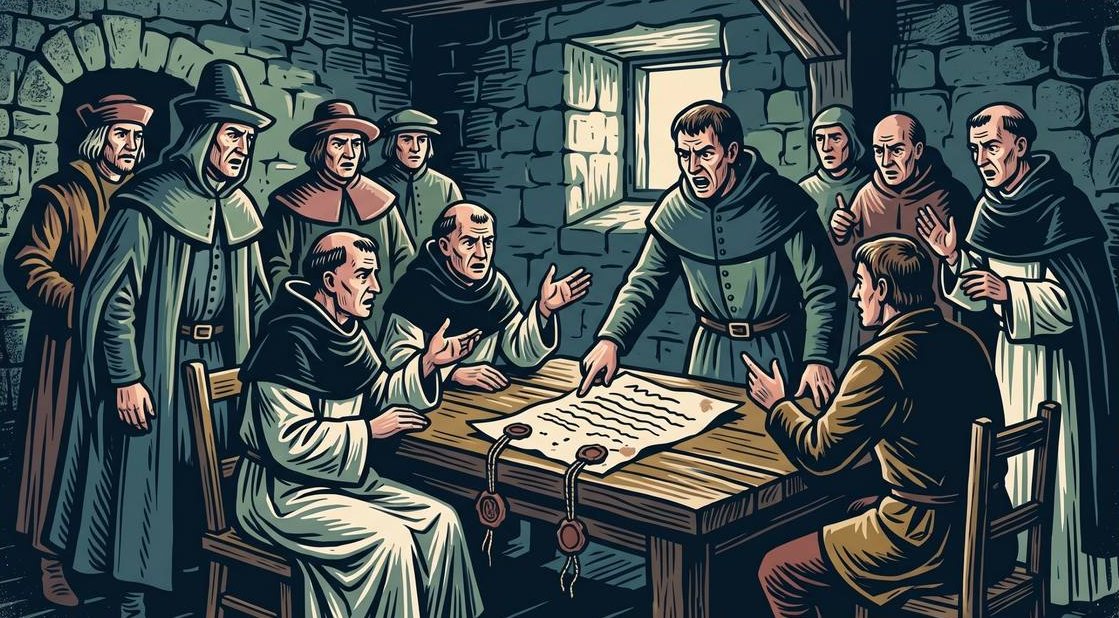
Friday 3 November 1424, in the chapter house by the cathedral in Nidaros, present-day Trondheim. Sigurd Jonsson says of the will of his maternal uncle Håkon Sigurdsson, the previous owner of Giske, that he will not accept it unless the law shows him he must, «thy at thet ær grunsamlikt», for it is suspicious.
Nidaros had been an archiepiscopal see since 1152 and 1153. The cathedral with the shrine of Olaf the Holy (St Olaf) was the largest church building in the country and the goal of pilgrims from all over the Nordic countries, and the chapter house and the archbishop's residence lay close by. According to the sagas it was here that Kalv Arnesson and Einar Tambarskjelve brought Magnus the Good in 1035, when Kalv of the Arnling family helped make the young king's son king. Nearly four hundred years later a descendant of the same family stood in the chapter house and claimed Giske. His opponent, Magnus Magnusson, had married Håkon's widow Sigrid Erlendsdatter and held the estate. The town was small. Around 1300 the population of Nidaros is estimated at about 3000, against about 7000 in Bergen.
Around Archbishop Eskil of Nidaros sat the knight Jakob Fastolfsson, the brothers Narve and Mattis Jakobssønner, six of the canons of the cathedral, the king's lawman in Trondheim and Trøndelag, Olav Nikolasson, and three of the town's councillors. Sigurd was the plaintiff and Magnus Magnusson the defendant. The letter the archbishop had written records what was said. Sigurd asked: «Do you acknowledge, Magnus Magnusson, that you have agreed to meet me here in Trondheim before my lord the archbishop and the other good men he will call to him, and to submit the case about Giske and the whole Giske estate, the will and the gifts, to a final judgment?» Magnus answered: «Yes, I acknowledge that I have agreed to this with you concerning Håkon Sigurdsson's letter of testament and the other letter.»
Two witnesses, Herlog Gøtstavsson and Nisse Jønisson, swore a full oath on the book that they had seen the two hold each other's hands on Giske that autumn and promise to lay the case before the archbishop. The day was St Matthew's Day according to the witnesses. The original has «sancti Mathissa dagh», and that is probably 21 September. Then came Sigurd's objection: «mik tykker hans testamenti bref ekke skælikt væra», he did not think the letter of testament was reasonable. Magnus said that he did not have all his letters with him. Many words passed between them, writes the archbishop, and they drew more towards disagreement than towards settlement.
The same day, in the archbishop's residence, Sigurd laid formal claim to Giske and the Giske estate. He made a formal, public claim to the estate and forbade Magnus to use it or take land rent from it before the case was decided. The lawman and two councillors witnessed it. Magnus replied that he would have nothing to do with Sigurd's maternal inheritance, which was a third of the whole Giske estate. Sigurd's mother Agnes was Håkon's sister. Under the national law of 1274 a daughter received half a share against a son's, and with one son and one daughter that comes to exactly a third. This is probably what Magnus meant. He too, then, accepted that part of Giske belonged to Sigurd.
The archbishop took counsel with the good men around him and gave the parties a new day, at the law assembly in Bergen on St Botolph's Day, 17 June the following year, before the Council of the Realm, lawman, councillors and members of the law court. The reason was that Giske and the estate lay for the most part in the Bergen law province, that Håkon had lived there, that the gifts at the marriage with Sigrid had been given there, that the will had been made there, and that the inheritance had been divided there. Wills belonged under the law of the Church and inheritance under the king's, and the case lay in the borderland between the two.
The journey here had been long. From Giske to Nidaros the sailing route ran north past Hustadvika, the open stretch of sea between Molde and Kristiansund, which together with Stad, the peninsula just south of Sunnmøre, are the most dangerous stretches of sea on this coast. The distance is an estimated 145 to 160 nautical miles, and with night harbours and waiting for weather the voyage took an estimated four to eight days. The King's Mirror, a textbook from the 1200s, advises merchants not to go out to sea in the autumn, and the winter nights in the second half of October were the old limit for sea travel. According to the King's Mirror the ship was to be tarred in the autumn and preferably stand on land over the winter. How Sigurd and Magnus travelled, the letter does not say. Along the coast sailed jekts, open and clinker-built in the western Norwegian tradition, with a covered space aft, the veng, for sleeping and cooking. How large the jekts were before 1621 is unknown, and an ordinance from 1381 restricted «unpropertied farmers» to vessels of four lasts. Men of Sigurd's and Magnus' rank probably travelled with their own ship and crew. Food at sea, according to the sagas and the finds from the Viking Age, was porridge, flour, stockfish, butter and bread, with water as the usual drink, and it is reasonable to think it was similar in the 1400s. In November the days are short in Trøndelag.
Sigurd Jonsson was around 34. He was the youngest son of the knight and councillor of the realm Jon Marteinsson at Sudreim in Romerike north-east of Oslo, who probably came from Östergötland in Sweden, and Agnes Sigurdsdatter. His sister Katarina became the link that later carried Giske on to Tre Rosor, a Swedish family of ancient nobility. When his father made a will before a pilgrimage to Rome in July 1400, his son Sigurd received a silver-mounted drinking horn. In 1409 he was so young that the knight Alv Haraldsson pleaded the case for him when the lawman in Bergen judged him to be the rightful heir. Since then he had built up his position. In August 1422 Margrete Eilivsdatter declared before the bishop in Bergen that Sigurd was her only living heir, because his maternal grandmother Ingebjørg and her mother Gyrid were full sisters, daughters of Erling Vidkunsson. In August 1424 he sat in Bergen and confirmed the gifts Margrete had given her old servant Skog Torbjørnsson. In September he was on Giske, and in November in Nidaros.
Magnus knew Trondheim. For several years he had administered a fief (len), an administrative district, in Trøndelag for the king, and the year before he had acknowledged in Copenhagen that he owed King Eric 300 lødige mark (mark of fine silver) for the dues from there, reckoned at 45 Lübeck shillings for each mark and paid over three years into the king's treasury. Sigrid Erlendsdatter was not present in Nidaros. In October 1423 she sat at Losna in Gudbrandsdalen and received testimony from three women about a betrothal feast and a wedding in Nordland, in a case where a marriage had to be proved so that the children could inherit.
The archbishop who presided over the meeting was the same Eskil who nineteen years before had taken Håkon Sigurdsson's estate in Senja, the island south-west of Tromsø, in pledge for fourteen lasts of stockfish. The Church was the largest landowner in the country. In the late Middle Ages, according to SNL, it most probably owned up to half the land, and the archbishop was probably the richest man in the country.
The king was Eric of Pomerania, union king over Norway, Denmark and Sweden, who was taken up with the conflict with the counts of Holstein over Schleswig (Sønderjylland), the southern part of Jutland. Norway had got kings who lived elsewhere, and when the king was far away, the Council of the Realm became more important. Fifteen years later Sigurd was drottsete (steward of the realm), the highest officer of the realm. In Bohemia, present-day Czechia, the Hussite Wars raged after Jan Hus had been burnt at the Church council at Constance on Lake Constance in 1415. In France the Hundred Years' War was in a period of English victories, five years before Joan of Arc came forward.
People: Sigurd Jonsson, Magnus Magnusson
Sources
DN 1/699; DN 1/700; DN 1/621; DN 1/683; DN 1/691; DN 3/674; DN 5/565; DN 16/42; DN 1/604; prosjektnotatene «Giskebrevene 4», «Båtbygging, seil og leidang» og «Jordbruk i Norge 800 til 1650»; rapporten «Havner, seilaser og mat» (kontrollert); Kongsspeilet; SNL, Sigurd Jonsson, jekt, Norge i høymiddelalderen og Norge i senmiddelalderen; nettsidens sider «Makten i riket» og «Slektsbånd»; prosjektnotatet «Giskefolket i arkiver og kilder» (SDHK 22651).