Timeline · The king's in-laws
Tora bears sons to King Harald
c. 1045
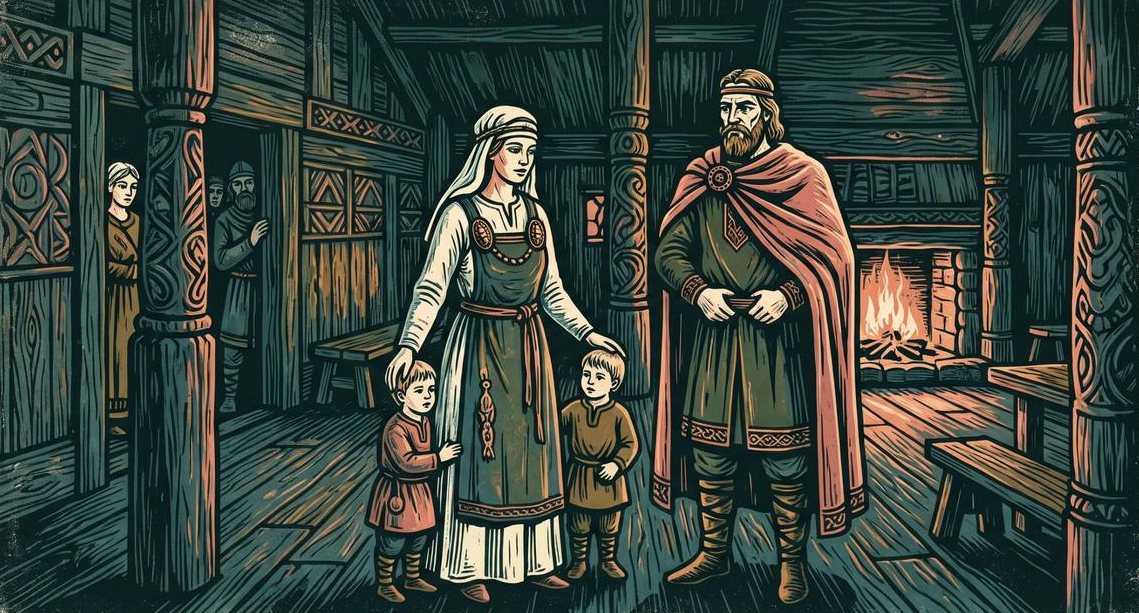
Sometime in the mid-1020s the wife of the lendmann (the king's landed vassal) Torberg Arnesson, son of Arne Arnmodsson, lies in a difficult childbirth on Giske. There is no priest on the island. By the shore lies an Icelandic ship, and on board is a young priest who baptises the girl who is born.
The saga writer Snorri Sturluson tells the story in the saga of Olaf the Holy. The girl was named Tora. The ship's owner, the Icelander Stein Skaftesson, gave the child a gold ring, and the mother promised to help him if he were ever in need. Snorri calls the mother Ragnhild and makes her a daughter of Erling Skjalgsson of Sola near Stavanger, the most powerful man in western Norway. The local history «Borgund og Giske», volume I, holds that her name was Astrid, and that Snorri has confused her with Torberg's sister Ragnhild. The sources, in other words, disagree about the name. According to the sagas Tora's maternal grandmother was Astrid Tryggvesdatter, sister of Olaf Tryggvason, so the children on Giske were related to the king who had brought Christianity to the coast. That link rests on the sagas alone.
The promise at the childbed was put to the test. Stein later killed one of King Olaf's men and came to Giske as an outlaw. The saga tells that Torberg and his wife took him in, and that they gathered six lendmenn, magnates who governed districts for the king, and 540 men to force the king into a settlement. A word given by the lady of the house on Giske weighed so heavily that the family was willing to field an army against the king to keep it. The Gulathing Law, as it was written down later, reckons 80 to 100 men on a large leidang (naval levy) ship, so 540 men correspond to an estimated five to seven ships.
The island Tora grew up on covers 2.67 square kilometres and lies low in the sea. The highest point, Ørnebakken, is around 25 metres above sea level, and just to the west the neighbouring island of Godøya rises almost 500 metres. In the middle of the island lay bog. Around the bog lay light sandy soil with grain and pasture, and sandy beaches ran almost all the way round. No source describes woodland, and Giske was probably treeless, with open heathland and pasture like the rest of the outer coast. At the church site on the south side archaeologists have found cultivation layers from the Viking Age, cooking pits dated 540 to 680, animal bones dated 660 to 880, and a ploughed-out burial mound. A little further away, also on the south side, lies Mjeltehaugen, a burial mound with ship carvings on its stone slabs. It is dated to the end of the Stone Age or to the Bronze Age, and the dating is disputed. Giske lacks a sheltered bay, and NIKU, the Norwegian Institute for Cultural Heritage Research, believes that the ships were moored or hauled up on the southern shore. By that shore lay the chieftain's seat, in the part of the island where the powerful had lived for many hundreds of years.
The soil was worked with the ard, a tool that scratches up the soil and throws it to both sides. Only the tip was iron. At Giskegjerdet, an area on the island, there is barley pollen going right back to the Neolithic, and the cultivation layers by the church show that grain was grown at the chieftain's seat in the Viking Age too. The sandy soil was easy to work, but poor in nutrients and prone to sand drift. Beyond the fields lay the heathland, a landscape people had created themselves by burning, grazing and mowing. In western Norway the heath was grazed by sheep all year round, and seaweed and kelp were used for fodder and manure. No source describes the farming on Giske in particular, but it is likely that the island was farmed in this way. The sheep gave the wool for clothes, rugs and sails, and the weaving was mostly women's work.
Who did the work on the farm, no source says for Giske. The Frostathing Law mentions a farm with twelve cows, two horses and three thralls as compensation for a blinded man, and Store norske leksikon interprets this to mean that a couple of thralls was usual on good farms. Snorri writes that Erling Skjalgsson at Sola, Tora's maternal grandfather according to the saga, had 30 thralls at home on the farm, but that figure was written down around 200 years after Erling's death. Thralls had no legal rights and were counted as chattels, and a free man could become a thrall for debt. Based on conditions in England in the late 11th century, it has been guessed that thralls may have made up around a tenth of the population. It is reasonable to think that the chieftain's seat on Giske had some thralls and household members at work in the fields, in the byre and at the loom, while power lay in the family, in the alliances and in control of the sailing route.
Power came from location. The main route between Bergen and Trøndelag ran through Giskesundet by the island, between the two most dangerous stretches of open sea on the coast, the Stad peninsula to the south and Hustadvika off the Romsdal coast to the north. Ships that were to pass had to go through the waters by the island and often lie waiting for weather nearby. About ten kilometres south-east, by Katavågen in present-day Ålesund, lay the trading place Borgund, which is first mentioned in connection with the events after the battle of Bokn in Rogaland in 1027. Archaeologists have excavated 5,300 square metres there and found around 45,000 objects. Fishing fell in the winter half of the year and sailing in the summer half. The spring cod went into Borgundfjorden off Ålesund from Candlemas on 2 February to Lady Day (marimess) at the end of March. It was caught with handlines, in Sunnmøre called djupsogn, from open rowing boats, and the fish was hung on wooden drying racks (hjeller) and dried in wind and cold. The longline only came into use in Møre in the 16th and 17th centuries. The researcher Sørheim dates the transition to commercial fishing in Borgundfjorden to the 12th century, and most of the catch in Tora's childhood probably went to the household's own use and to exchange along the coast.
Grain was the scarcest commodity. There was seldom enough for a large farm, and later sources show that the land rent, the rent the tenant farmers paid for the land, to Giske was paid in fish. It may already have been so in Tora's childhood. The tenant system was then in its beginnings: between the 11th and the 13th centuries the majority of farmers in Norway went from being freeholders to becoming tenant farmers, farmers who rented the land they worked. In northern European annals the historian Nils Hybel has found two great famines in the 11th century. The annals do not mention Norway specifically, and Scandinavia had relatively warm summers precisely in the 11th century. In bad years bark bread was baked from dried and ground inner bark, mixed with a little flour, a custom known from the early Middle Ages. On a windswept island the grain was vulnerable to storm and rain at harvest, and much suggests that fish had to be exchanged for grain in the bad years.
Tora's father was a lendmann, and his power probably covered all of Sunnmøre. A lendmann was to send out the budstikke, the summons baton, when the king called out the leidang, the naval defence in which the districts provided ships, crews and food, and he held the weapons thing. The Gulathing Law, which was written down between the late 11th and the mid 12th century, demands of «Mørene», probably Sunnmøre, 16 ships of the large type with 25 sesser (rowing benches). It was the farmers in each ship district (skipreide) who built the ship, kept the boathouse and sewed the sail. How fixed the system was in Torberg's time, we do not know. His brothers sat at other key points: Kalv at Egge near Steinkjer in Trøndelag and Finn at Austrått at the mouth of Trondheimsfjorden. When Tora was around five, in 1030, Kalv led the farmers' army against Olaf the Holy at Stiklestad in Verdal, while Finn had followed the king into exile in Gardarike (Kievan Rus'), the land along the great rivers east of the Baltic. The family stood on both sides of the greatest showdown in the land. Later it was Kalv who fetched Olaf's son Magnus home from Gardarike and made him king.
Harald Sigurdsson was a half-brother of Olaf the Holy. He was fifteen years old at Stiklestad and got away wounded. After fifteen years in Gardarike and in the emperor's service in Constantinople, he came back to the North in 1045 with great quantities of gold. He was married to Ellisiv, daughter of Grand Prince Jaroslav of Kiev. He wanted a share in the kingdom with his nephew Magnus the Good, Olaf the Holy's son and king from 1035, and from 1046 they were kings together. When Magnus died the following year, Harald became sole king. In England Edward the Confessor was king, and in Constantinople, where Harald had served, Emperor Constantine IX ruled. The gold and silver Harald brought with him came to a country where payment was still often made in silver by weight, and under him coins were struck in Norway in far greater quantities than before.
The local history sees the union with Tora as part of an agreement: the Arnlings supported Harald, and Tora was the pledge for the alliance. Harald took her without divorcing Ellisiv. The sources disagree about what she was to him. Snorri and Morkinskinna call her queen. Store norske leksikon holds that she was probably a concubine (frille), because Harald was already married. The local history believes that Harald had both at the same time. The year is given as 1047 or around 1048, and Tora was then around twenty, Harald around thirty. The Church did not yet have an archiepiscopal see in Norway, and among magnates concubinage was common. Permanent bishops in Nidaros, Bergen and Oslo came only in the 1070s, and the archiepiscopal see in Nidaros in 1152 or 1153, over a hundred years after Tora came to the king. Sons of a concubine could become kings.
The family on Giske was bound to the king in several ways. Tora's sister Jorunn married the king's marshal (stallare) Ulv Uspaksson, the Icelander who had been with Harald in Constantinople. From Jorunn descends Archbishop Øystein Erlendsson, who died in 1188. Tora's brother Øystein Orre was, according to Snorri, the lendmann the king loved most, and he was betrothed to Harald's daughter Maria. Torvard Kråkenebbs tått, a short Icelandic tale, shows Øystein at the king's side. The Icelander Torvard offered Harald the sail from his ship in Nidaros, present-day Trondheim. The king declined, because a sail he had once been given by Icelanders had torn. Øystein asked the king to look at the sail, and when the king held to his answer, Torvard gave the sail to Øystein. The tale is retold from an English translation, and the wording of the Old Norse text may differ, and since Harald was king, it probably takes place between 1046 and 1066.
Tora had two sons with Harald, Magnus and Olaf. Both became kings. Magnus II ruled from 1066 until he died in 1069. Olaf, who got the byname Kyrre, was king from 1067 to 1093 and ruled the country for over a quarter of a century without war. Through Tora the Arnling blood entered the Fairhair dynasty, and the kings in the line after Olaf Kyrre counted themselves as his descendants. For several of them, among others Harald Gille and Sverre, the claim rested on paternity that is disputed. If the claims hold, the blood from Giske passed on through the line of kings to Håkon Håkonsson, king 1217 to 1263, and Magnus the Lawmender, king 1263 to 1280, over 200 years after Tora.
Tora was on board the king's ship when her uncle Finn Arnesson was taken prisoner at the river mouth of Niså in Halland, on the west coast of present-day Sweden, in 1062. Finn had entered Danish service and fought as jarl for the Danish king against Harald. The saga tells that Finn called her a mare.
People: Tora Torbergsdatter, Harald Hardråde, Torberg Arnesson
Sources
Snorre, Olav den helliges saga kap. 138 og Harald Hardrådes saga; Morkinskinna; Torvard Kråkenebbs tått (engelsk gjengivelse); Gulatingsloven, utgjerdsbolken; Frostatingsloven; bygdeboka Borgund og Giske, bind I; Store norske leksikon (ard, lynghei, trell, barkebrød, Norge i høymiddelalderen); Hybel, Historisk Tidsskrift (DK); Sørheim; Vollan 1942; NIKU 168/2013; UiB, Borgund kaupang og Giskegjerdet; prosjektnotatene «Giske: landskap, beliggenhet og jordbruk», «Slektsoversikt, rettet», «Båtbygging, seil og leidang», «Jordbruk i Norge 800 til 1650» og «Fiske og fiskeredskap»; Melheim og Sand-Eriksen, Open Archaeology 2020 (Mjeltehaugen); siden «Makten i riket» og siden «Slektsbånd»; prosjektrapporten «Funn i Møre og verden».