Timeline · The heirs fight over the estate
The division in Bergen
1490
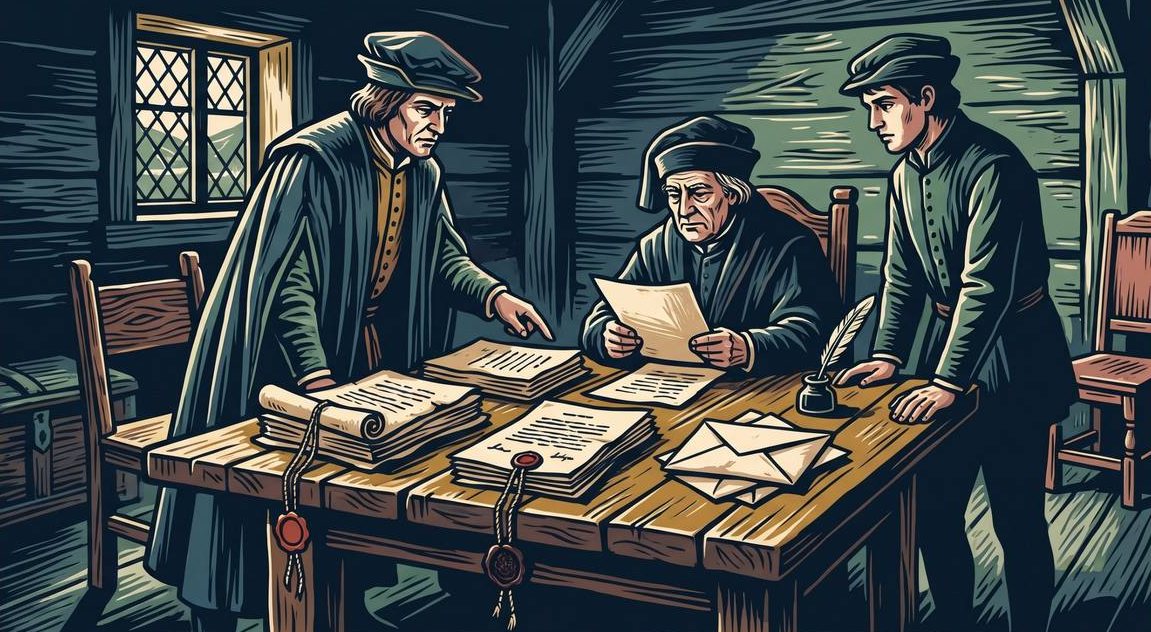
Saturday 11 September 1490, six men sit at the royal residence in Bergen by order of King Hans, king of Denmark and Norway: Archbishop Gaute of Nidaros, present-day Trondheim, Bishop Hans of Bergen, Provost Christiern Pedersson of the Church of the Apostles at the royal residence, the knight Niels Henriksson, the esquire Didrik Pining and lawman Erlend Frak. After several days' work they have divided the inheritance of Junker Hans Sigurdsson, the childless owner of Giske, into three equal lots.
The royal residence lay at the entrance to Vågen, the harbour bay in the middle of Bergen. Across the bay lay Bryggen, where the German Kontor (Hanseatic office) had been based since around 1360, and Stranden on the other side. The year before, in October 1489, Archbishop Gaute, Bishop Hans and Provost Christiern Pedersson had judged a complaint from the councillors and common people of Bergen that the German merchants were unlawfully owning and building houses on Stranden. Beside them sat the knights Alv Knutsson and Otte Matsson. The merchants were given three years to move the houses or sell them. Whether the judgment was followed, the letter does not say. Now the same clergy sat and divided the estate between two of their fellow judges. Gaute Ivarsson had by then been archbishop for 15 years. Seven years before the division he led the Norwegian envoys when the Council of the Realm met King Hans at Halmstad in Halland and obtained the Halmstad Recess, the conditions for the election of the king, among them that the fiefs were to be given to native-born men. The same summer he crowned Hans in Nidaros Cathedral. In 1489 the Council of the Realm in Copenhagen chose the king's eight-year-old son Christian as heir to the throne.
Junker Hans had died in 1466, and the estate had lain undivided for 24 years. The heirs were three branches that stood equally close to him. Alv Knutsson of Tre Rosor and his siblings were descendants of the sister of Hans' father, the drottsete Sigurd Jonsson, Katarina Jonsdatter. Alv was the son of Knut Jönsson and Agnes Alvsdatter, Katarina's daughter. Otte Matsson of the Rømer family and his siblings were also heirs of Katarina, as the judgment of the Council of the Realm from 1482 shows, and how he was related to her has not been established. The third branch was the sisters Ingerd and Sigrid Erlendsdøtre. Ingerd was present herself, and her husband, the esquire Arald Kane, conducted the case. Six years later, in 1496, Kane was killed by farmers in Sunnmøre. He was then a councillor of the realm and feudal lord of the fief, and Store norske leksikon calls him Arild Kane. According to Mona Ringvej's book on Erik Valkendorf he held the whole of Sunnmøre as a fief, and the killing took place at the thing (assembly) in Borgund, the trading town by present-day Ålesund, where the common people took joint responsibility. The book tells that his servants had taken the odal deeds from the farmer Mats Olsson, and that the farm went to Kane. As a widow Ingerd later gave an altar in Nidaros Cathedral dedicated to the union's three patron saints, the Swedish Erik, the Danish Knut and the Norwegian Olaf, with land in Nordmøre and Trøndelag, so that the priests should sing masses for Arald, herself and her parents. How the two sisters were related to Hans has not been established in the sources either.
Because the estate lay so scattered, the judges examined the case for several days. They weighed dues, value and location against each other according to the registers and evidence that were presented. Alv and his siblings received Sudreim, the manor in Sørum north-east of Oslo, with the estate in Romerike and Hallingdal, the farm Skenem in Oslo, and Giske with all the estate in Romsdal and Sunnmøre. To the same lot came Yriøn in Senja, the large island in Troms, with Bodholmane, farms in Kvæfjorden near Harstad and land in Shetland, the island group north of Scotland, among them Valøy, Fotaberg and Fogle. Otte and his siblings received Hval in Sogn, probably Kvåle, the estate in Nordfjord and Sunnhordland, the whole of Sørøya in Finnmark, Berg in Senja with the islets around it, the lower farm on Bjarkøy, an island north of Harstad in Troms, and Papøy in Shetland. Kvåle in Sogndal is known from a division of inheritance in 1314, which shows a clustered farmyard with 20 to 30 houses, its own church and many families and servants. This is probably the same farm. Otte's son-in-law, the councillor of the realm Nils Henriksson at Austrått at the mouth of the Trondheimsfjord, was commander at Vardøhus, the fortress in the far north-east of the country. According to Mona Ringvej, Austrått and the archiepiscopal see were the two equal lords north of Stad. Otte died in 1512, and his daughter, Lady Inger of Austrått, was later to take possession of Giske. Arald Kane received, on behalf of his wife and her sister, Dønnes on the island of Dønna in Helgeland in Nordland, half the landvard on the island of Vega farther south in Helgeland, the estate in Surnadal and Edøy fief in Nordmøre, Midfjorden in Senja, the upper farm on Bjarkøy and land in Tingwall and other districts in Shetland. Each of the three received a third of the landvard in Øyfjorden, Gryllefjorden and Torsken on the outer side of Senja. The plots in Bergen had not yet been divided, and property later traced was to be divided by the same rule.
The landvard was the fee the landowner took for the use of land and fishing villages. On Outer Senja the fjords faced the Norwegian Sea, and farthest out lay the fishing villages where the skrei (spawning cod) came in during the winter. Every boat that rowed out paid for the right. The fishermen used handlines from open boats. In the 1400s the åttring, with four rowing spaces and four or five men, was a handline boat, and the fembøring first appeared in the middle of the 1500s. Sandberg thinks that the Bjarkøy estate in the High Middle Ages probably also yielded income from sealing and whaling, and that is his interpretation. In 1520 it cost 10 sperrer of fish per boat to row from Torsken and Gryllefjord, and in 1563 the landvare from the fishing villages there was worth about four times as much as the land rent from all the estate's farms in the north. The fish was dried on racks and carried by jekt to Bergen. There the first known order for vraking, public inspection of the stockfish, came in 1444, and the Hanseatic merchants sorted the fish into 24 grades. In 1563 the bailiff sold 493 våger (c. 18 kg each) from the Giske estate in Bergen, about 8.9 tonnes, and by one estimate that was around 0.2 per cent of what Bergen exported late in the 1500s. After the division the three branches shared the income from the same fishing villages, just as the Bjarkøy people had lived off the skrei in the north for several hundred years.
Christian I had pledged Shetland to the Scottish king in 1469, as part of the dowry of his daughter Margaret. The land nevertheless followed its Norwegian owners, and the land rent from there was probably collected through agents. In 1563 the Giske estate in Shetland was leased out for 66 daler a year. In the land register for Shetland from 1582 it comprised 71 farms, and the rent is entered in butter and vadmel (homespun woollen cloth), 136 lispund 12½ mark of butter and 1121½ ells of vadmel.
Alv Knutsson had in practice held Giske since 1477. Now his siblings, the knight Tord Bonde, the esquire Jens Knutsson and the sisters Ragnfrid and Katarina Knutsdatter, gave him their share and right in the farm, with the islands and islets Ærthen, Okseøya and Kalvøya and with hunting rights, mill and fishing. In 1563 two of the oxen slaughtered on the main farm came from Ertenøya, and it is reasonable to think that this is the same island as Ærthen. Water mills had been in use since the 1200s, and in 1563 the bailiff had to buy millstones. The sources disagree about his year of birth, around 1420 or 1432. He was married to Magnhild Oddsdatter from Finne in Voss, had the manor Grefsheim at Nes in Hedmarken, by Lake Mjøsa, and was a councillor of the realm and commander of the royal residence in Bergen. Five months before the division, on 24 April 1490, he sat on Giske and bought the deserted farm Ålesetter in Vatne parish east of Ålesund from Kort Hansson, and he paid at once in silver and copper. Over 60 per cent of the farm holdings in the country were left deserted between 1350 and 1500. Land prices and rents fell, wages rose, and deserted farms could be bought cheaply, and Alv went on buying land around Giske until he died around 1496.
Didrik Pining was commander in Iceland and is known as a sea captain in the North Atlantic. Later accounts link him to a voyage towards Greenland in the 1470s, and that voyage is disputed. The king was Hans, king of Denmark and Norway. Two years after the division Columbus sailed west across the Atlantic.
With the division Giske and Bjarkøy were separated. Erling Vidkunsson had brought them together in the 1300s, and since then they had followed the same line of inheritance. Now Giske went to Tre Rosor, while the two farms on Bjarkøy went to the two other branches. Tre Rosor was Swedish ancient nobility, one of the oldest noble families in Sweden, noble long before the kings began to issue letters of nobility. The founder, Jon Liten of Myrby, is mentioned in 1299, and his great-grandson Knut Jönsson was lawman in Västergötland when he married Agnes Alvsdatter, heiress to Giske, Sudreim and Bjarkøy. Their son Jöns stayed in Sweden, and his descendants became barons and counts. Their son Alv became a member of the council of the realm in Norway. The estate yielded income from land, fishing villages and blubber from Finnmark to Romerike. Soon a new income arrived. The water-powered sash saw came to Norway just before and just after 1500, and in 1563 the saw at Solnør in Skodje, by Storfjorden east of Ålesund, cut 1476 boards, which were sold for 72 daler to buyers in Trondheim and Copenhagen. Giske had no forest of its own. In 1647 the forest at most of the saws under Giske in Romsdal was «nu mesten gandske udhugget», and the farmers used the boards mostly for their own farms. Alv Knutsson's son Knut Alvsson inherited Giske after his father. Twelve years after the division he was killed under safe conduct, a promise of safe passage to and from a meeting.
People: Alv Knutsson, Otte Matsson (Rømer)
Sources
DN 8/426; DN 2/903; DN 1/966; DN 1/963; DN 1/932; DN 5/915; prosjektnotatene «Giskebrevene 6», «Fiskeværene og Giskegodset», «Fisk som valuta: slik virket Giskegodset», «Slektsoversikt», «Fiske og fiskeredskap», «Giskegodset og produksjonen» og «Jordbruk i Norge 800 til 1650»; Gjørvel Fadersdatters regnskap 1563 (Sandberg 1986); jordeboka for Shetland 1582; Digitalarkivet 76953 (rapporten 1647); Stiftelsen Bryggen, Oppgangssagene i Norge; SNL, Tre Rosor, uradel, Knut Alvsson, åttring og ødegård; Orning, «Gårdslivet i middelalderen», norgeshistorie.no; Ringvej, Et kongerike foran undergangen; prosjektsiden «Makten i riket».